The Federal Chancellor responds to government question time
Speaking in the Bundestag, Federal Chancellor Scholz sketched out a positive picture of the future: the cost of electricity will fall thanks to renewable energy, and pension payments will remain stable. And, he added, because Germany is transitioning to a climate-friendly economy, we will have something to offer the whole world in the future. All arms of the Federal Armed Forces are being strengthened.
3 Min. Lesedauer
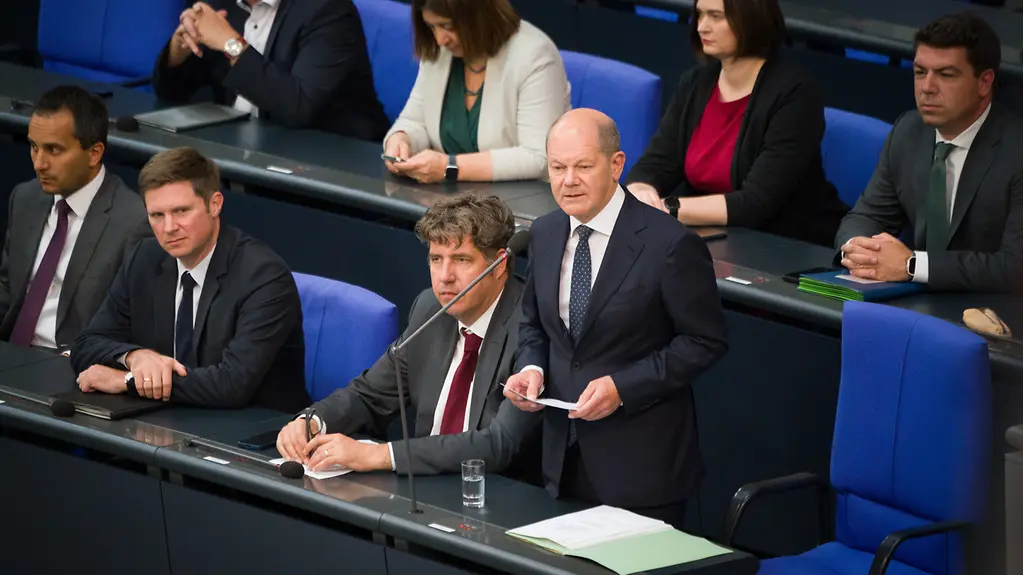
Federal Chancellor Olaf Scholz during government question time in the Bundestag.
Foto: Federal Government/Kugler
"Our primary concern is for the security of our country. The Russian offensive represents an epochal change because it poses a direct threat to Europe's security architecture," said Federal Chancellor Olaf Scholz in his opening statement to government question time in the Bundestag. Regarding budget planning, the Federal Chancellor emphasised that Germany is spending a lot of resources to support Ukraine, financially, in humanitarian terms, but also with arms supplies, which, he said, had an impact on the budget. Scholz pointed out: "We need to take on this task to properly equip the Federal Armed Forces and to ensure that the NATO alliance is as strong as possible."
A modern industrial country
The Federal Chancellor said that the Federal Government would continue to work towards making Germany a modern industrialised country with good jobs and social cohesion adding that the expansion of renewable energy, electricity grids, and new power plants as well as electromobility would continue to be driven forward. Federal Chancellor Scholz expects "very cheap electricity prices" as soon as the power grids, wind turbines and solar plant networks have been expanded throughout Germany. The goal is to generate 80 percent of electricity from renewable energy sources by 2030 and to achieve climate neutrality by 2045. According to the Federal Chancellor, Germany will become less dependent on expensive energy imports. He added that there were a number of good options for heating, such as solar energy, geothermal energy, or heat pumps. Citizens, Scholz explained, would be able to decide what suits them best on the basis of municipal heat planning. Many municipalities have already started planning and the plan is now to adopt the nationwide legal framework as rapidly as possible.
Securing future prosperity
The recent establishment of a semiconductor production industry, Scholz said, exemplifies Germany’s progress as an industrialised nation. As is the case with electricity, the aim is to become less dependent on supplies from other regions. In response to a question, the Federal Chancellor confirmed that the fact that we will have cheap electricity plays an important role in the decision to invest in this sector. The Skilled Workers Immigration Act is a "very progressive policy. One of the great innovations", which, Scholz said, would secure our future prosperity.
Pension – stable and a good sign
"Today's school leavers who start an apprenticeship have 50 years ahead of them," said the Federal Chancellor. There should be no further increase in the retirement age. "We guarantee that the pension level will remain stable," Scholz continued. The equalisation of pension rates in East and West Germany was a "great moment", he added, "an encouraging sign for the unity of our country". Now was the time to bring wages and salaries up to the level of the West, too, he said. The twelve-euro minimum wage has already been implemented.
Working towards basic child security
"We will do everything necessary to ensure that everyone is able to cope, that everyone feels acknowledged, and that everyone knows that they are included," said Federal Chancellor Scholz. The Federal Government has already done a lot in the social sphere, in such areas as housing benefit, citizen's allowance, child benefit and child allowance, tax relief, and social security contributions, and it intends to continue to do so. "We want to complete the basic child allowance," said the Federal Chancellor adding that the respective drafts would be available by the end of August whilst the relevant legislation is scheduled to come into force in early 2025. Plans were in place to develop parental allowance in a dynamic manner, the aim being, he continued, to encourage parents to have children and for women and men to take an equal share in caring for their children. It was important for parents to have jobs in order to combat child poverty, he said.