International cooperation
Germany is a reliable partner of the United Nations and an advocate of international order that takes a principled stance. The Federal Government supports the United Nations financially and is involved in its missions around the world.
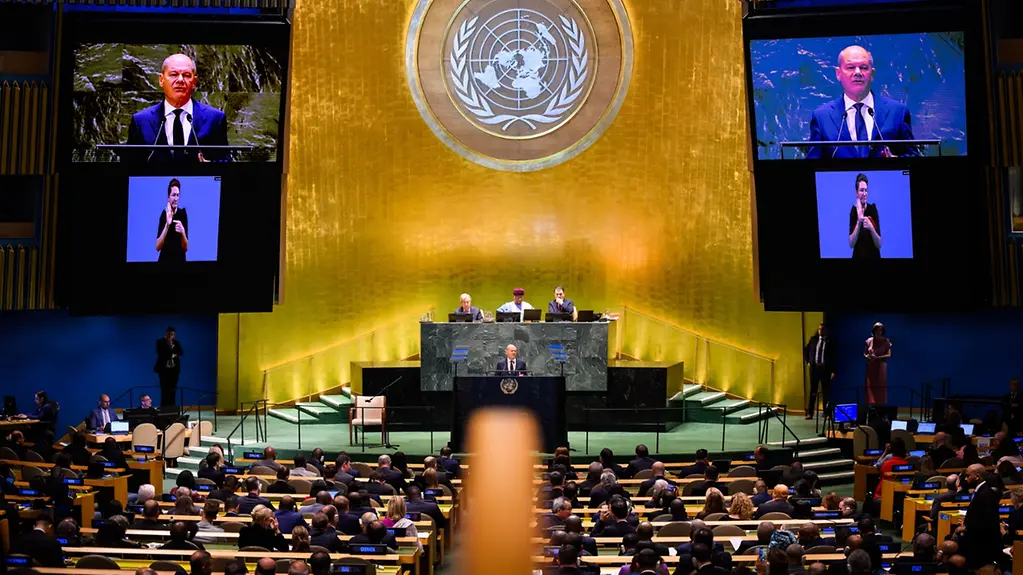
Federal Chancellor Olaf Scholz during a speech at the United Nations Summit of the Future in New York.
Foto: Federal Government/Marvin Ibo Güngör
As a firm supporter of multilateralism, the Federal Government is actively involved in mastering global challenges within the framework of the United Nations (UN), such as crises and conflicts, climate change and poverty.
In this context, Germany works towards strengthening a rule-based international order in which regional and international conflicts are addressed through dialogue and joint solutions. Almost all countries of the world cooperate in the United Nations to promote peace, safety, human rights and development.
For a better present and future
Together with Namibia, Germany took a key role in organising the negotiations for the United Nations Summit of the Future in 2024. With the Pact for the Future that was adopted here, the UN member states showed that there is a general consensus of a vast majority that allows for collaboration within the United Nations despite the wars and conflicts around the world. It represents a new international agreement on how we can improve the present day and ensure a viable future for later generations.
Multilateralism is a central pillar of German foreign policy and is based on the firm belief that global challenges can only be mastered through international cooperation. Multilateralism is key when it comes to solving global problems such as climate change, international security and economic development, that cannot be solved by any individual country.
Reliable partner of the United Nations
Germany is actively involved in the United Nations’ work: politically, financially and also with personnel. To this end, Germany operates a number of Permanent Missions to the United Nations, for example in New York, Geneva and Vienna. The principles of international law, the UN Charter and human rights form the foundation of German foreign policy. Germany is applying for a non-permanent seat in the UN Security Council also for 2027/2028, wishing to further enhance its role as mediator in international crises and to get actively involved in the Security Council’s decisions that are binding under international law.
To enable the United Nations to effectively carry out its tasks, Germany has contributed more than 5 billion euros’ worth of mandatory contributions and voluntary payments to UN organisations in 2023. This makes Germany the second biggest contributor of the United Nations’ overall structures. The funding is used for projects that strengthen rule-based international order.
Germany is also home to many organisations of the United Nations itself, with 40 offices and over 1,000 staff members. This underlines Germany’s central role in international matters. The offices of the UN Framework Convention on Climate Change (UNFCCC), the UN volunteer programme (UNV) and the United Nations Convention to Combat Desertification (UNCCD) are all headquartered in Bonn, for example. Further UN facilities can be found in Berlin, Hamburg and Frankfurt am Main.
Involvement in UN peace missions around the world
As the biggest donor of the UN Peacebuilding Fund, the Federal Government advocates for a closer interconnection of peacekeeping, crisis prevention and peace promotion. Germany’s commitment is not limited to providing funding; the country is also involved in the United Nations’ activities with its Federal Armed Forces and qualified civilian staff. Around 2,000 Germans were actively involved in international peace missions in 2023.
The Federal Government promotes peace processes through close cooperation with international and regional partners and seeks to strengthen the global peace architecture. In its global commitment, Germany contributes non-military resources in particular. Crucial aspects of Germany’s involvement include diplomatic activities, training of security staff and the promotion of stability in regions affected by crises, for example by establishing institutions.
The UN Charter is dedicated to global peacekeeping and relies on a wide spectrum of measures ranging from recovery aid and diplomatic activities through to sanctions and military operations. Each of these activities requires a mandate of the United Nations Security Council.
Germany has had a leading role in the area of peacekeeping ever since the country joined the United Nations back in 1973. With its Federal Armed Forces, Germany is now one of the most important Western troop suppliers, especially in Africa, the Balkan region and the Mediterranean.
UN peace missions are often based on a multidimensional approach that includes military activities, as well as civilian tasks such as supervising elections, establishing institutions based on the rule of law and monitoring the human rights situation. Peacekeeping missions are performed in regions in which a ceasefire or peace agreement has been achieved but that are still at risk of further conflicts. The peacekeepers monitor compliance with peace agreements, they protect civilians, assist the disarming process and help to rebuild police and security structures, as well as helping to establish civilian government institutions. One example of these missions is the United Nations Mission in the Republic of South Sudan (UNMISS).
German personnel is currently involved in a number of missions mandated by the UN, such as: United Nations Interim Force in Lebanon (UNIFIL), United Nations Mission in the Republic of South Sudan (UNMISS), United Nations Mission for the Referendum in Western Sahara (MINURSO) and United Nations Peacekeeping Force in Cyprus (UNFICYP).
Promoting reforms
Germany has been calling for a reform of the Security Council for several years, to adapt the council to the geopolitical reality of the 21st century. The Federal Government is striving for a permanent seat for Germany as part of a comprehensive reform of the United Nations and is also advocating for other reform steps.
Regional stakeholders in particular should be involved more strongly. This is why Germany is calling for stronger representation of countries of the so-called Global South in the UN Security Council. Stronger involvement would make the council more representative and increase its legitimacy. Germany is working closely with its G4 partners (Brazil, India and Japan) to reach this goal and ensure that the Security Council continues to be effective and fair.