Governing coalition continues with its reform programme
The governing coalition has agreed on a wide range of significant reforms to ensure Germany is fit for the future. A fair overall package to create growth, safeguard jobs and strengthen social cohesion. An overview of the reforms.
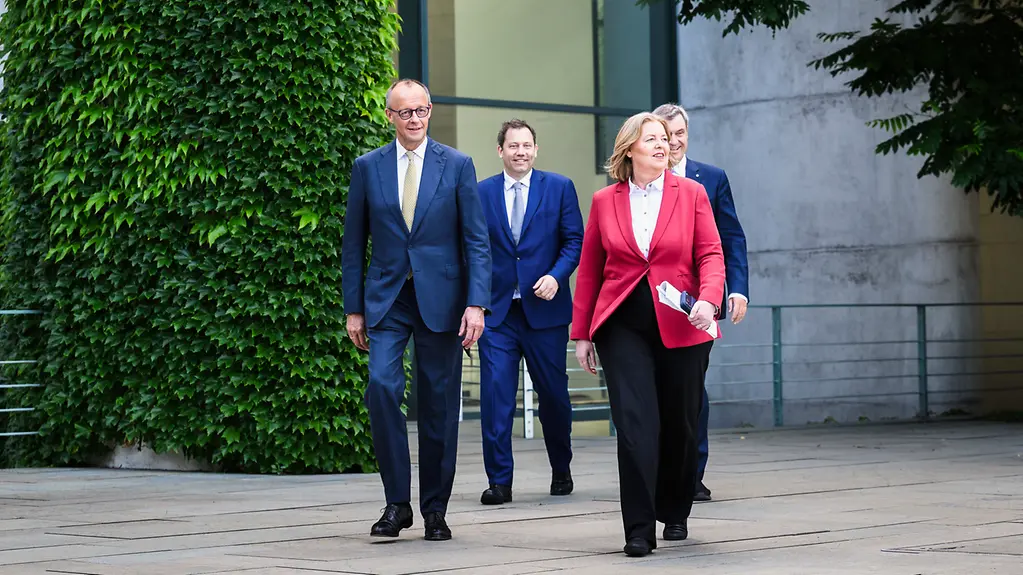
The coalition has agreed on a joint package of measures to put the country on a sustainable footing for the future.
Photo: Federal Government/Sandra Steins
“We are modernising our country and leading it into the future”, said Federal Chancellor Friedrich Merz the morning after the coalition committee meeting. Through a total of 34 measures, the governing coalition will boost competitiveness, cut red tape, safeguard the welfare state and reduce taxes. “This coalition has set out as a government of renewal”, the Federal Chancellor emphasised. He said that citizens want decisions, not arguments. “We’ve delivered that.”
Making pensions fit for the future
The governing coalition is in agreement that the report by the Pensions Commission has set out groundbreaking recommendations for pension reform. It will now implement these recommendations in a package of legislation. The aim is to pass the pension reform in the Bundestag by the end of 2026. “This is the second major reform following the health care reform – the reform of the statutory health insurance system”, explained Chancellor Merz.
Tax relief is on the way
“Those who are suffering most from rising prices, inflation and stagnant wages will receive relief”, said the Chancellor. Families and people on low and middle incomes will benefit most from the agreed tax reform, which is due to come into effect on 1 January 2027. For example, the basic allowance and the child allowance will be increased, and child benefit will be raised. In total, the tax relief will amount to around ten billion euros a year. Chancellor Merz stated: “We estimate up to 600 euros a year for an average household.”
“People are ready for change, and change works when it is fair”, emphasised Federal Minister of Finance Lars Klingbeil, referring to the income tax reform. He stressed that the intention was to make work more rewarding, “so that people have a little more money in their pockets at the end of the year during times that are challenging and demanding”. The Federal Minister of Finance announced that this would make the tax system fairer. “Those at the very top of the income scale will pay more tax. It’s a question of fairness”, said the Minister.
Making the labour market fit for the future
The labour market is being reformed. In the Federal Chancellor’s view, the most important decision concerns fixed-term contracts without objective justification, which in future may last for up to 48 months. “This is an important opportunity for creating new jobs, particularly for young companies and start-ups, but also for businesses looking to expand”, said the Federal Chancellor.
Furthermore, for example, the upper limits for Sunday and public holiday allowances eligible for tax relief will be raised. In addition, a programme will be developed to give young people who have not completed their schooling or vocational training a second chance to catch up on their qualifications. In future, it will no longer be possible to issue sick notes over the phone; a sick note will soon be required from the first day of an illness. “This is a difficult decision; we know that”, the Chancellor explained. “But we can no longer afford this competitive disadvantage caused by long periods of absence from work.”
Creating more growth and greater fairness
The governing coalition has also set itself the aim of creating affordable housing, specifically, in areas where the market does not provide enough of it. To this end, a house-building association will be set up to support social house-building and large-scale, industrialised construction. In addition, from 1 January 2027, there will be substantial additional funding for housing construction provided by German banks.
In addition, the governing coalition has agreed that the Ministry of Social Affairs and the Interior will jointly present an action plan this summer to combat the misuse of social security benefits, setting out both statutory and non-statutory measures. Implementation is scheduled by the end of 2026.
Cutting red tape
Germany will become faster, simpler and more efficient. To achieve this, the governing coalition has agreed to reduce unnecessary reporting and documentation requirements. “We are generally waiving all reporting obligations to government bodies. If a ministry wishes to retain reporting obligations, it must provide new grounds for this,” explained the Federal Chancellor. Furthermore, in future, many applications will be deemed to have been approved if the applicants have not received any notification to the contrary four months after the application was received. In addition, the process of filing tax returns will be simplified in order to spare taxpayers unnecessary hassle.
“Through all this, Germany will realise that things are happening. Everyday life is becoming easier”, the Chancellor said with conviction. “Germany is making progress.”