Decided by the Cabinet: Federal budget 2027
The Federal Government has approved the draft 2027 Federal budget and the financial plan through 2030 in a Cabinet meeting. In doing so, it is creating the financial conditions needed to advance future investments, reforms and consolidation measures.
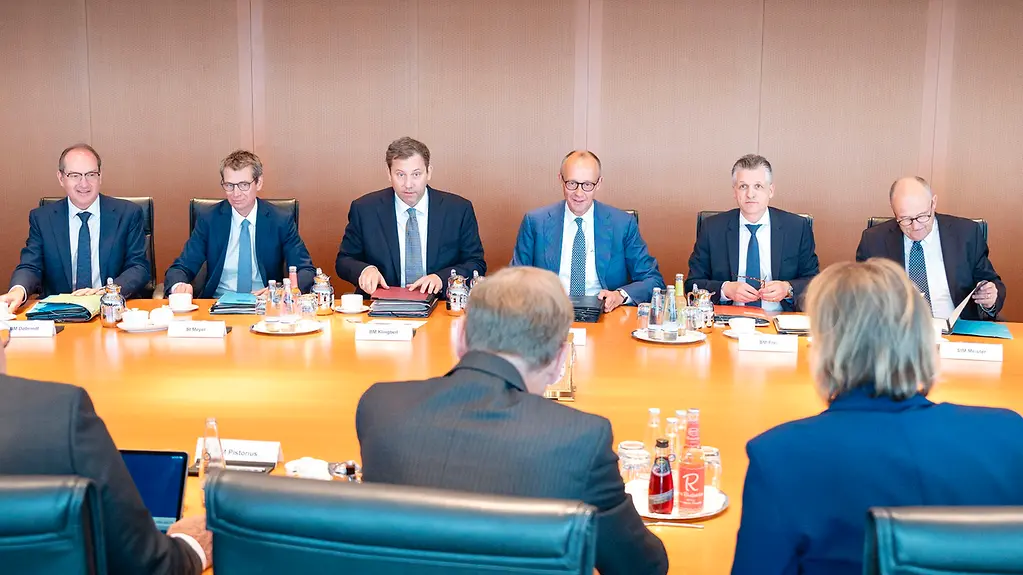
The draft budget presented by Federal Finance Minister Klingbeil is intended to strengthen the German economy for the long term.
Photo: Federal Government / Guido Bergmann
Global crises and conflicts are disrupting supply chains, driving up energy prices and hampering economic growth. The Federal Government is responding to this period of uncertainty with decisive action. It has made far-reaching decisions on reforms to strengthen the economy, safeguard jobs and ensure that social security systems are fit for the future.
Creating the framework for prosperity and security
With the adoption of the 2027 Federal budget and the financial plan through 2030, the Cabinet is now also establishing the financial framework needed to safeguard freedom, employment and prosperity in Germany in the long term. The Federal Government continues to pursue a three-pronged approach comprising investment, structural reforms and fiscal consolidation.
Federal Finance Minister Lars Klingbeil said during the presentation of the budget that the government was focusing on investment and reforms in the Federal budget. The priorities are clear, he said: “We want to put our country back on the path to growth. We want to create the jobs of the future in Germany. We are committed to high-tech, AI and innovation, and we want to live in security in the future; that is why we are strengthening security, resilience and defence. We are taking action and investing to ensure that Germany remains a strong country.”
Investment drive to modernise the country
With the 2027 Federal budget, the Federal Government is continuing its investments to strengthen security and boost the economy. A total of around 118 billion euros is available for investment. These record investments are intended to modernise the country, safeguard jobs and strengthen Germany’s capacity for innovation. This investment drive will be consistently advanced in the coming years.
The Special Fund for Infrastructure and Climate Neutrality plays a key role. Over 36 billion euros has been earmarked for Federal investment in 2027. In addition, there is 10 billion euros for the Special Climate and Transformation Fund, as well as around 8 billion euros to support the Federal states and local authorities. These investments are necessary to make the country a more equitable place, according to the Finance Minister. “Public investment in infrastructure benefits everyone: good schools and free nurseries, well-maintained roads, rail connections, affordable housing, modern hospitals and refurbished sports facilities – these things benefit everyone in our country, whether they live in the city or the countryside, and whether they have a lot of money or very little.” All of this represents improvements to everyday life. For example, 775 kilometres of high-speed rail corridors will be completely refurbished by the end of 2026, said Klingbeil. “That is equivalent to the distance from Rostock to Munich.”
Focus on security and easing the strain on the Federal budget
The Federal Government is also increasing defence spending in order to improve Germany’s deterrence and defence capabilities. The primary aim is to prevent military conflicts. Planned defence spending is set to rise significantly next year to over 109 billion euros, supplemented by funds from the Special Fund for the Federal Armed Forces. Overall, the Federal budget will help strengthen resilience to crises.
The Federal Government is implementing the consolidation measures agreed within the coalition step by step. “Fiscal consolidation today ensures our freedom tomorrow. This will give us some leeway again”, said Klingbeil. This financial leeway will be created, amongst other things, by cutting financial support from the Climate and Transformation Fund, combating financial and tax crime even more effectively, taxing cryptocurrencies, introducing a plastic tax and adjusting the tobacco tax. Financial support within the core budget is also set to be cut.
Cost savings by the Federal Government
More efficient processes and structures within the Federal Ministries are expected to generate savings of 1.2 billion euros for the Federal budget by 2027. The impact of these efficiency measures is expected to increase steadily, reaching 3 billion euros by the 2029 financial year at the latest. The target of one percent across-the-board spending cuts per Ministry is being implemented, and the Federal Government is creating further savings by cutting administrative posts – although security agencies are exempt from this directive.
The target for staff reductions in 2027 is set at two percent. The coalition agreement provides for an eight percent reduction in the number of posts in the Federal administration by the end of the parliamentary term.
In the Budget Accompanying Act, the Cabinet has also approved further measures to strengthen the Federal budget. The plan is to increase the tax rate on certain alcoholic drinks – with the exception of beer and wine. If these increases are passed on in full to consumers, this will result in moderate price changes in the double-digit cent range. Furthermore, the Federal subsidy to the statutory pension insurance scheme will be reduced by one billion euros in 2027, which will result in a corresponding reduction in the burden on the Federal budget.