Policy statement by the Federal Chancellor to the German Bundestag
In his policy statement, Federal Chancellor Merz emphasised the importance of ensuring the Federal Government’s ability to act, prosperity and a “bright future”. “We can lead our country from the political centre; we can achieve our goals.”
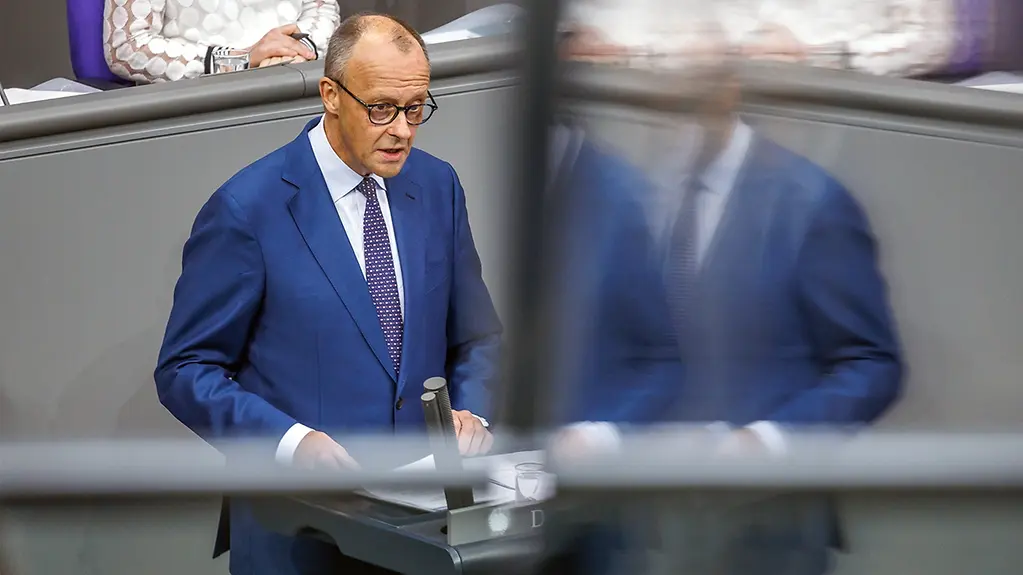
The coalition has “set out as a government of renewal”, said Federal Chancellor Friedrich Merz in the German Bundestag.
Photo: picture alliance / dpa / Andreas Gora
“We are a strong country: economically, politically and also socially”, said Federal Chancellor Friedrich Merz in the German Bundestag in his policy statement on the current political situation. He went on to say that, just over a year ago, the Government had set out to modernise the country. “We all agree that the centre must demonstrate here and now that we are shaping our country, modernising it and leading it into the future”, remarked Merz.
He said that the fact that this was possible had been demonstrated on occasions including last week, when the parties forming the Government had agreed on a major package of reforms in the coalition committee. “These measures are primarily aimed at giving our businesses greater flexibility, preserving our welfare state and reducing the tax burden on workers”, the Chancellor emphasised.
“Embarking on fundamental reforms”
It was stated that a great deal had already happened during the first year of the Government led by Federal Chancellor Merz, and that this work was now beginning to bear fruit. The Chancellor cited the active pension as an example: “The initial figures show that more than 10,000 employees have now taken advantage of this offer at their companies in the first half of 2026.” He also referred to the basic income support scheme, which came into force on 1 July, “through which we are once again demanding personal responsibility and something in return from those who are capable of this”.
“We are embarking on fundamental reforms: tax reform, pension reform, healthcare reform, the labour market. This is a massive package, the likes of which no Federal Government has tackled on this scale in recent years”, said Federal Chancellor Merz. He is taking an optimistic view: “Because we have every reason to be courageous, to dare to do things and to have confidence in our own abilities.”
The Federal Chancellor spoke about issues including…
… the future of pensions
The Chancellor’s aim is to “restore a fair balance between the generations and, to that end, to also make use of the opportunities offered by the capital market”. The coalition committee agreed to implement the ground-breaking recommendations set out in the report by the Pensions Commission as part of a package of legislation. The aim is a double reversal: looking ahead, the contribution rate under the pay-as-you-go system should fall rather than rise, and the standard of provision should rise rather than fall.
… the tax reform
As agreed in the coalition agreement, the Government intends to provide tax relief for those with low and middle incomes – and particularly for families – through the income tax system. To this end, the highest earners are to be taxed slightly more. From the Chancellor’s point of view, this is a “contribution to social justice in our country”. He also announced that the Government, in collaboration with the federal states, intended to put forward proposals for simplifying tax law by the autumn.
… the labour market
The Chancellor emphasised: “We want to, and we must, inject more dynamism into the labour market.” The aim is to allow fixed-term employment contracts where there is no objective justification for the fixed term to be entered into for a longer period than has previously been the case. This should encourage employers to take on new staff.
… cutting red tape
The Federal Government intends to abolish all reporting requirements in future. If a ministry wishes to retain a reporting obligation – in other words, if it wishes to cling to bureaucracy – it must provide new justification for doing so. “Compared with all previous simplification laws, this is a real breakthrough”, said Chancellor Merz.
… encouraging signs in the economy
Federal Chancellor Merz noted the opening of the world’s largest power semiconductor factory in Dresden: “Not only can and will we play a part in the value chains of the future, we can also benefit from them and come out on top.” He was also encouraged by the latest figures from the German Startup Association: “Over 3,000 new companies were set up in Germany between January and June”, said Merz. He added that that was almost as many as in all of 2025 and that the Federal Statistical Office had also forecast a significantly higher rise in production for May and June. “These are encouraging signs for our economy.”
... security and defence
“We are working hard to restore our country’s defence capabilities”, said Merz. He said that the aim was to safeguard freedom and peace in Europe, and that the NATO summit in Ankara, which had just come to an end, had shown that NATO is united, strong and self-assured. The Chancellor also said that Canada’s decision to modernise its submarine fleet with German and Norwegian assistance was “the largest international defence contract in the history of the Federal Republic of Germany”. It would, he said, generate added value of up to 100 billion euros over the coming decades and secure thousands of jobs in Germany.