Recent developments in Iran
The Federal Government welcomes the fact that the USA and Iran have agreed on a framework agreement. Federal Chancellor Merz congratulated US President Donald Trump and the Iranian side on this diplomatic breakthrough. At the same time, further negotiations should now take place.
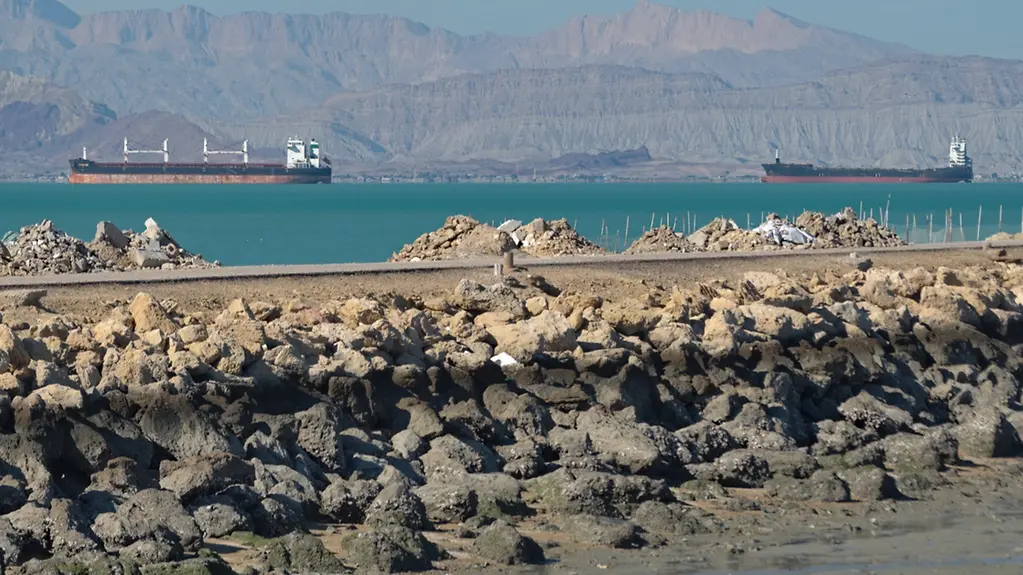
The Strait of Hormuz is essential for crude oil and liquefied natural gas exports, and the fact that it is being blocked by Iran is one of the key points of dispute.
Photo: Getty Images/ Germán Vogel
The Federal Government welcomes the fact that the United States and Iran have agreed on a framework agreement,” said Federal Chancellor Merz in his statement on 15 June. He expressed the government's thanks to all partners who had helped make this possible. The Federal Chancellor also made it clear that: “Now the task is to implement the agreed measures in a diligent and purposeful manner.”
Further steps are needed
According to Merz, the agreement could pave the way for a recovery in the global economy and stabilisation in the region. “The Strait of Hormuz must remain permanently and unconditionally open to free navigation.” Further negotiations would have to ensure a verifiable end to Iran's nuclear weapons programme, the Chancellor said. And: “There must be no further attacks against Israel and other neighbours in the region.”
The Federal Government continues to support all diplomatic efforts and is in close contact with the United States, its European partners and the countries in the region.
Contribution to securing the Strait of Hormuz
On 15 June, the Federal Government, together with France, the United Kingdom and Italy, stated: “We are determined to play our part, in accordance with our respective constitutional provisions, including through a purely defensive independent mission to protect merchant shipping and conduct mine clearance.”
As the Federal Chancellor had always stressed, there would be three conditions for Germany's contribution to efforts to secure the Strait of Hormuz: “The war must come to an end. There must be a legal basis and a mandate from the Bundestag. Ultimately, there must be a viable comprehensive political and military strategy.”
No nuclear weapons in Iran’s possession
Iran must never be allowed to acquire a nuclear weapon. The Federal Government’s stance on this is also clear. Together with France, the United Kingdom and Italy, it stated: “We stand ready to cooperate with the US, Iran and the IAEA on this matter. We are offering to lift the relevant sanctions, provided that Iran takes clear and verifiable steps regarding its nuclear programme.”
Support for Lebanon
Furthermore, the Federal Government, together with France, the United Kingdom and Italy, reaffirmed its “full support for the stability, sovereignty and territorial integrity of Lebanon. We stress the great importance of a robust ceasefire.” Hezbollah is being called upon to lay down its arms and cease its attacks on Israel. The Federal Government is encouraging Israel and Lebanon to continue along the path of direct talks.
Iranian people should also be able to take their destiny into their own hands
For years and decades, the Iranian regime has subjected the world to terror and destabilised the region. Federal Chancellor Merz made this clear in his policy statement on 18 March. “This regime bears responsibility for the current crisis in the region,” said the Chancellor.
The Federal Government shares the aim of Israel and the United States that Iran should no longer pose a threat in the future, neither to Israel nor to neighbouring states in the region. The Chancellor expressed his hope that the Iranian people “might be allowed and able to take their destiny into their own hands, and establish a legitimate government through democratic elections.”
Preventing uncontrolled migration movements
In view of the situation in the Middle East, the EU is prepared to “fully mobilise its diplomatic, legal, operational and financial instruments to prevent uncontrolled migration flows into the EU and to safeguard security in Europe”, according to the European Council conclusions of 19 March. The security and control of the EU's external borders will be further strengthened. The European Council emphasises the importance of working with partners in the region to ensure they receive the help and support they need.
Impact on the economy
The Federal Government is also working to minimise the impact of the war on the economy. From now on, it will only be possible to increase fuel prices once a day. The reduction in energy tax on diesel and petrol came into force for the months of May and June. Fuel taxes, including energy tax and VAT, will be reduced by around 17 euro cents per litre at the pump. In addition, oil reserves were released within the framework of the International Energy Agency.