After the NATO meeting in Helsinki
Security in the Baltic Sea region was the central theme addressed at the meeting in Helsinki of the NATO countries that lie on the Baltic Sea that was held. The German Navy would also contribute to infrastructure surveillance in the region, said the Federal Chancellor in a statement delivered after the meeting.
- Transcript of press conference
- Tuesday, 14 January 2025
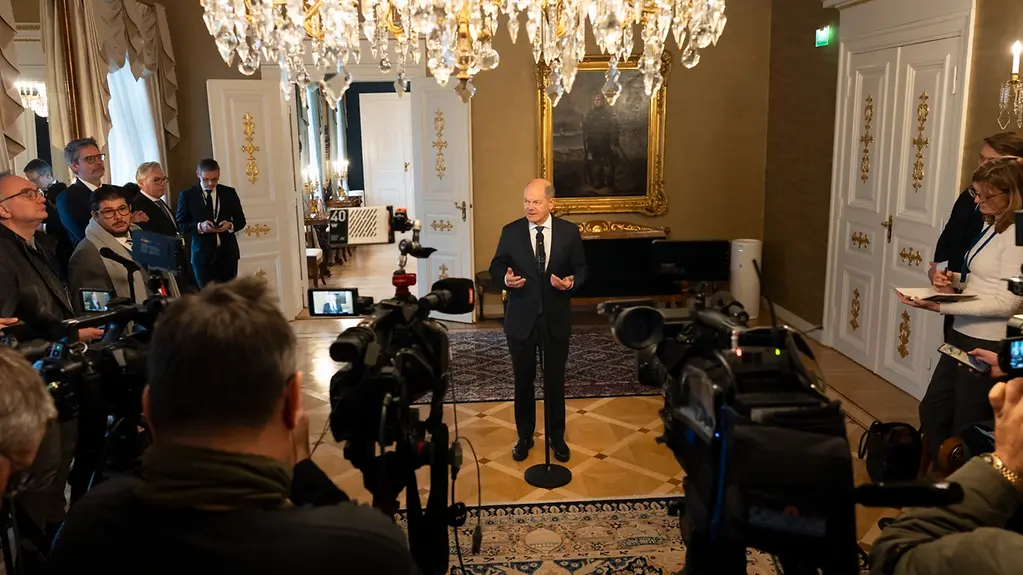
Federal Chancellor Scholz delivered a press statement, following the meeting of NATO countries that lie on the Baltic Sea.
Photo: Federal Government / Steffen Kugler
The heads of state and government of the NATO countries on the Baltic Sea met with NATO Secretary General Mark Rutte and the Vice-President of the European Commission Henna Virkkunen in Helsinki to discuss how security can be improved in the Baltic Sea area. Following the severing of a number of undersea cables, which is at least suspected to have been done deliberately, measures are to be taken to protect the undersea infrastructure of data and electricity cables in the Baltic Sea.
The German Navy would also contribute to infrastructure surveillance in the region, said Federal Chancellor Olaf Scholz in his statement.
The goal of the NATO meeting in Helsinki was to improve information flow between the governments of the countries on the Baltic Sea, and to jointly establish a strong surveillance structure for the Baltic Sea area.
The key facts at a glance:
- Enhancing surveillance: NATO has already set up a dedicated unit in charge of situation reporting and surveillance in the Baltic Sea region. To improve this unit’s capabilities, it was decided to launch the “Baltic Sentry” mission, which the Federal Armed Forces will also be involved in with ships and aircraft. In addition, technological surveillance for monitoring the Baltic Sea area is to be enhanced and developed further in cooperation with the arms industry.
- Exploring legal measures: A working group of the foreign ministries of the countries on the Baltic Sea will discuss possible legal action against ships that cause damage. Further EU and national legislative measures may also be necessary.
- Sanctions against Russian shadow fleet: Sanctions against the Russian shadow fleet are to be extended: Russia has been using ships flying foreign flags to avoid sanctions due to the country’s invasion of Ukraine.
You can read a transcript here (only German).