Humanitarian, financial and military aid
The existence of Ukraine as a strong, democratic and sovereign state is of central importance – including for Germany’s security. That is why the Federal Government stands in solidarity with the country and is continuing to provide aid.
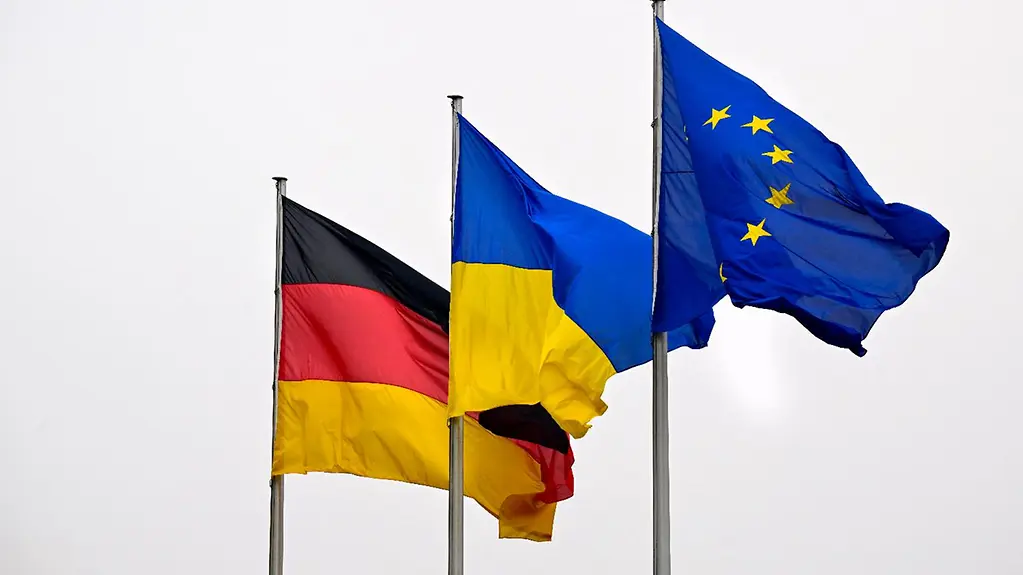
In the hope for peace, Germany stands firmly alongside Ukraine
Photo: Tobias Schwarz/AFP via Getty Images
The Russian war of aggression against Ukraine is causing immeasurable suffering. Countless people have already lost their lives. Even now, in the fifth year of the war, Russia shows no sign of letting up in its attacks. Recently, there has been a significant increase in the number of attacks by the Russian military resulting in civilian casualties. Germany remains firmly committed to supporting Ukraine and has also been linked to the country through a strategic partnership since April 2026.
“We stand firmly by Ukraine’s side,” stressed Federal Chancellor Friedrich Merz on the occasion of Ukraine’s 35th Independence Day on 24 August 2026. “For years, the people of Ukraine have been defending their country’s independence against Russia’s brutal war of aggression with remarkable courage.” Since April 2026, Germany has also been linked to the country through a strategic partnership.
Support for Ukraine
With the adoption of the 21st EU-sanctions package in July 2026, we are further increasing the pressure on Russia. Ukraine is receiving substantial support for its defence capabilities in the form of a 90-billion-euro loan from the European Union.
Since the start of Russia’s war of aggression on 24 February 2022, the Federal Government has provided bilateral civilian aid to Ukraine totalling more than 43.3 billion euros and has provided, or earmarked for the coming years, military aid amounting to around 57.6 billion euros.
Energy supply and infrastructure
Through the Reconstruction Loan Corporation (KfW), the Federal Government finances the repair and maintenance of electricity and heating systems, makes replacement parts available, and supports the reconstruction of power plants that have been destroyed.‑ Emergency relief measures are being optimised and accelerated by a task force set up by the Federal Ministry for Economic Affairs and Energy (BMWE).
At the same time, air defence is being strengthened through the procurement and provision of air defence systems to protect the energy infrastructure from further attacks. The Federal Foreign Office (AA) is also involved in the physical protection of nuclear power plants and supports the International Atomic Energy Agency (IAEA) in the deployment of experts.
To make the energy sector more resilient, the Federal Ministry for Economic Affairs and Energy is contributing to the RAMP-UP Guarantee Fund set up by the European Bank for Reconstruction and Development (EBRD). This scheme is intended to stimulate investment in the renewable energy sector.
Humanitarian aid
Germany supports Ukraine in close cooperation with international organisations and non-governmental organisations. This includes medical care, food, clean water and other emergency aid, particularly for people in regions close to the front line. The Federal Agency for Technical Relief (THW) is strengthening emergency management, for example, by setting up local rescue centres. Millions of internally displaced persons and returning refugees likewise need support.
Unexploded ordnance devices and land mines, which are scattered over a wide area, also pose a particular danger to the civilian population. In addition to clearance and mapping, the Federal Foreign Office (AA) also runs information campaigns for the civilian population to teach them how to cope with the daily threat.
Military support
Germany is Ukraine’s biggest supporter – including in the military sphere: aid includes equipment and weapons deliveries from Federal Armed Forces stocks as well as deliveries from industry, which are financed by the Federal Government’s defence equipment aid.‑ The systems supplied include air defence, artillery and combat vehicles, armoured transport vehicles, small arms, ammunition, medical supplies and protective clothing.‑‑ Furthermore, more than 27,000 Ukrainian soldiers have been trained in Germany since the start of the war.
Help for refugees
Since the outbreak of full-scale war, more than a million Ukrainian refugees, mainly women and children, have found refuge in Germany. Where necessary, Ukrainian refugees receive state support, access to vocational language courses, further training and integration programmes, as well as assistance from job centres in finding work. Refugees have immediate access to the labour market.
The support portal Germany4Ukraine enables online applications for residence permits, courses and applications for financial support.‑‑ The free support hotline “Nummer gegen Kummer” is available in Ukrainian and Russian.
Economic and financial support
The Federal Government is providing grants worth billions, via an account managed by the International Monetary Fund (IMF), in order to strengthen Ukraine’s capacity to govern.
To safeguard Ukraine’s economic stability, Germany is providing support in particular to small and medium-sized enterprises and to the training of skilled workers. Through the “UkraineConnect” financing instrument, attractive loans are provided for investments by companies from Germany and Europe. Ukrainian companies can take advantage of low-interest loans. In addition, Ukrainian executives are supported through the programme “Partnering in Business with Germany”.
The long-term competitiveness of Ukrainian industry is also being promoted through the Ukrainian “National Development Institution” (NDI, formerly the “Business Development Fund”). The Federal Ministry for Economic Cooperation and Development (BMZ) has supported the institution’s further development in recent years – with the aim of establishing it as an efficient development bank modelled on the KfW.
As part of its responsibility to provide redress for injustices committed by the Nazis, the Federal Government also supports Holocaust survivors in Ukraine through the Jewish Claims Conference.
Reconstruction
National and international coordination is required for the reconstruction of Ukraine. To achieve this, short-term and long-term support must mesh. In Germany, the “Rebuild Ukraine” platform brings together everyone who wants to support Ukraine. At the international level, Germany is working through the Ukraine Donor Platform to promote a coordinated approach to supporting Ukraine. In addition, the BMZ, together with European partners, has launched the “European Flagship Fund for the Reconstruction of Ukraine”, which is intended to generate private funding for reconstruction in order to finance large-scale reconstruction projects.
Reforms
Through its contributions to the Council of Europe’s “Action Plan for Ukraine”, the Federal Foreign Office is helping to promote the rule of law and decentralisation. The aim is, in particular, to strengthen independent anti-corruption institutions and to promote measures to combat (financial) crime in Ukraine. Ukraine is also the beneficiary of a BMWE-funded programme for high-level government advisory services.
The Federal Ministry of the Interior (BMI) and the Federal Foreign Office (AA) provide support to partner agencies from their budgetary resources in the form of training assistance in the areas of personal security, combating cybercrime and counter-terrorism. The Federal Foreign Office also supports the further development of the Ukrainian judicial system and assists Ukraine in its EU accession process. Against this backdrop, the Federal Ministry of Justice (BMJV) has also expanded its support for the rule of law in Ukraine, with the fight against corruption remaining a key focus here too.
Health
Medical care is being supported both in Ukraine and for refugees in Germany. Bilateral healthcare projects in Ukraine are being promoted in a targeted fashion. This involves, for example, measures in the areas of telemedicine, prosthetics and rehabilitation services, as well as the strengthening of so-called Emergency Medical Teams (EMT). The evacuation of sick and injured people for medical treatment in Germany is also being supported.
Education & research
In the area of career guidance, the portal BerufeNavi, in collaboration with the KAUSA – Coordinating Agency for Training and Migration (‑), regional offices and the BOFplus Vocational Orientation Programme (‑), supports people on their path to training and employment.
In the areas of research and innovation, the Federal Government’s aim is to further expand cooperation, strengthen local scientific potential, support reforms in the science and innovation system, and integrate Ukraine more closely into the European Research Area. Since July 2025, the Federal Ministry of Research, Technology and Space (BMFTR) has been supporting the German Academic Exchange Service (DAAD) in establishing a German-‑-Ukrainian higher education network.
Culture and media landscape
Culture and independent media are central pillars of a democratic society. The Federal Government has set up special programmes to protect cultural workers, academics and students and is ensuring the security of cultural assets, museums, archives and libraries. With the Hannah Arendt Initiative, Germany is also supporting Ukrainian media professionals so that they can continue to report – including from areas affected by fighting.