Federal Cabinet: focus on reducing red tape
The course that has been set in reducing bureaucracy is proving effective: this is evident from the record of the second caretaker cabinet. In recent months, the German Government has introduced relief measures worth around ten billion euros. Further measures have now been decided upon.
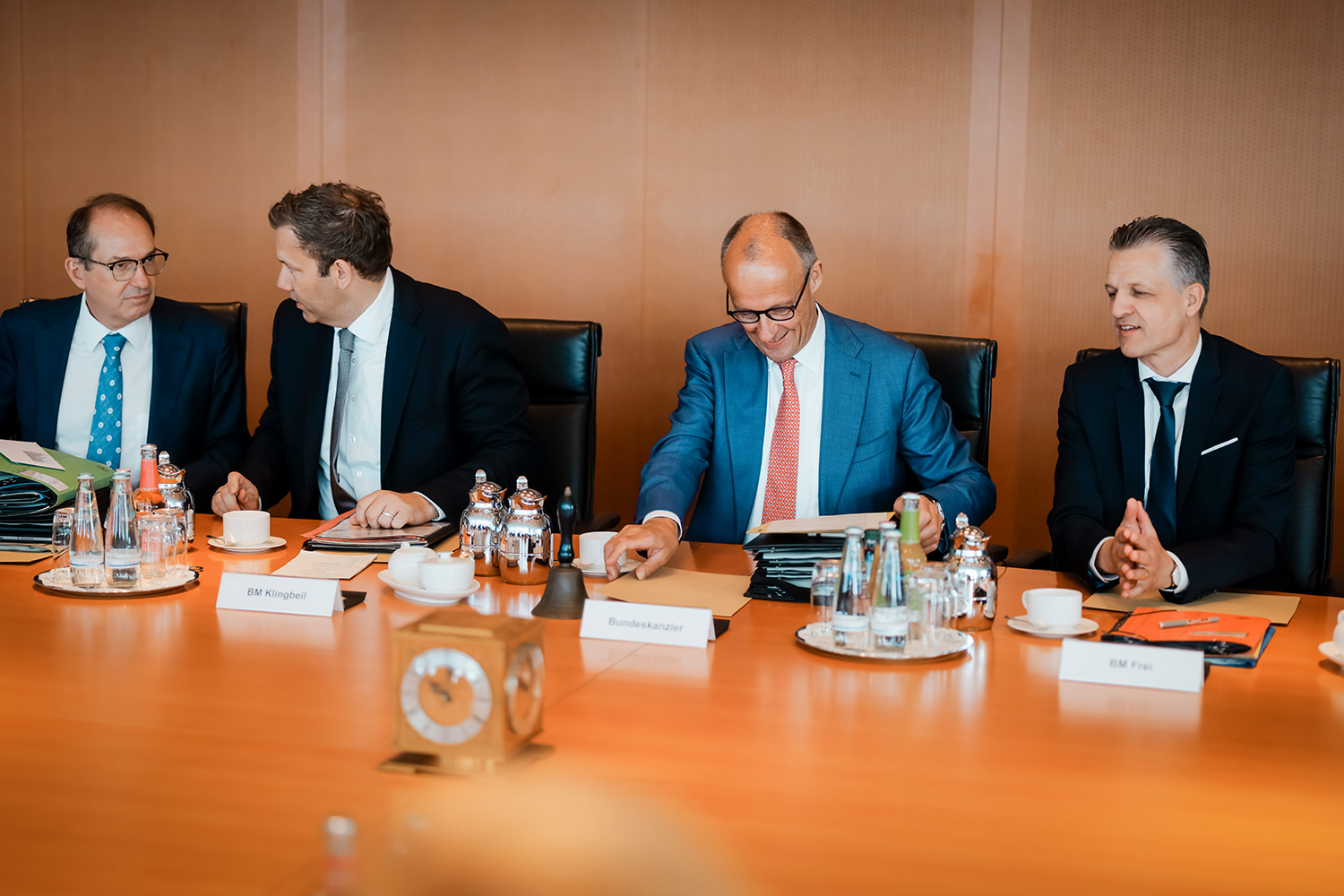
Through the decisions taken by the second caretaker cabinet, the Federal Government is consistently pursuing its course towards less bureaucracy and greater efficiency.
Photo: Federal Government/Tobias Koch
Fewer visits to government offices, faster procedures, more digital solutions: a key priority for the Federal Government is to make everyday life easier for citizens and to strengthen the economy. Specifically, the aim is to fundamentally modernise the state and public administration in Germany, to avoid unnecessary bureaucracy and to speed up procedures.
The record of the second caretaker cabinet demonstrates that the course we have taken is a successful one. Since the first caretaker cabinet meeting on 5 November 2025, the Federal Government has adopted more than 40 specific measures that will result in annual relief of around ten billion euros. This directly benefits the public, the business community and the public sector.
“A paradigm shift in bureaucracy”
At the summer press conference in July, Federal Chancellor Merz praised the “caretaker cabinet” as being evidence of steady progress in the modernisation of the state and he has already announced the next “caretaker cabinet” for the end of the year: “This will be a long-term challenge for us. It’s not something we’ve finalised today.” The Chancellor reiterated his intention to continue reducing bureaucracy in order to “relieve citizens, as well as businesses in Germany, of heavy bureaucratic burdens”.
This includes the planned abolition of comprehensive reporting and documentation requirements in future. Applications are deemed to have been approved if a public authority does not object within a specified period.
“An expression of a new sense of identity”
Karsten Wildberger, the Federal Minister for State Modernisation, highlighted the fundamental shift in the state’s outlook during the press conference following today’s cabinet meeting. “This reflects a new self-image for the state: lean, efficient and with greater trust in the personal responsibility of business owners and citizens. In future, we will only regulate what is absolutely necessary,” he emphasised. This also means that it is not citizens and businesses who should have to wait for the state; rather, it is the state that must deliver.
Key decisions taken in recent weeks
In the last few weeks alone, the German Government has introduced key measures providing relief amounting to around 1.5 billion euros. These include, for example:
- fewer obstacles to the expansion of telecommunications networks and fibre-optic cables
- lower costs for obtaining a driving licence
- greater energy efficiency and less red tape for businesses
- faster and simpler housing construction
- as well as a drive to modernise the administrative courts, leading to faster proceedings
The common aim of these legislative proposals is to bring about tangible relief in everyday life, speed up procedures, ensure consistent digitalisation and create better conditions for investment, innovation and economic growth. The aim is to speed up the development of a modern state.
Further relief measures approved
The Federal Government is steadfastly pursuing its policy of reducing red tape and speeding up procedures. As part of the second relief cabinet meeting on Wednesday, further measures have now been set in motion – providing relief totalling a further 600 million euros or so:
One of the key priorities of the second caretaker cabinet is digitalisation in the healthcare sector. The annual savings amount to around 445 million euros. Among other things, the following changes will be made: In future, referrals from GPs to specialists are to be made digitally. The old referral form, which you used to have to take with you and present to the specialist, is now a thing of the past. Electronic bank transfers mark the digitalisation of one of the last paper-based processes in the healthcare sector.
In future, insured persons will be able to use the ePA (electronic patient record) app to access initial assessments, referrals and appointment booking all in one place, with the digital appointment booking system designed to be fair and non-discriminatory. A standardised, digital medication plan is also being introduced, which is continuously updated by doctors and pharmacies, thereby significantly improving medication safety.
Another advantage: Medical practices and clinics will be required to send test results and doctors’ reports to one another exclusively via a secure digital communication channel. This saves time and money, and enables digital workflows. The Act improves the exchange of information between the parties involved and makes healthcare provision faster, more digital and more efficient.
The German Government is significantly reducing red tape in the transport sector. The Act and the Ordinance on Reducing Red Tape in the Transport Sector will simplify administrative procedures and increase their digitalisation. In addition, existing regulations are being modernised, for example by lifting the ban on lorries on public holidays that vary from state to state. This will make processes more efficient for businesses, public administration and transport, and reduce the administrative burden. The Federal Government is thus putting an end to the previous patchwork of bureaucratic regulations and providing certainty for planning.
In future, drivers of fully electric cars will no longer need to buy a green sticker and display it on their windscreen in order to enter an environmental zone. The “E” electric vehicle registration plate itself serves as proof.
The Act on the Modernisation and Digitalisation of Employment Support is intended to make unemployment insurance and employment support more citizen-friendly, more efficient and less bureaucratic. Anyone who, for example, needs to apply for benefits or notify the authorities of changes should be able to do so more easily online. In future, consultation and registration appointments can be held via video link from home. The daily duty of checking the post-box can also be done away with, as long as citizens remain contactable digitally.
The German Government is boosting further training opportunities to support career progression. The appeal of career progression opportunities is enhanced and potential barriers to entry are removed. To this end, the costs of subsidised training programmes for participants are significantly reduced through a package of measures. For example, if a person undertakes a master craftsman’s examination or other further training and receives support from their employer for this, this will no longer be taken into account for the purposes of the Aufstiegs-BAföG (Federal Training Assistance Act). Support from employers should be worthwhile.
A wide-ranging package of measures will relieve farms and the administration of unnecessary red tape, and streamline administrative processes. Here are a few examples: In future, farmers and gardeners will only have to undertake the compulsory plant protection training every six years, rather than every three years. Reporting obligations under the Food and Feed Code are to be abolished. There are bureaucratic simplifications for the cultivation of industrial hemp and for the veterinary profession. Furthermore, no new environmental regulations will be introduced until 2028, in order to avoid creating further red tape.
Further relief measures
At the second caretaker cabinet meeting, further measures were also adopted with the aim of providing consistent relief for citizens, the economy and the public administration:
- modernisation of radiation protection legislation, including in relation to X-rays
- Simplifying company acquisitions: fewer notifications, faster merger procedures
- Strengthening the cooperative legal form: starting a business and working are becoming more digital
- Higher education law: outdated rules are no longer applicable
What is to be decided in future
State modernisation is a long-term endeavour which the Federal Government has tackled with determination – and which will continue on a long-term basis. Specifically, the Federal Government is planning further key legislative initiatives that will significantly advance the reduction of red tape:
the abolition of reporting and documentation requirements is intended to reduce excessive bureaucracy and state control. In future, the principle will be that reporting obligations are abolished. Only those that are truly indispensable should be retained. At the same time, the aim is to speed up approval procedures involving the state. In future, complete applications will be deemed to have been approved after four months unless the authority makes contact. Construction is also set to become easier, cheaper and faster. To this end, the law governing building contracts is being amended in line with Building Type E, so that it is easier to deviate from building standards that are not statutory requirements.
The very first caretaker cabinet, formed in early November 2025, already included numerous initiatives designed to free citizens and the business community from red tape. The Federal Modernisation Agenda also sets out over 80 specific measures aimed at reducing red tape and creating a fast, digital government. In addition, the Federal Government, together with the federal states, has agreed on more than 200 projects as part of the Federal Modernisation Agenda, aimed, amongst other things, at speeding up processes and creating efficient structures. The initial measures are already having an effect: further information and examples relating to the federal and state programme can be found here (only German).