Singapore's Premier visits Berlin
During the visit of Singapore’s Prime Minister, the Chancellor underscored the excellent cooperation between the two countries in the economic and technological sectors. Singapore is a "key location" for German business, said Angela Merkel. A free trade agreement between the EU and Singapore is to be finalised soon.
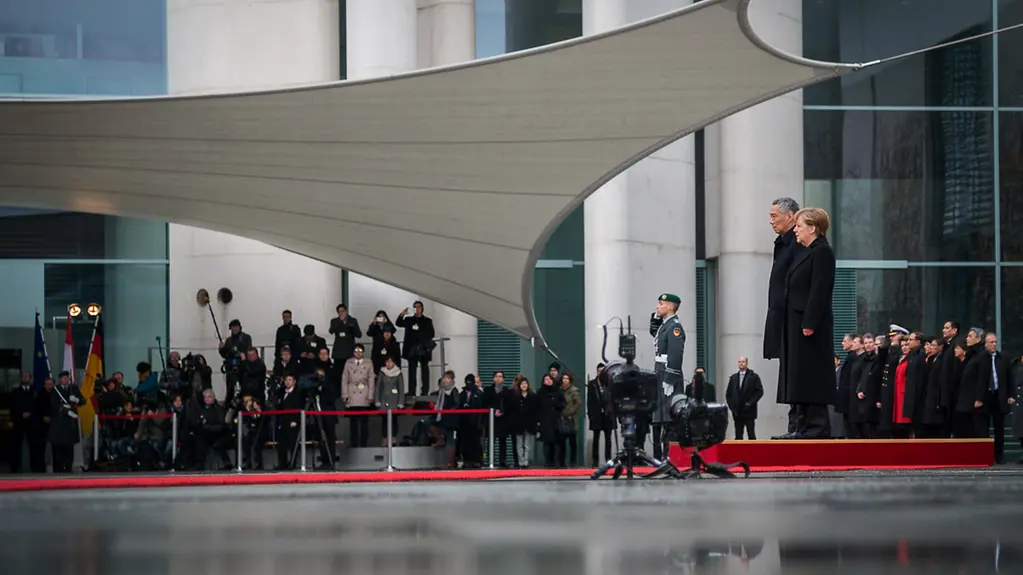
Chancellor Angela Merkel welcomes Singapore's Prime Minister Lee Hsien Loong with military honours in a sleet shower
Photo: Bundesregierung/Kugler
Chancellor Angela Merkel was happy to welcome the Prime Minister of Singapore, Lee Hsien Loong. In 1965 Singapore became independent. In the same year it established diplomatic relations with the Federal Republic of Germany.
For half a century now relations between the two countries have been marked by mutual trust and respect, said the Chancellor after a working luncheon. "We appreciate Singapore as an economic partner and a partner in science and research, but we also appreciate its knowledge and understanding of Southeast Asia," said Angela Merkel.
Prime Minister Lee Hsien Loong last visited Berlin ten years ago. He was the first foreign guest received by Chancellor Angela Merkel, when she took up office in 2005. Angela Merkel visited Singapore in 2001. They last had the occasion to talk during the Nuclear Security Summit in The Hague in March 2014.
A secure and innovative location
Singapore is a key location for German businesses, said the Chancellor. The country’s "high level of legal certainty" and policies "geared to innovation" are important factors in this context. As a result Germany and Singapore cooperate closely in the fields of research and vocational education and training.
Only if our economies become increasingly efficient, said Angela Merkel, "will we be able to master the challenges posed by our aging populations while retaining or even increasing prosperity". It is not only a question of having the jobs, but of ensuring that these are good quality jobs.
In the field of research and vocational training Singapore cooperates particularly closely with the German state of Saxony, including the University of Dresden and city’s vocational training centre. Before he arrived in Berlin, the Prime Minister had visited partner facilities in Dresden and signed a number of cooperation agreements.
Free trade important for Germany
The Chancellor pointed out that a free trade agreement between the EU and Singapore is very close to being finalised. "We in Germany welcome this. We want this free trade agreement." The text of the agreement is now undergoing legal and technical review procedures.
She agreed with Prime Minister Lee that the ratification process "should not take too long, because an agreement of this sort obviously does become out-dated and the world is constantly changing," said Angela Merkel. Many bilateral free trade agreements exist in the Asian and Pacific region, and free trade is very important for Germany as an exporting nation and Europe in general.
Crisis in the euro zone
With a view to the sovereign debt crisis in the euro zone, the Premier expressed confidence, "that an arrangement can be found to prevent another such crisis in Europe". The Chancellor added that it was "clear that the Greek government still has to work out where it stands". This is obvious when we see that the government has only just taken up office. "We await their proposals and then we will engage in talks. There will be opportunity enough for that," underscored Angela Merkel.
Ukraine – shared values
The two heads of government also discussed the Ukraine-Russia conflict, "and we share the same values in terms of the territorial integrity of countries," noted the Chancellor. Angela Merkel reiterated the German position, that Germany will not be supplying Ukraine with lethal weapons. "We are focusing on a diplomatic solution."
Should a qualitatively new situation emerge, or should the situation deteriorate, the EU ministers of foreign affairs have made it plain that "it would then be necessary to work on additional sanctions," she stated. Although this is a protracted procedure and although there have been many unsuccessful attempts, the focus is still on working towards a diplomatic solution and a ceasefire. "I believe that this is what is called for at this time." The framework of reference is still the Minsk Protocol, said Angela Merkel.
Prime Minister Lee said that the annexation of Crimea was unlawful. "Countries cannot simply annex parts of other countries." Otherwise Singapore too, as a small state, could find itself in a situation "in which at international level the powerful are always right. That would be a disaster," declared Lee Hsien Loong.
Lee Hsien Loong has served as Prime Minister of the Republic of Singapore since 2004. He studied mathematics and computer science at the University of Cambridge before embarking on a military career. He held the post of Director of the Joint Operations and Plans Directorate of the Singapore Armed Forces, attended the US Army Command and General Staff College at Fort Leavenworth and studied in Harvard. Before becoming Prime Minister he held various ministerial posts.
In Berlin Prime Minister Lee met with Federal Foreign Minister Frank-Walter Steinmeier, Federal Minister for Economic Affairs Sigmar Gabriel and Federal Finance Minister Wolfgang Schäuble. He also addressed the Körber Foundation.