Press conference by Federal Chancellor Merz, Norway’s Prime Minister Støre and Canada’s Prime Minister Carney
Germany is training with Norway, Canada and other partners to defend the North as part of NATO’s Cold Response exercise. Federal Chancellor Merz noted the consequences of the Iran war for Germany’s security and energy supply.
- Transcript of press conference
- Friday, 13 March 2026
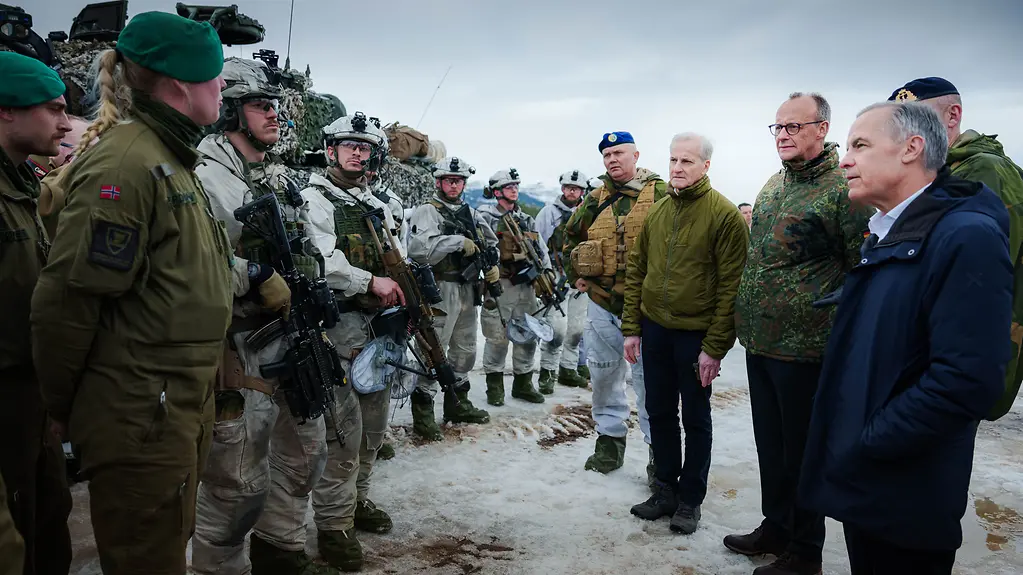
Federal Chancellor Merz together with Norway and Canada’s heads of state Støre and Carney at the NATO COLD RESPONSE exercise.
Photo: Federal Government/Jesco Denzel
Federal Chancellor Friedrich Merz visited NATO’s Cold Response exercise together with Norwegian Prime Minister Jonas Støre and Canadian Prime Minister Mark Carney. The aim of the exercise is to strengthen deterrence on NATO’s northern flank. At the meeting, the Federal Chancellor emphasised that the hostilities against Iran also have an impact on security in the Far North. Merz said that, being there on the ground, he has been able to see what an important contribution the Bundeswehr is making and how Germany is also defending NATO’s northern flank.
The most important points in brief:
- War against Iran: The world needs a stable, viable Iran that does not threaten Israel or other partners. Iran must end its nuclear and ballistic ambitions and renounce terror. At the same time, Merz expressed concern that there was no clear, shared plan on how the war between the USA and Israel against Iran could be ended.
- Impact on Germany: Germany has no interest in an extended war between the USA and Israel against Iran. A disintegration of the country would also have serious consequences for Germany, affecting security and energy supply as well as potentially also impacting migration.
- Shared strategies: Merz discussed closer cooperation on energy policy with Støre and Carney, with a plan to develop a joint energy policy strategy in future. Within the EU, Germany wants to work together with Canada and Norway to secure the energy supply. The heads of government also discussed joint strategies for satellite programmes and aviation.
You can view the series of photos from the visit to Norway here:

Nordmela, 13 March 2026: Federal Chancellor Friedrich Merz travelled to the Norwegian island of Andøya, around 300 km north of the Arctic Circle. On the agenda for the day were two meetings with Norway’s Prime Minister Jonas Gahr Støre.

At the beginning of his visit, Merz emphasised the importance of the strategic partnership with NATO member Norway. According to the Chancellor, the cooperation works “extremely well” and has “potential for the future”.

The first destination was the Andøya spaceport, which serves as a launch site for rockets and research balloons. Merz was accompanied by Defence Minister Boris Pistorius and Dorothee Bär, Federal Minister of Research, Technology and Space.

The “Spectrum” orbital rocket from the German start-up Isar Aerospace is due to be tested here in a few days’ time.

The 30-metre rocket is scheduled to be launched into orbit from Andøya with five satellites on 19 March. “It is precisely this European sovereignty that we also need in space travel,” said Merz.

After a brief exchange with the pilot, the Chancellor travelled further east to Bardufoss, one of the most important military sites in northern Europe.

Together with Canada’s Prime Minister Mark Carney, Merz and Støre visited NATO’s COLD RESPONSE exercise. The geographical location north of the Arctic Circle creates a suitable environment for military operations under Arctic conditions.

Around 25,000 soldiers from 14 NATO countries are taking part in the exercise, with the Federal Armed Forces sending around 1,600 personnel.

Here on the ground, Merz saw for himself how the Federal Armed Forces perform their role professionally, resolutely defending Germany on NATO’s northern flank.