Speech by the Federal Chancellor in the general debate on the 2026 budget in the German Bundestag
The Federal Government wants to ensure economic growth, reform the welfare state and eliminate any “blank spots” in security policy. Federal Chancellor Merz made this statement in his speech during the general debate on the 2026 budget in the Bundestag.
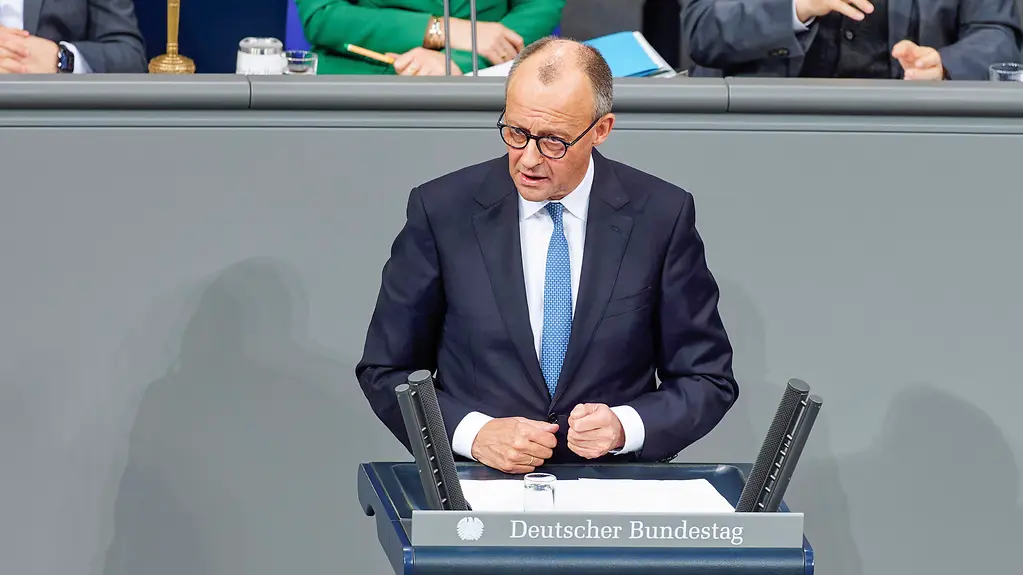
“We must find a new consensus on justice”, said Federal Chancellor Friedrich Merz in the Bundestag.
Photo: Federal Government/Henning Schacht
“The competitiveness of our economy, the security of our country and solidarity with one another in a democratic framework” – these are the key objectives of the 2026 budget, said Federal Chancellor Friedrich Merz in the German Bundestag. The Chancellor used the general debate on the 2026 federal budget to take stock of current challenges, upcoming tasks and reforms that have already been tackled.
“If we take this path of the renewal of our country in the face of the greatest geostrategic and geoeconomic challenges, if we take this path together, then we will also be successful together for our country. This is what we are working on. Every day”, emphasised the Chancellor.
In his speech, the Chancellor spoke about issues including:
... the economy and growth:
The Federal Government, he said, had already stimulated growth through tax reforms and falling energy prices. An industrial electricity price was to follow. According to the Chancellor, new gas-fired power plants are to be built as part of a power plant strategy to ensure low-cost energy. The Chancellor reported that digitalisation and a reduction in bureaucracy were being driven forward in Germany and Europe. The High-Tech Agenda focussed on key industries in the fields of artificial intelligence, quantum technology, microelectronics, biotechnology, fusion energy and climate-neutral mobility. “We are on a path leading to state-of-the-art technologies in Germany”, said the Federal Chancellor.
... the welfare state:
“We will negotiate a new consensus between the generations”, said the Federal Chancellor. The new active pension was, he said, a step in this direction, and the Federal Government was also reforming private and company pension schemes. He reported that it would work on a new welfare state model that could last for years. This also included transferring citizen's income into basic income support. “People who work should get the sense that their taxes and social security contributions are being handled carefully”, said Merz. At the same time, “those who need the welfare state should not be left in the lurch”.
... security policy:
The Federal Government, according to Merz, was aligning its foreign and domestic security policy with the interests of Germany and Europe. The newly established National Security Council ensured a forward-looking security policy. “We don’t want any blank spots when it comes to the security of our citizens, when it comes to the security of our country”, said the Federal Chancellor. That, he said, was why the Federal Government was investing in cybersecurity and the protection of critical infrastructures, and was also launching a new military service law. “Peace and freedom don’t come free”, said Merz.
... peace in Europe:
Perhaps the most important guiding principle of politics is “the preservation of freedom in peace in Europe”, said Merz. “We want peoples to live together peacefully on the basis of our democratic, liberal values.” And with regard to a peace solution for Ukraine, Merz said he welcomed the “continued American commitment to resolving this conflict”. But: “European affairs can only be decided in agreement with Europe”, emphasised Merz. He said that the war could end tomorrow if Russia were to stop the war and withdraw its troops from the territory. The Federal Government would continue to support Ukraine “for as long as it is necessary”, said Merz. It was planning 11.5 billion euros for this in the 2026 budget.