Federal Cabinet retreat
How can Germany become more competitive and modern? This was the main focus of the first joint Cabinet retreat, held this week by the Federal government at Villa Borsig. Concrete decisions were taken on Wednesday.
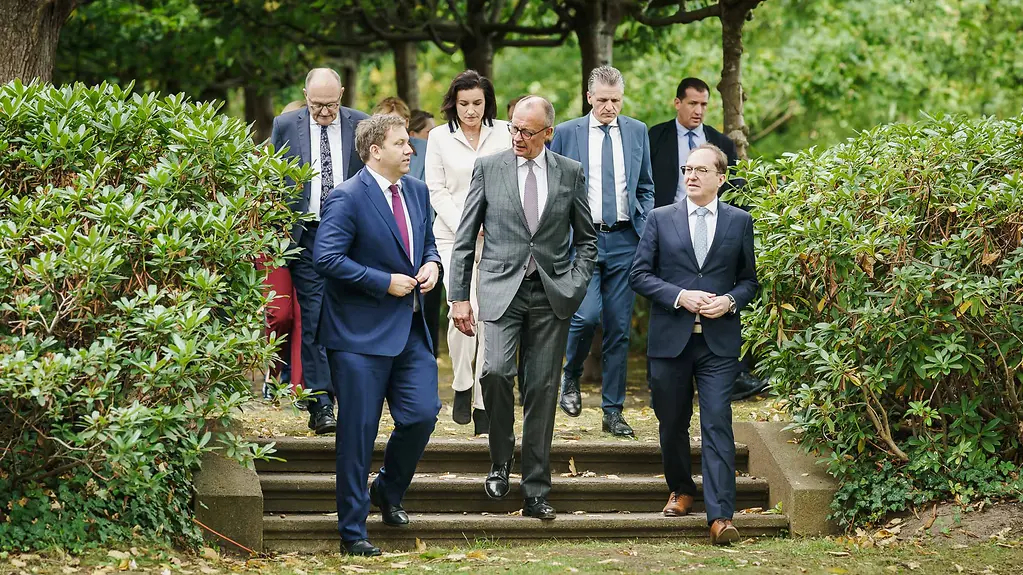
The Federal Government met at Villa Borsig for the Federal Cabinet retreat to discuss the topics of competitiveness and state modernisation.
Photo: Federal Government/Jesco Denzel
The Federal Government is doing everything it can to get Germany's economy back on track for growth and to modernise the country. The aim is to increase investment and make Germany fit for the future. At the Federal Cabinet retreat at Villa Borsig, the members of the Federal Government made concrete decisions on this topic -– in particular with the adoption of the modernisation agenda for a fast Germany. Exchanging ideas played a key role in the retreat.
Merz: good and trusting collaboration
“There is a good, trusting, open, collegial and collaborative working relationship in this coalition. And that is why I am very confident that the tasks we are facing can be addressed,” emphasised Federal Chancellor Friedrich Merz at the end of the retreat on Wednesday.
Klingbeil: strengthen competitiveness, secure jobs
According to Federal Minister of Finance Lars Klingbeil, the focus was on strengthening German competitiveness and innovative power – and how to secure growth and jobs. “That's the big task. We are a long way from being able to sit back,” said Klingbeil. We must now press forward with many issues.
Dobrindt: making up for missed opportunities
“We want to, we can and we will move Germany forward,” said Federal Minister of the Interior Alexander Dobrindt at the end of the retreat. He also signalled: “Some things that have not been done in the past” will now be made up for. “We will continue to consistently pursue this path,” said the Minister.
Key focus: strengthening the economy and innovation
On the first day of the retreat, the members of the Federal Government exchanged views with both the scientific community and representatives from the business world. Federal Chancellor Merz emphasised on Wednesday that the Federal Government's ambition is to return to the top. The Federal Chancellor pointed out that the Government has already introduced a number of measures, such as a corporation tax reform and better depreciation options for capital assets.
Making Germany more innovative and strengthening it as a high-tech location are key to increasing competitiveness. The High-Tech Agenda adopted in July is an important first step in this direction.
“It is a High-Tech Agenda that should ensure that we have growth again, that we enjoy sovereignty, prosperity and competitiveness,” said Federal Research Minister Dorothee Bär at the Federal Cabinet retreat. The High-Tech Agenda will begin in the fields of artificial intelligence, quantum technology, biotechnology, microelectronics and nuclear fusion, said the Federal Minister.
Decisions on energy supply
The Federal Government has also passed two important resolutions regarding the supply of energy. Fusion energy could play an important role in the power supply in the future in order to meet the growing demand for electricity. For this purpose, the Federal Cabinet has therefore launched an action plan, which outlines measures to set the course for a fusion power plant in Germany and create innovation-friendly framework conditions.
A Hydrogen Acceleration Act was also passed, with which the Federal Government is thus setting the course for a hydrogen ramp-up. Hydrogen is crucial for the decarbonisation of industry – especially in areas where direct electrification is not possible or economically viable. It is also an important raw material for the chemical industry.
With its immediate action programme, the Federal Government has provided the first comprehensive investment incentives. It has also introduced measures that will significantly reduce the burden on businesses, farmers, restaurateurs and citizens.
Key focus: modernising the state and reducing bureaucracy
All government action needs to become more efficient and digital. For this reason, the second day of the Federal Cabinet retreat focused on reducing bureaucracy and modernising the state. “The long overdue modernisation of our state must now really proceed quickly. We need to review state services. They must become more efficient and less complicated,” said Federal Chancellor Merz.
In order to underpin a concrete roadmap for the central task of modernising the state, the modernisation agenda for the state and administration was adopted at the Federal Cabinet meeting on Wednesday. The Federal Government is thus taking an important step towards making the Federal Government more future-proof, efficient and citizen-centred.
Villa Borsig is a historic property on the Reiherwerder peninsula in Berlin's Tegel district, built by industrialist Ernst von Borsig in 1906 and now used as an international guest house and conference centre as well as a training centre for the Federal Foreign Office.