Auschwitz remembrance ceremony in German Bundestag
In a remembrance ceremony the Germany Bundestag has paid tribute to the victims of National Socialism. Federal President Joachim Gauck spoke in front of Auschwitz survivors, members of the German Bundestag and guests. The Chancellor too was present.
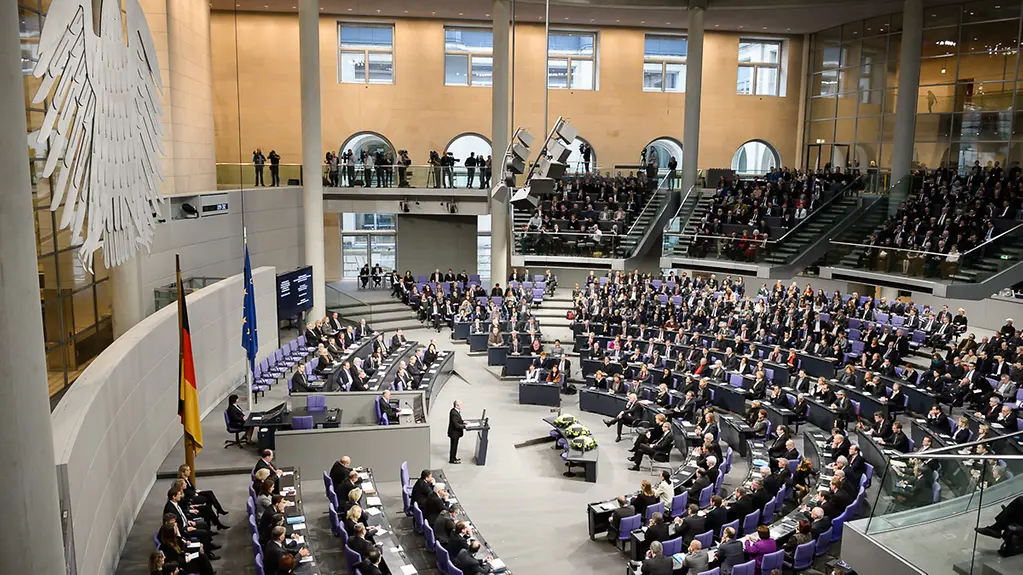
The German Bundestag remembered the victims of National Socialism
Photo: Bundesregierung/Steins
In a special session on Holocaust Remembrance Day the German Bundestag remembered the victims of the Nazi dictatorship. As well as Federal President Joachim Gauck and Bundestag President Norbert Lammert, Chancellor Angela Merkel and Bundesrat President Volker Bouffier attended the ceremony along with representatives of the Federal Constitutional Court.
On 27 January 1945, the Red Army liberated the German concentration and death camp in Auschwitz.
Historical responsibility
In his address, Bundestag President Norbert Lammert pointed out that the following generations were not responsible for the past, but that they absolutely were responsible for the way they deal with this past. Crimes ordered and organised by the state can never again be allowed to take place anywhere in the world, he declared. Germans must be aware of their historical responsibility, and in this knowledge must face up to the urgent humanitarian challenges of the present.
Auschwitz is synonymous with the "industrialised genocide that is unparalleled in history" and for what human beings can do to other human beings, said Norbert Lammert. The Bundestag President remembered those who resisted National Socialism, and also the people "marked by the trauma of survival". He urged the young generation to listen to the survivors, and to become "witnesses of the witnesses" and keep the memories alive.
We must preserve the memories, says Joachim Gauck
In his address Federal President Joachim Gauck also called on his audience in the plenary chamber of the Reichstag building to keep alive the memories of German crimes. One of the most important lessons to be learned from engaging with the National Socialist past is "that silence does not erase blatant crimes or blatant guilt", said the Federal President.
Joachim Gauck warned that the remembrance day could ossify into a ritual "an empty husk that we fill with the same old incantations". Remembrance days do not protect us from "becoming indifferent in our daily lives", underscored the head of state. The Holocaust was a "rupture woven into the texture of our national identity. Anyone who wants to live in truth cannot deny this." The resulting moral obligations go beyond remembrance. From this remembrance follows the mission to protect and preserve the rights of every human being.
The 27th January is the Day of Remembrance for Victims of National Socialism. It was introduced in 1996 by Federal President Roman Herzog. On 27 January 1945 Soviet troops liberated the concentration camp in Auschwitz, where about 1.1 million people were murdered. A total of some six million Jews were killed in Nazi concentration and death camps. The remembrance ceremony for the victims of National Socialism has been held every year since 1996 in the German Bundestag.
Composition of a survivor
Between the addresses of Norbert Lammert and Joachim Gauck the clarinettist Ib Hausmann played the third movement "Abîme des oiseaux" (Abyss of birds) from the "Quatour pour la fin du temps" (Quartet for the End of Time) by French composer Olivier Messiaen (1908-1992). The piece is based on the first seven verses of the Book of Revelation. Messiaen was interned in 1940 in a camp near Görlitz as a prisoner of war, where he completed the Quartet. In January 1941 it was performed for the first time in the prisoner of war camp.
Youth encounters and exhibitions
This year’s youth encounter of the German Bundestag also looks at Auschwitz, the symbol of the Holocaust and Nazi crimes. Eighty young people are involved, and are engaging with the history of National Socialism in Germany and in neighbouring countries, especially Poland and France.
Following the remembrance ceremony, the Bundestag President extended an invitation to the opening of the exhibitions "Der Tod hat nicht das letzte Wort – Niemand zeugt für den Zeugen" (Death does not have the last word – nobody bears witness for the witnesses) and "Zeichnen gegen das Vergessen" (Drawings to remember) in the Foyer of the Paul-Löbe-Haus in Berlin. The exhibitions are open from 28 January to 27 February 2015 with prior registration.
Remembrance celebrations with survivors
To mark the 70th anniversary of the liberation of the concentration camps, the eight concentration camp memorial sites receiving institutional funding from the German government will be holding remembrance ceremonies. The focus will be on the invited survivors and their families. These events are being supported with special German government funding.