Federal Chancellor Friedrich Merz made his first official visit to the People’s Republic of China. He met Premier Li Qiang and President Xi Jinping for talks in Beijing; visits to German companies were also on the agenda. See the photos from the trip here.

Beijing, 25 February 2026: the Chancellor’s two-day trip to China began in Beijing. Chancellor Merz emphasised that there is “great potential for growth” in both economies.

In the Great Hall of the People, the Chancellor was welcomed by China’s Prime Minister Li Qiang with a military ceremony. Merz said he is looking forward to having positive discussions and a good exchange between the countries.
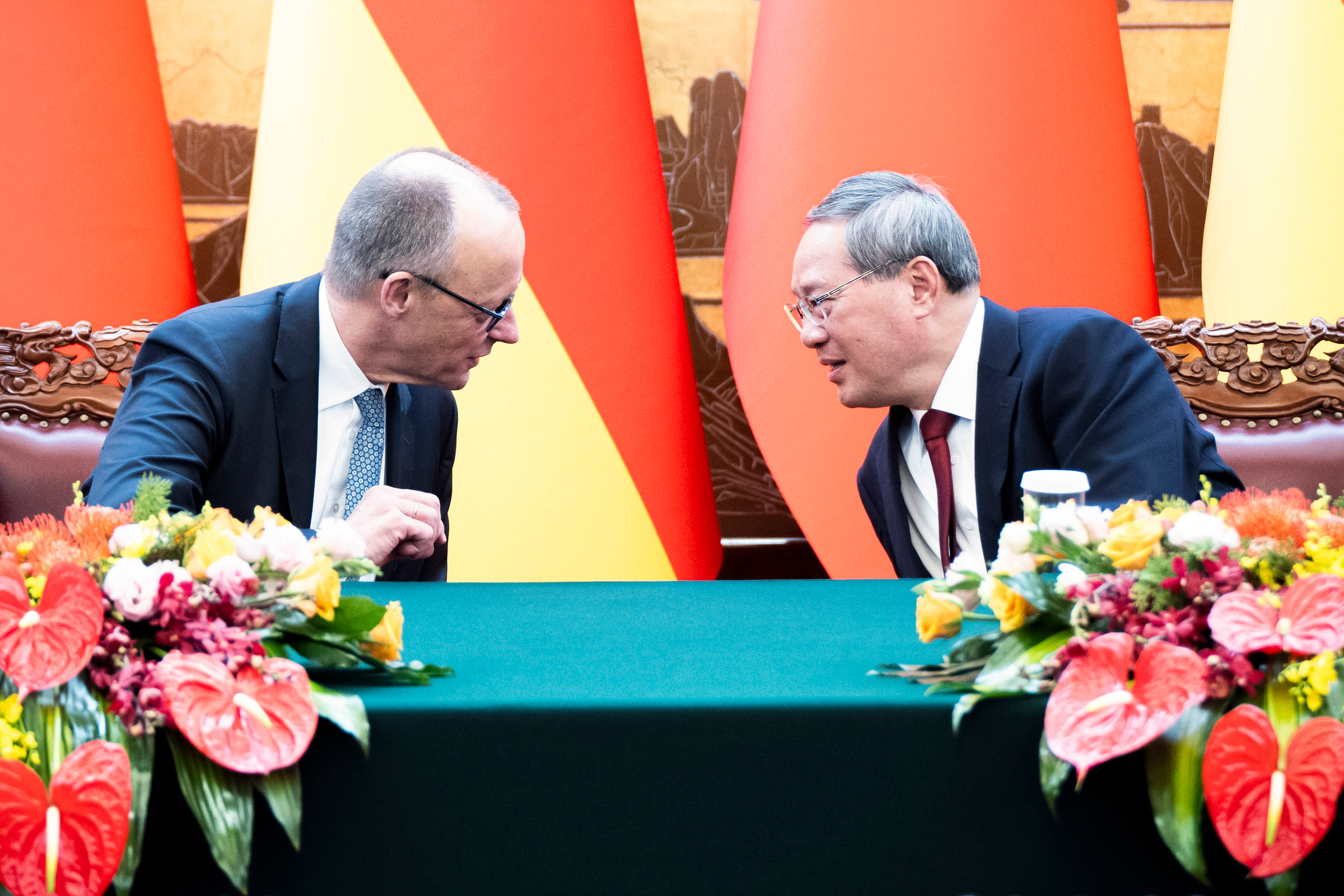
The talks centred on opportunities for economic cooperation and security policy.

Federal Chancellor Merz was accompanied by a 30-strong business delegation. The German government’s goal is for trade with China to be as open, fair and free as possible. While there are a number of challenges – such as the growing trade imbalance – the Chancellor stressed that these challenges could be overcome “through cooperation and dialogue”.

At the end of the first day, President Xi Jinping invited the Chancellor to a joint dinner.

Chancellor Merz would like to maintain and deepen diplomatic ties and intensive economic relations with China.

Beijing, 26 February: The second day started on a cultural note: the Forbidden City is a designated World Heritage Site and one of the most important historical sites in China. The chancellor was led by the director of the German Archaeological Institute Beijing, Dominic Hosner.

This was followed by various company visits, starting with the Mercedes-Benz Group in Beijing, where the Chancellor was able to take a look into the future at the German car manufacturer. He took a short ride in an autonomous vehicle.

Chancellor Merz then travelled to the technology metropolis of Hangzhou. The Chinese manufacturer Unitree specialises in the development, production and worldwide distribution of high-quality humanoid robots. The Chancellor was able to see these in action for himself at a demonstration.

They jump, dance and even fight: the first AI-controlled robot models, which can also help with household chores, are already on the market in China.

The last appointment on the agenda was a visit to Siemens Energy. In a joint venture with two Chinese companies, high-voltage and circuit breakers are produced here to prevent short circuits in power stations and substations.

For the Chancellor, the company visits were “impressive examples of successful cooperation and good technological development”. The aim now is to seek good cooperation, but also to openly address those issues that present challenges, the Chancellor said this at the end of his trip.