Centre Against Expulsion
Chancellor Merkel wants to see to the rapid completion of the Documentation Centre for Flight, Expulsion and Reconciliation.
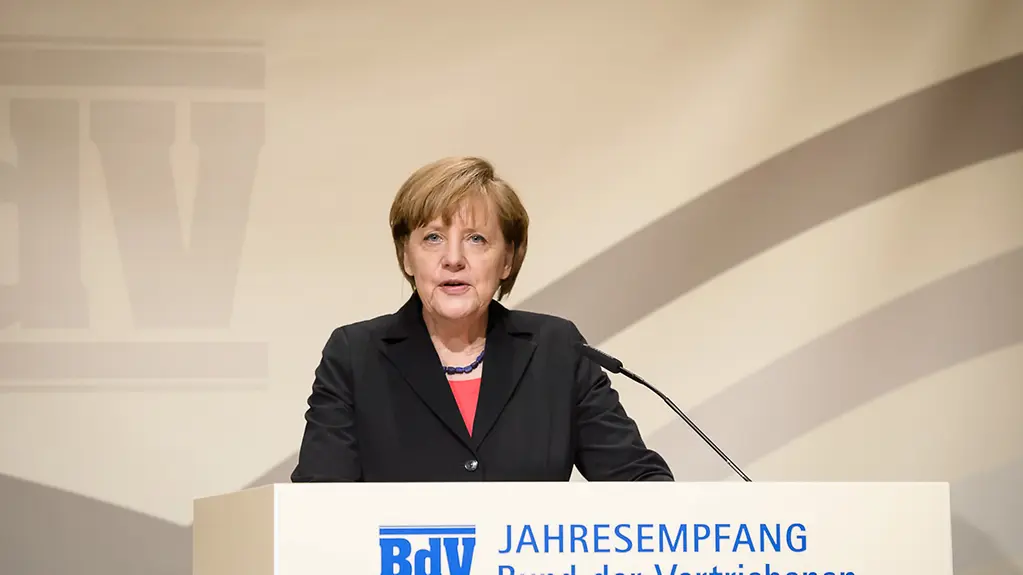
Merkel: 2014 is a year full of important anniversaries
Photo: Bundesregierung/Steins
At the annual reception of the German League of Expellees she said that the Centre would be an important place for increasing historical awareness and a sense of responsibility for the future.
“I promise to do all I can to ensure there is no let up when it comes to getting the Documentation Centre finished,” the Chancellor assured her audience. It was Merkel herself who had last year she had set the ball rolling for the Deutschlandhaus in the heart of Berlin to be converted into the new Documentation Centre.
Thinking about identity, history and reality
The League of Expellees (Bund der Vertriebenen) has chosen “Germany needs us” as its annual motto this year. The aim is to encourage people to “think about their own identity, about our history and also about our reality today,” Angela Merkel said.
“Flight and expulsion are an indelible part of our history,” the Chancellor went on. “There are millions of people living in Germany today who either had to flee or were expelled from their homes, or who are related to those who suffered that fate.” One’s family background and history, as well as one’s own and often painful experiences always left their mark, she added. “We all know that it is not good to suppress those memories.”
Keeping the story of expulsion secret for many years
The fate of the expellees was a taboo subject in the GDR for many decades. “It was not until the Wall came down 25 years ago that expellees were finally able to talk openly and in public about their horrific experiences in eastern Germany as well, and thus in the whole of Germany,” Angela Merkel said. That was why remembrance needed to be given sufficient space in the public domain.
“And that means calling what people experienced by its name, without any reckoning up. Remembering what one person suffered does not mean that we have to forget what someone else went through. And we know that the suffering that Germany brought upon millions of people on account of the Second World War and the Holocaust ultimately struck back at us Germans at the end of the War. We are not mixing up cause and effect. Remembrance in the spirit of reconciliation looks at both these aspects,” the Chancellor explained.
2014 - a year full of important anniversaries
The Chancellor pointed out that 2014 was “a year full of important anniversaries”. It not only marked the centenary of the start of the First World War and the beginning of the Second World War 75 years ago. November sees the 25th anniversary of the fall of the Berlin Wall – a happy memory.
These commemorations offer us the opportunity to talk to young people in particular and to heighten their historical awareness, Angela Merkel said. The young generation was at best capable of sympathising with such a deep feeling of loss. “But it is absolutely essential that we at least try to achieve that. Because that is how we can internalise what all of us are called to do, namely to put all our effort into making sure that our continent never experiences flight and expulsion again,” Merkel went on.
Flight and expulsion - still happening today
The Chancellor also emphasised how important it was to remember that people who are forced to flee have no choice in the matter. They are, she said, forced to leave their home against their will – and that is something that is still happening today.
“We only need call to mind Syria, where hundreds of thousands of people are fleeing the horrific civil war to have a chance at survival. I imagine that the older ones among you in particular can sympathise with their situation, because when you were young you yourselves experienced what it means to be afraid for one’s life. You know what it means to have to embark on a journey into the complete unknown,” Merkel said.