NATO defence ministers
At the meeting of NATO defence ministers in Brussels, agreement has been reached that in future NATO is to conduct reconnaissance, monitoring and surveillance of refugee movements in the Aegean.
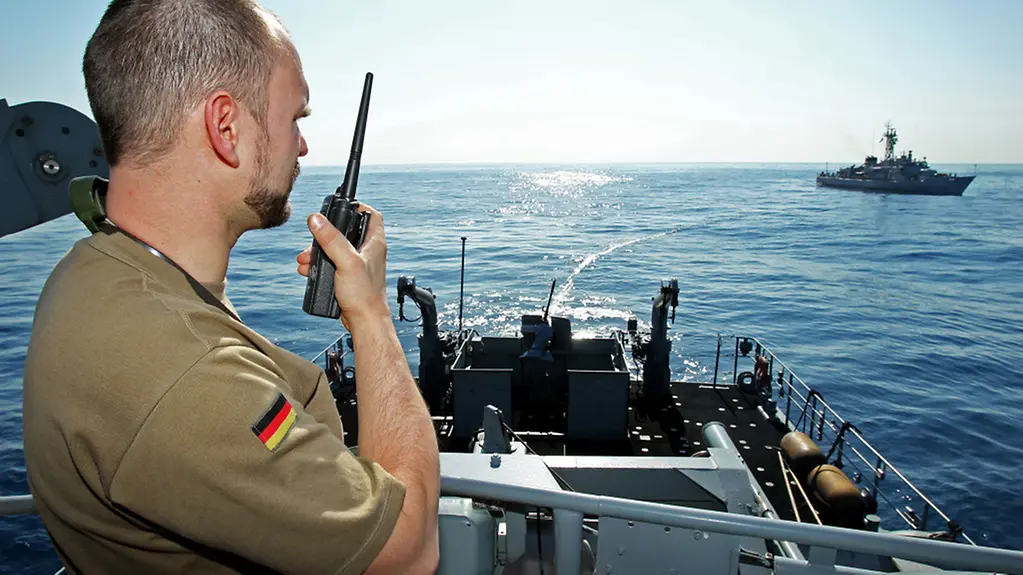
The German navy is to head an international NATO task force to address the problem of human traffickers in the Aegean
Photo: Sebastian Wilke/Bundeswehr
The aim is to identify the patterns of smugglers and traffickers and to stem the activities of these gangs, said Federal Defence Minister Ursula von der Leyen.
Time is now of the essence, stressed Federal Defence Minister Ursula von der Leyen at the meeting in Brussels.
With her Turkish and Greek counterparts, Ursula von der Leyen had submitted a proposal to NATO. At the meeting the massive support of all allies was tangible, said the Federal Defence Minister.
The NATO mission is to stem the activities of organised gangs of traffickers operating between Turkey and Greece. The aim is to put a stop to their operations.
Flotilla under German command
NATO naval units are already in the area. The existing naval force will be deployed in the Aegean with new duties, reported Ursula von der Leyen. The units are to be strengthened and placed under German command.
The most important task is to identify refugee boats and report these to the Turkish and Greek coastguards. Frontex, the EU border management agency, will also be involved.
Refugee boats are not to be stopped or returned by the NATO vessels, which are only to conduct reconnaissance and monitor refugee flows.
Mission must be planned precisely
Should a NATO vessel encounter a refugee boat that is in danger of capsizing, rescue measures will be taken. There is, however, a firm agreement with Turkey that the refugees will be returned to Turkey, said Ursula von der Leyen.
NATO military planners will now lay down the details of the assignment. NATO Secretary General Jens Stoltenberg explained that Turkish and Greek vessels will operate only in their own territorial waters.
Putting an end to the deaths of refugees
"The deaths in the Aegean are caused by criminal activities that must be tackled and that will be tackled," said federal government spokesperson Steffen Seibert on Wednesday (10 February) in Berlin. This is a police matter, but it should nevertheless be established whether NATO capacities could help better monitor the seas, he added.
The Chancellor visited Ankara on Monday for talks with the Turkish government. They also discussed ways of supporting Turkey’s efforts to tackle the traffickers.
NATO rapid response capabilities
The meeting of defence ministers also reviewed the implementation of the Wales resolutions. In September 2014 the heads of state and government adopted a Readiness Action Plan to enhance NATO’s ability to respond swiftly and decisively to any threats to the alliance.
The key document to emerge from NATO’s summit in Wales was the Readiness Action Plan (RAP), which lays out effective short-term measures to address the continuing need for assurance of member states.
NATO Secretary General Jens Stoltenberg stressed that many measures have already been completed. Air policing, maritime patrols and robust exercises have been stepped up. The size of the NATO Response Force has been increased to more than 40,000 soldiers, and six small headquarters have been activated in eastern member states.
Much accomplished before the NATO summit in Warsaw
The infrastructure in eastern NATO member states has been developed such that it is now possible for larger contingents of NATO troops to increase troop strengths on the ground at short notice.
At the NATO summit in Warsaw in July, final decisions will be taken regarding precise troop strengths, said Jens Stoltenberg.