Middle East
The ceasefire in Gaza is stabilising. We must now succeed in realising the second phase of the peace plan. Germany stands up for Israel – and will continue to do its part to ensure that the path to lasting peace succeeds.
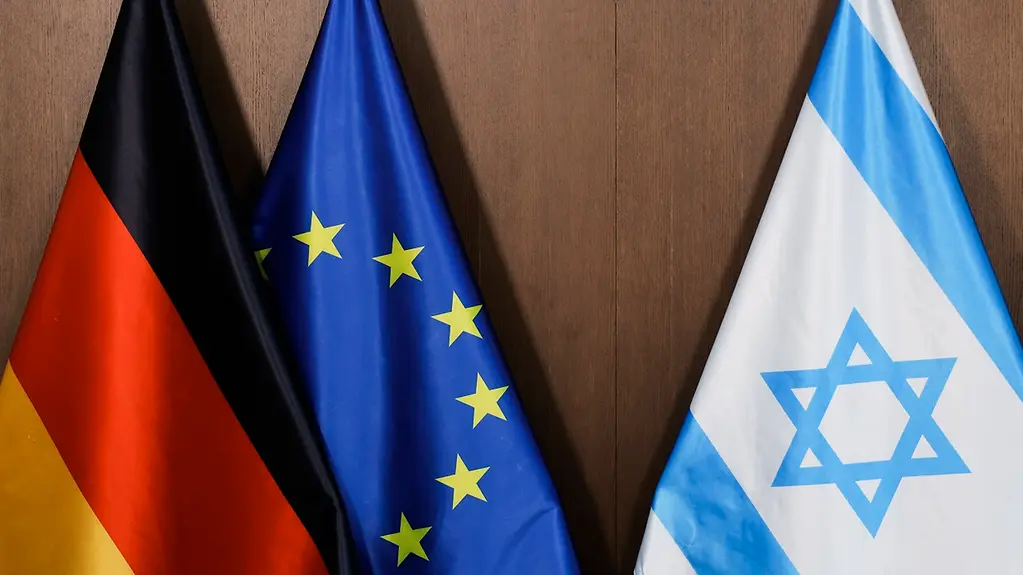
Germany, Europe and Israel stand for dialogue and partnership.
Photo: Federal Government / Tobias Koch
In the wake of the horrific terrorist attacks carried out by Hamas on 7 October 2023, Germany stands firmly by Israel’s side.
Federal Chancellor Friedrich Merz emphasised this once again on the occasion of the third anniversary of the crime. The focus, he said, must now also be on laying the foundations for a new order in which Israelis, Palestinians and their neighbours can live in peace and security. The Chancellor stated that the Federal Government is committed to this.
First visit to Israel
The Federal Chancellor travelled to Israel on 6 and 7 December 2025 for talks with President Itzchak Herzog and Prime Minister Benjamin Netanyahu. “I hope that, after difficult years of terror and war, a better era will now begin for the Israeli people,” said Federal Chancellor Friedrich Merz at the time during his inaugural visit. "That decisions are made that contribute to peace and good neighbourliness in the region." Germany and he personally would stand by Israel’s side in deep friendship, the Chancellor said at a joint press conference with Netanyahu.
The talks also centred on the US peace plan for Gaza. The Chancellor emphasised that after the release of the living and dead hostages by Hamas, it must be possible to enter the second phase. This includes permanently removing the basis for Hamas' terror. Hamas should no longer play a role in Gaza. In addition, the precarious humanitarian situation of Gaza's civilian population must be improved quickly and noticeably.
Thanks to the US government and partners in the region
After more than two years of war, a ceasefire was agreed for Gaza in October 2025 thanks to the mediation of US President Donald Trump. The Federal Chancellor took part in the signing ceremony for peace in Gaza on 13 October 2025 in Egypt. "This day, 13 October 2025, is an historic day," said Chancellor Merz on the ground. The war in Gaza is over – after two years of bloodshed, and after the barbaric terrorist attack by Hamas on 7 October 2023.
The Chancellor thanked US President Donald Trump and the US government for the peace initiative, their commitment and unequivocal position in this conflict, and the partners in Qatar, Egypt and Turkey for their mediation. Thanks are also due to the Israeli government, which has paved the way for peace. Read the full text of the press statement here. In a statement on the ceasefire, the Chancellor emphasised that Germany would continue to play its part in ensuring that the path to peace was successful. The Federal Government has high hopes for the peace process and strongly supports President Trump's peace plan.
Criticism of settlement projects
The Federal Government is in favour of a negotiated two-state solution. The best way to achieve the goal of Israelis, Palestinians and their neighbours living in peace and security is through the establishment of a Palestinian state alongside Israel. Federal Chancellor Merz made this statement on the third anniversary of the barbaric acts of 7 October 2023. He said that recognition of a Palestinian state comes at the end of a negotiation process.
Nevertheless, the Israeli government should not make it impossible for such a state to emerge one day. Germany and its international partners have criticised the Israeli government’s recent decision to issue tenders for the construction of the E1 settlement project as unacceptable. In a joint statement, the Israeli government is therefore urged to withdraw these plans immediately and to halt the expansion of settlements in the West Bank. This would undermine the prospects for a two-state solution by dividing the West Bank and damaging the territorial integrity of the Palestinian territories.
Federal Government deeply concerned about the suffering in Gaza
“Israel has the right – and indeed the duty – to defend its citizens and its very existence against those who repeatedly deny the democratic Jewish state’s right to exist,” the Chancellor stated during his visit to Israel. No state can tolerate its citizens being murdered, kidnapped and tortured by Islamist terrorists. That is why Germany stands by Israel. At the same time, people in Gaza continued to live in very precarious circumstances. Germany is providing humanitarian support here.
Ahead of his recent trip to Israel on 7 July, Federal Foreign Minister Wadephul stated that the Federal Government was not losing sight of Gaza. “Unrestricted access for humanitarian aid workers and their supplies is essential to alleviate the desperate situation of the people in Gaza,” said Wadephul.
In July 2026, an initiative launched by European countries and the European Commission was presented, with the aim of providing just under 900 million euros for early recovery measures in Gaza. Germany is involved in this. “The initiative will also provide fresh impetus for the swift implementation of the Peace Council’s 20-point plan. The framework conditions for reconstruction must finally be put in place – which also includes the disarmament of Hamas,” said Federal Minister for Development Alabali Radovan in Brussels.
Fearing for the hostages with Israel
After 738 days, the last surviving hostages were released from Hamas captivity in October 2025. The peace plan also provided for the bodies of the murdered hostages to be handed over so that their families could say goodbye with dignity. More than 1,000 Israeli citizens died in the Hamas attack and 250 were taken hostage.
"We mourned the dead with the Israeli people. We feared for the hostages with you,” said Friedrich Merz in Israel last December.
“We hope that the deep pain and wounds inflicted by this day and by these monstrous, barbaric acts can heal,” the Federal Chancellor said as he looked back at the murderous attacks of 7 October 2023.
The unchanging heart of German-Israeli relations
The Federal Government’s commitment to Israel’s existence and security continues to be at the heart of German-Israeli relations. That is a lesson learnt from the Shoah and part of German identity, said Chancellor Merz. “We stand up to those who downplay or even question Israel’s right to exist. Not just on 7 October, but every day.”
History of the Middle East conflict: one of the central disputes in the Middle East is the unresolved conflict between Israelis and Palestinians. After the end of the British Mandate over Palestine, Ben Gurion proclaimed the State of Israel on 14 May 1948. Since then, there have been repeated armed conflicts with neighbouring countries. These conflicts are also about the future of an independent state for Palestinians.
Two-state solution: The Federal Government remains convinced that only a negotiated two-state solution will bring lasting peace and security for Israelis and Palestinians. It continues to view the recognition of a Palestinian state as one of the final steps on the way to achieving a two-state solution. The Federal Government is continuing its aid to create the conditions for Palestinian statehood. This includes support for the Palestinian Authority.
Since the attack on Israel by the terrorist organisation Hamas, Germany has been working hard to ensure that the situation does not escalate into a crisis affecting the entire Middle East.
During his visit to the region on 6 December, Chancellor Merz met King Abdullah II in Jordan to discuss joint efforts to achieve peace in the Middle East and close cooperation on security policy.
On the same day, the Chancellor spoke on the telephone with the President of the Palestinian Authority, Mahmoud Abbas. He welcomed the Palestinian Authority’s cooperative stance on US President Trump’s peace plan. The autonomous authority must now tackle urgently needed reforms.
Foreign Minister Johann Wadephul last travelled to Israel on 7 July to meet his Israeli counterpart, Gideon Sa'ar. “He is travelling to visit a close friend and business partner,” said Wadephul before departure. The aim of his visit had been to contribute to mutual understanding and long-term peace in the region. Germany wishes to support Israel and Lebanon in their efforts to bring an end to the decades-long conflict between the two countries. At the same time, the humanitarian situation in Gaza was one of the topics discussed during their talks.
As early as March 2026, Wadephul travelled to Israel at the request of the Federal Chancellor. The continuing dire humanitarian situation facing the people in the Gaza Strip, as well as the tense situation in the West Bank – caused in particular by Israeli settlement construction in breach of international law and by extremist settlers – were the focus of his visit to Jerusalem. He conveyed the Federal Government’s request that the Israeli Government thoroughly reconsider its settlement plans.
Prior to this, Wadephul had visited the region on 5 October 2025, amongst other occasions, holding talks in Qatar and at the Gulf Cooperation Council in Kuwait, as well as in Israel. At the end of July 2025, following a decision by the Security Cabinet, Wadephul travelled to Israel and the Palestinian Territories to discuss the situation – which had deteriorated dramatically by that time – with his counterparts. The goal remains lasting and sustainable peace, on the condition of a negotiated two-state solution. The German Foreign Minister emphasised that this was the only realistic prospect that would allow Israelis and Palestinians to live side by side in security and dignity in the future, and the only chance for lasting peace in the region.
During his recent trip to the region to mark the 60th anniversary of German-Israeli relations, Federal President Frank-Walter Steinmeier also got a feel for the situation and held talks.
The focus is increasingly on the future prospects for Gaza. Issues such as administration and reconstruction need to be addressed. The Federal Government welcomes initiatives to rebuild the Gaza Strip.
One thing is clear: fighting Hamas is a legitimate goal. At the same time, the humanitarian situation in the Gaza Strip must continue to improve. Deliveries of aid and goods must be allowed to go ahead, and the residents of the Gaza Strip must continue to receive humanitarian and medical aid. Germany provides humanitarian aid.
Germany is taking part in an EU initiative that was presented in Brussels on 13 July 2026 at the second meeting of the Palestine Donor Group. The aim of the initiative launched by European countries and the European Commission is to provide just under 900 million euros for early recovery measures in Gaza. As part of the EU initiative, the BMZ will expand its support; for example, it will restore water infrastructure to working order and get bakeries up and running again.
As part of the EU initiative, the BMZ is providing 66.5 million euros in new funding for this purpose. In addition, there are just under 57 million euros from projects already underway. “As a European initiative, we want to put emergency measures in place as quickly as possible to make life more bearable for the people of Gaza,” said Federal Minister for Development Reeem Alabali Radovan. The initiative is also intended to provide fresh impetus for the swift implementation of the Peace Council’s 20-point plan.
In August 2025, the Federal Government, in cooperation with Jordan, organised an airlift of humanitarian aid to Gaza – in close coordination with France and the United Kingdom. Air force transport planes dropped a total of 717 pallets containing just under 381 tonnes of urgently needed relief supplies - mainly food and medical supplies.
The Federal Government is making the scope of future support for the United Nations Relief and Works Agency for Palestine Refugees in the Near East (UNRWA) dependent on comprehensive reforms.