Meeting
If Germany is to remain competitive and innovative, the country’s training system is vitally important. It is also crucial that the country attract and retain the skilled specialists it needs. Chancellor Merkel has discussed how to cope with the challenges the future brings at a meeting with representatives of the two sides of industry.
2 min reading time
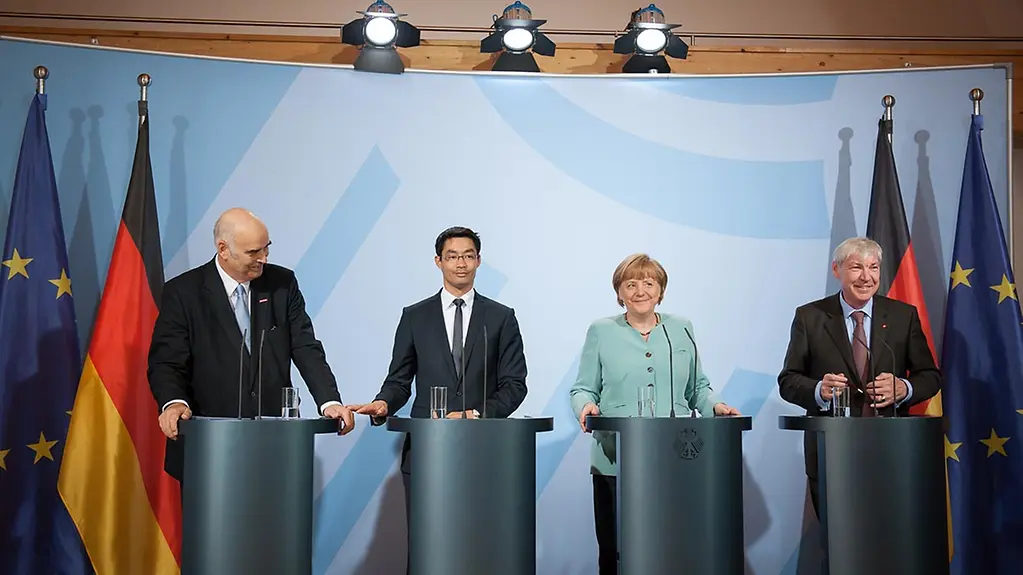
Otto Kentzler, President of the German Confederation of Skilled Crafts, Federal Economics Minister Philipp Rösler, Chancellor Angela Merkel and Michael Sommer, President of the German Confederation of Trade Unions
Photo: Bundesregierung/Bergmann
"These discussions are specifically geared to considering not only at our day-to-day work, but also to looking beyond these at the challenge the future seems likely to bring," reported Angela Merkel after the meeting.
Progress on attracting skilled specialists
In 2009 we first turned our attention to the problems of ensuring an adequate supply of skilled specialists, reported Angela Merkel. Progress has been made during the life of this government. Migrants can now have their foreign professional qualifications recognised more easily and the Blue Card system is in place, enabling highly qualified specialists from outside the European Union to live and work in the EU.
"How can we cope with the challenges of the modern working world and increasing demands for knowledge?" This was the issue discussed by the Chancellor and top-level representatives of major industrial associations and trade unions, as well as seven federal ministers. The meeting was held at the government guest house in Meseberg. It was the fourth meeting of this sort.
Demographic change
This year, participants discussed the challenges posed by demographic changes in the field of vocational training and the education system, said Angela Merkel. With a view to ensuring an adequate supply of skilled specialists, she said, "We must realise that we can actually extend people’s working life." There are very positive developments here.
To enable older people to exercise their profession for longer, additional measures must be taken into account. Angela Merkel mentioned in particular lifelong learning and health care. The number of people in unstable forms of employment must not rise in the long term.
Dual vocational training – a success story
Angela Merkel reported that education had been the second important point on the agenda – both dual vocational training (in which trainees split their time between school-based theoretical instruction and industry-based practical training) and university education. "We all agreed that the dual vocational training system is becoming increasingly important not only in Germany, but at international level." And that is a good thing, the Chancellor said. "It underpins our competitiveness and ability to innovate."
Flexible training systems
Participants also discussed the need for flexibility that would allow people to move from vocational training to tertiary education and vice versa. "There is still room for improvement here," said the Chancellor.
Universities are currently seeing a huge number of young people starting degree courses, she added. Things are set to change radically as of 2020. That makes it important firstly to train the people we really need. Engineer training is crucial here. Secondly, the surplus capacities of universities could be used to offer lifelong learning in the form of advanced training measures.
Digitalisation moves to the centre stage
Participants had agreed to look in more detail at the issue of digitalisation in future, the Chancellor reported. Deliberations on the development of smart factories were not central to discussions at this meeting, she said.