Germany/France
At a ceremony held at Reims Cathedral, Federal Chancellor Angela Merkel and French President François Hollande commemorated 50 years of friendship between France and Germany.
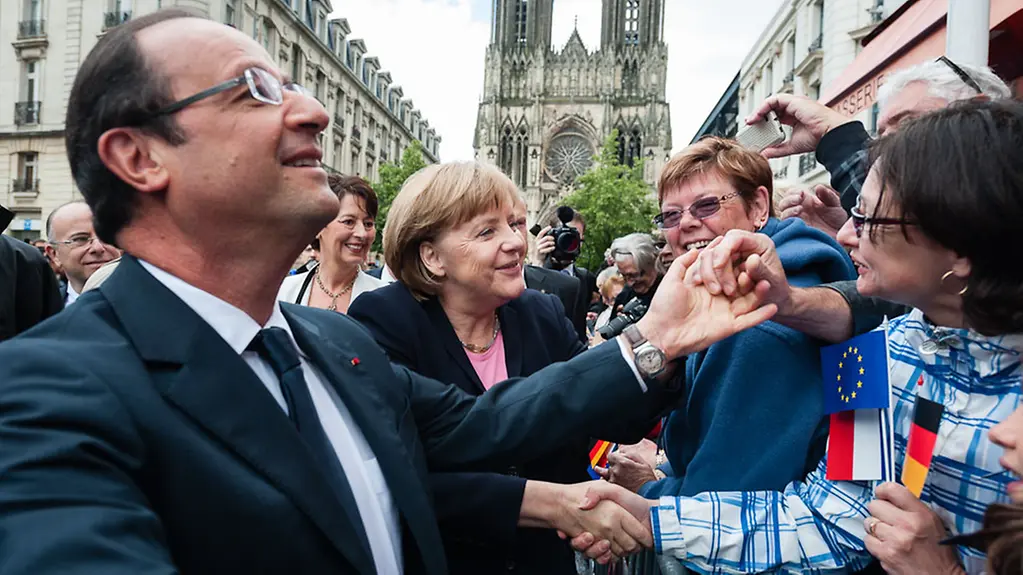
Merkel: "Europe is a lot more than a currency"
Photo: Bundesregierung/Kugler
In that same cathedral, Charles de Gaulle and Konrad Adenauer had celebrated a "mass of reconciliation" together on 8 July 1962, following the sufferings of two World Wars. Merkel and Hollande called for more political integration within the EU. Europe today faces a great challenge, the Chancellor said in Reims, which is located in Eastern France. The Economic and Monetary Union established 20 years ago is still not "strong enough", she stressed in light of the euro zone crisis. This is why it is important, she said, to put the "finishing touches on a political level of the economic and monetary union".
"It’s a herculean task, but Europe is up to it", the Chancellor declared. Hollande stressed the importance of a close cooperation between both countries, particularly in the context of the euro debt crisis. It could help overcome current challenges such as the defense of the common currency or the energy challenge.
50 years of Franco-German relations
The Chancellor paid tribute to the work of Konrad Adenauer and Charles de Gaulle in the reconciliation between the former enemies. The two statesmen began 50 years ago to construct the "edifice of Franco-German friendship", after a dark chapter of history.
The precious heritage of Franco-German friendship must be revitalized with each new generation. "United, we can face up to all challenges, to the benefit of our two peoples and to the benefit of Europe."

Merkel and Hollande celebrate the 50th anniversary of Franco-German reconciliation in Reims

Reims, 08.07.12: Mit einem Gedenkgottesdienst in der Kathedrale von Reims zelebrieren Merkel und Hollande die deutsch-französische Aussöhnung nach dem Zweiten Weltkrieg.

The celebration is „a wonderful symbol of the relationship of confidence which exists between our two countries and our two peoples”

Merkel: "Europa ist weit mehr als eine Währung."

Hollande: "Our friendship inspires Europe."

Fifty years ago, Federal Chancellor Konrad Adenauer went to France for a state visit.

Adenauer took part in a High Mass alongside French President Charles de Gaulle at Reims Cathedral.

Reims Cathedral is a symbol of Franco-German reconciliation.

The meeting between Adenauer and de Gaulle in the Reims Cathedral sealed the reconciliation between Germany and France after the Second World War.

A memorial plaque before the cathedral’s main entrance commemorates the historic event.
The visit in Reims is a prelude to the Franco-German Year, which will be officially launched in Ludwigsburg on 22 September. The ceremony marking the 50th anniversary of the signing of the Élysée Treaty on 22 January 2013 in Berlin and the 50th anniversary of the Franco-German Youth Office (DFJW) in July 2013 will be a few of its highlights.
Throughout the Franco-German Year, a wide variety of events and projects will be held, reflecting the diversity of Franco-German relations. The very strong ties between both civil societies, through which dedicated men and women laid the foundations for the rapprochement between the two states from 1945 onward, will be particularly highlighted. The youth in both countries, which rediscovers and revitalises this unique bilateral relationship with each generation, will be another major focus. With this anniversary year, Germany and France want to look back in thankfulness, but also to look together towards a common European future.
Franco-German reconciliation
Franco-German reconciliation began with Konrad Adenauer's visit to France from 2 to 8 July 1962. Charles de Gaulle made a return visit to Germany in September 1962. The cities of Bonn, Düsseldorf, Duisburg, Hamburg, Munich, Stuttgart and Ludwigsburg were on the program of this six day visit.
This was also when he held his famous speech to the German youth in the castle courtyard of Ludwigsburg. Its central message, according to which the task of the youth was to look beyond the trenches of the past toward a common future with its challenges, has not lost any of its relevance. This is why the governments of Germany and France have decided to make the commemoration of this historic moment the official launch of the Franco-German Year 2012/2013.
The Élysée Treaty
The French President's visit was followed by the signing of the Élysée Treaty on Franco-German cooperation by De Gaulle and Adenauer on 22 January 1963 in Paris. This foundation of Franco-German relations continues to shape the unique relationship between the two countries.
The signing of the Élysée Treaty, the Treaty of Friendship between Germany and France, on 22 January 1963 was a historical step. "The reconciliation of the German people and the French people, ending a centuries-old rivalry, constitutes a historic event which profoundly transforms the relations between the two peoples", the joint declaration by Konrad Adenauer and Charles De Gaulle read.
Among other things, the Élysée Treaty introduced a binding timetable for regular meetings at all levels. The idea was to make cooperation between the two countries a matter of course. New institutions came later, such as the Franco-German Fiscal and Economic Council, the Franco-German Environment Council and the Franco-German Defense and Security Council (DFVSR), which were all set up on the occasion of the 25th anniversary of the Treaty. The Franco-German Brigade was founded within the framework of the DFVSR and was itself the foundation on which the Eurocorps was established in 1993. The "Blaesheim process", through which the French President and the Federal Chancellor meet approximately every two months, is also a child of the Élysée Treaty.
Moreover, on the occasion of the 40th anniversary of the Treaty in 2003, the summits which were held twice a year until then were made into joint cabinet meetings (Franco-German Councils of Ministers) and both governments named a Commissioner for Franco-German Cooperation holding Cabinet rank. They are mandated by the Federal Chancellor and the French President to coordinate the activities surrounding the anniversary of the Élysée Treaty within the framework of the Franco-German year; on the German side, this function is fulfilled by Minister of State Michael Link from the Federal Foreign Office.