
Osaka, 28 June 2019: Shortly after 7 o'clock local time the Chancellor landed at the port city on the Japanese island of Honshu.

The G20 brings together the leading industrialised nations and emerging economies. Together they are home to two thirds of the world's population, generate 80 per cent of global GDP and account for three quarters of world trade.

Japan's Prime Minister Shinzo Abe greets Chancellor Angela Merkel. The Chancellor was happy to see the agenda drawn up by the host nation: Japan took on board some of the topics that Germany placed on the agenda during its G20 presidency in 2017.

Before the first working session the European partners (Germany, France, the UK, Italy, Spain, the Netherlands, the European Commission and the European Council) met for consultations.

Angela Merkel met with President Donald Trump to discuss bilateral issues and a number of international conflicts. The focus was on developments in Libya and in the Sahel states, the situation in eastern Ukraine, the USA's conflict with Iran and trade relations between Europe and America.

The first working session was dedicated to the "Global Economy" and "Trade and Investment". Before the session the Chancellor spoke with other summit participants.

The conference room in Osaka - the first day of the summit was dedicated to digitalisation, artificial intelligence and developing the global economy.

Since 1999, the G20 have met regularly at the level of heads of state and government to discuss financial and economic policy measures to stabilize the global economy.

On the sidelines of the summit, other bilateral meetings were held. Here the Chancellor is in discussion with Egyptian President Abdul Fattah al-Sisi.

The Chancellor also met with China's President Xi Jinping for bilateral talks.

"No nation can solve global problems alone," said Chancellor Angela Merkel in a video podcast before the summit. What is needed is joint solutions, to master major challenges. The G20 can be part of this.
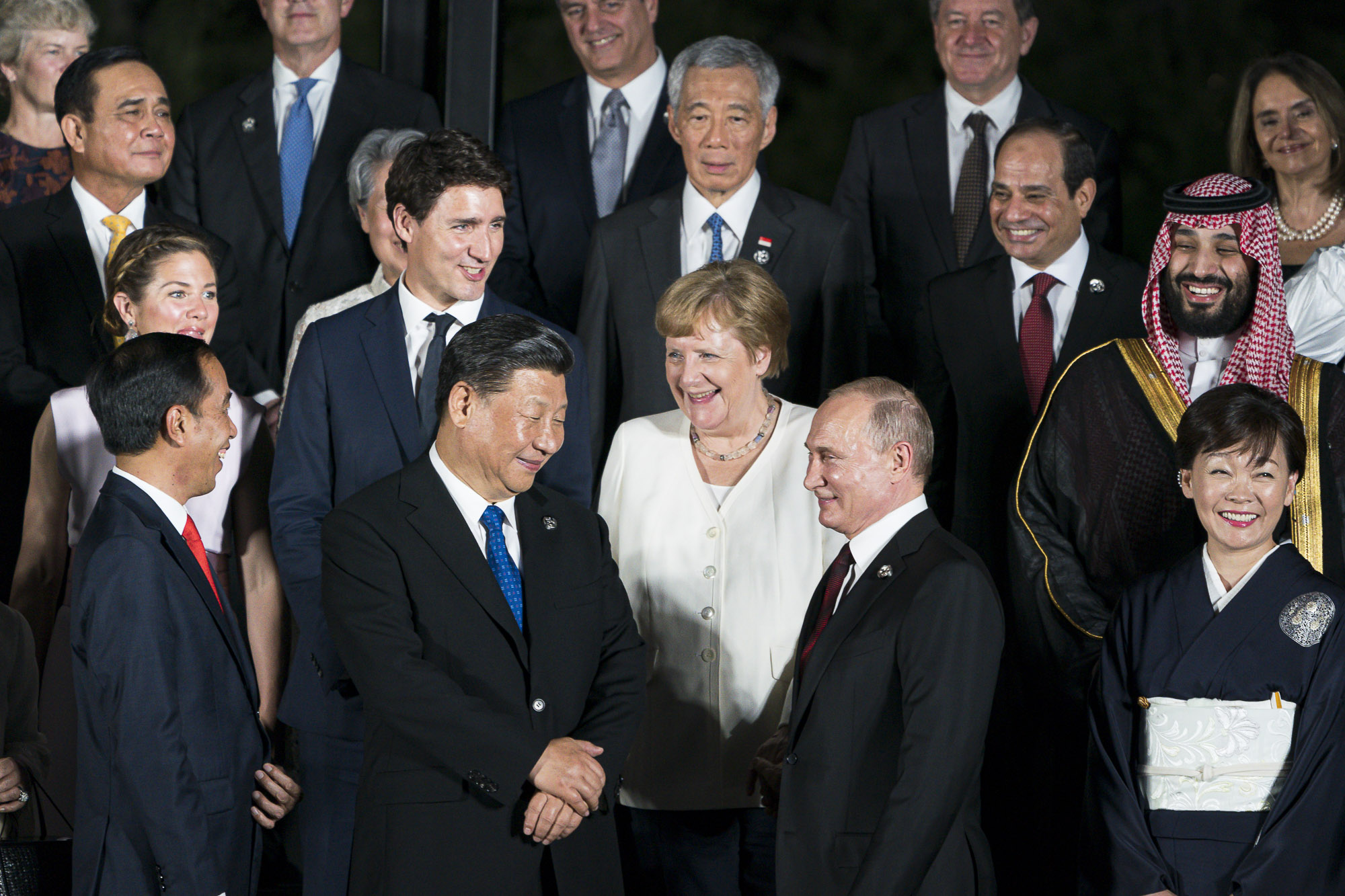
Angela Merkel summed up the first day of the summit. "All in all it has been a busy day so far." Japan focused strongly on digitalisation. The heads of state and government adopted a joint statement on the digital economy.

The second day's sessions were to concentrate on women's rights, sustainability and climate change. Between the sessions more bilateral meetings were held.

Osaka, 29 June 2019: The second day of the summit began with a meeting with Turkish President Recep Tayyip Erdogan. They discussed in particular the situation in Syria and the EU's support for more than three million Syrian refugees in Turkey.

After this, Chancellor Angela Merkel took part in an event to strengthen women. The main thing is "to enable women, especially in developing countries, to become better educated, to become part of the workforce, and thus to ensure their participation and gender equality," said Angela Merkel.

Agreement on a free trade deal between the EU and the South American Mercosur states (Argentina, Brazil, Paraguay and Uruguay) is a major achievement. Negotiations on the agreement, which could result in the largest free trade area in the world, began 20 years ago.

Russian President Vladimir Putin also met with the Chancellor on the sidelines of the G20 summit.

Sending a signal for climate action: the UK, France, Chile, Germany, the Netherlands and Spain have committed to achieving carbon neutrality by 2050. Chile is to host the next United Nations Climate Change Conference.

Differences of opinion on climate policy in particular stood in the way of a swift final statement. After hours of negotiation a compromise was finally found.

At the press conference following the two-day summit, Chancellor Angela Merkel announced that participants had managed to achieve "a 19 to 1 statement in which the 19 signatory states of the Paris Agreement commit to the same things as in Buenos Aires". The USA accepted that the other states reaffirm their commitment to climate action in the statement.