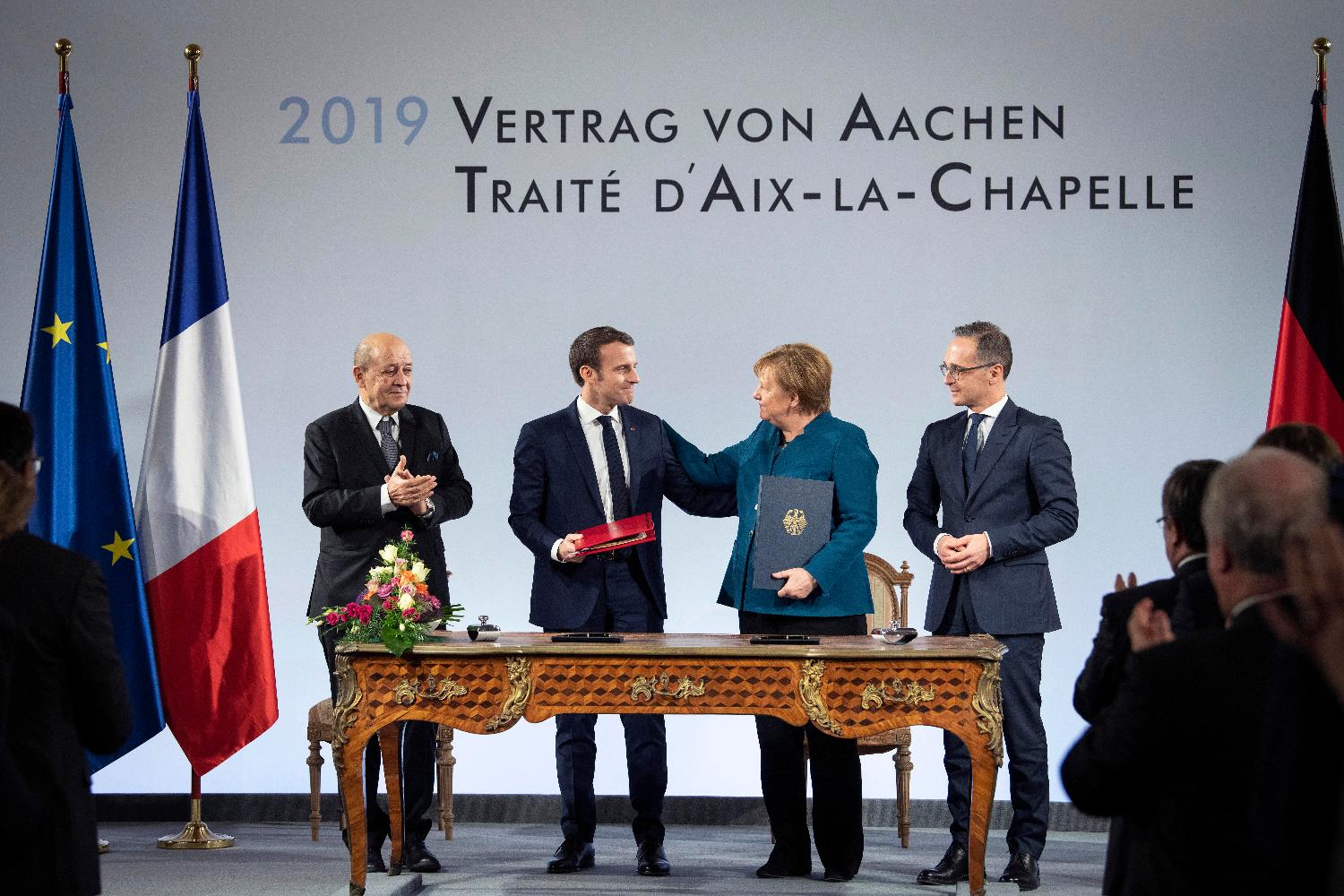
2 January: The Treaty of Aachen. 56 years after the Elysée Treaty was signed, Chancellor Angela Merkel and President Emmanuel Macron signed a new Franco-German friendship treaty - the Treaty of Aachen. The two countries intend to coordinate their actions even more closely in the fields of European, foreign and security policy and put in place an economic area with common rules and regulations.

28th January: Concerted Action on Nursing. 10 per cent more trainee nurses, no fees for nursing training, appropriate remuneration for trainee nurses. Those are only a few of the many objectives of the Concerted Action on Nursing launched by Federal Family Affairs Minister Franziska Giffey, Federal Health Minister Jens Spahn and Federal Health Minister Hubertus Heil. Parents ought to be able to advise their children to take up a career in nursing with a good conscience.

16 February: Since 1963, representatives of the worlds of politics, business, science and research and the military have met at the Munich Security Conference. The 55th conference brought together 600 security policy experts, including 35 heads of state and government and 80 foreign affairs and defense ministers. Chancellor Angela Merkel called for the preservation of the liberal world order.

3 March: The Chancellor visits Chemnitz. In summer 2018 a killing followed by anti-foreigner demonstrations made the city the focus of media attention. The city has since launched a campaign to demonstrate that it is neither a nonentity nor a pocket of right-wing extremism. Chancellor Angela Merkel went to see herself with Saxony's state premier Michael Kretschmer. She took part in a discussion with readers of the newspaper "Freie Presse" and watched the youth team of the NINERS basketball team train.

16 April: The largest offshore wind farm in the Baltic opens. 25 kilometers north east of Rügen, the largest offshore wind farm in the German Baltic Sea went online. It has an installed capacity of 385 Megawatt, enough to supply 400,000 households. Renewable energy has now moved from a niche to the centre stage of power supply said the Chancellor at the official opening.

23 May: 70th anniversary of the German Basic Law or constitution. In Karlsruhe, the Federal Constitutional Court and leading representatives of the German state celebrated the round birthday with the people. The German government was there. The celebrations marked the start of a country-wide information tour. At state-level celebrations, members of the public had a chance to speak with federal government staff, and were given a special edition of the German Basic Law to take home with them.
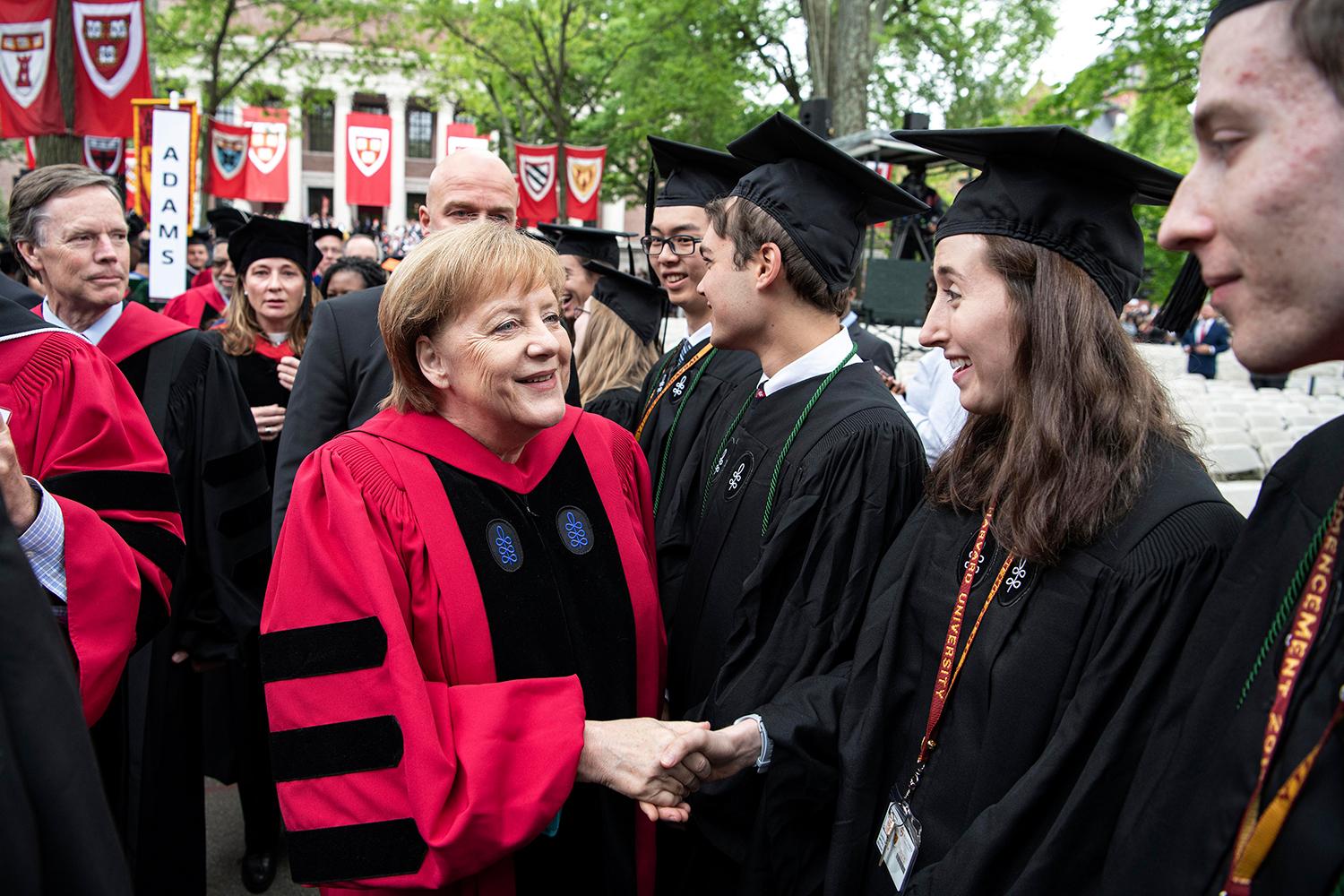
30 May: The Chancellor gave a speech at Harvard University, Massachusetts, USA. In it she advocated international cooperation and mutual respect. She called for joint action and exhorted her audience to think in terms of international contexts. Lies must not be called truths and truths must not be called lies - that was her message to students. She was awarded an honorary doctorate from Harvard Law School.

2 June: Walter Lübcke is murdered. The president of Kassel's municipal government was shot in the back outside his house. "The murder of Walter Lübcke is not only a dreadful crime, but also demands that we look at all levels where there could be extreme right-wing tendencies. Otherwise we will lose all credibility. And that is obviously exactly what we do not need. We need trust," said Angela Merkel at the annual convention of the German Protestant Church.

27 June: Katarina Barley hands over to Christine Lambrecht. Following her election to the European Parliament, Federal Minister of Justice Katarina Barley left the German Cabinet. She was followed by Christine Lambrecht, former Parliamentary State Secretary at the Federal Ministry of Finance. Federal President Frank-Walter Steinmeier presented them with their certificates of discharge and appointment, as Chancellor Angela Merkel watched.

28/29 June: G20 summit in Osaka - After long meetings, the negotiators agreed on a compromise: a 19+1 declaration for climate action. 19 states committed to fully implementing the Paris Agreement on climate change. The USA accepted this and, in spite of withdrawing from the Paris Agreement, stressed that it would be actively engaged in reducing CO2 emissions.

16 July: Ursula von der Leyen elected President of the European Commission. The European Parliament elected Ursula von der Leyen to the post of President of the European Commission. She had served as German Cabinet minister since 2005, firstly as Federal Minister for Family Affairs, then as Federal Minister of Labour and latterly as Federal Defence Minister. On 2 December she and the new Commission will begin their work, which will be dominated by the imperatives of climate action.

24 July: Annegret Kramp-Karrenbauer sworn in as Federal Defence Minister. In her first government statement in front of the German Bundestag she spoke of her respect for the work of solders and Bundeswehr staff. She affirmed her commitment to Germany's place in NATO and to the goal of raising the defense budget to 1.5 per cent of GDP (gross domestic product) by 2024.

17/18 August: The German government's open day. More than 100,000 visitors attended this summer. The traditional highlight is the tour of the Federal Chancellery with the Chancellor. But there was lots more on offer: a Bundeswehr helicopter in the grounds of the Federal Chancellery, GSG9 troops jumping from a height of 2000 meters, and Bundeswehr dogs demonstrating how they respond in emergencies. One highlight in the Federal Press Office was the children and youth press conference with federal government spokesperson Steffen Seibert.

29 August: WorldSkills championship in Kazan - 2 gold, 3 bronze, 19 medallions for excellence and a world champion in speed programming. Tile layer Janis Genter from Baden Württemberg and carpenter Alexander Bruns from Rheinland-Pfalz, both aged 21, demonstrated world class skills in the Russian city of Kazan. The gold medal winners were invited to visit the Chancellor at the Federal Chancellery on 2 December.

8 September: The 100th anniversary of Bauhaus, which has lost none of its fascination. Bauhaus ideas, architecture, art and design still influence how we live, build and design things today said Chancellor Angela Merkel at the opening of the newly built museum in Dessau.

9 October: German government gets climate action rolling. By 2030, Germany intends to cut greenhouse gas emissions by at least 55 per cent. The German government is the first in the world to lay down binding national climate action goals. By 2050 Germany is to achieve greenhouse gas neutrality. To this end a higher tax will be introduced on air travel in 2020, CO2 emissions will be priced and fossil fuels will become more expensive. In return, VAT on long-distance train travel will be reduced to 7 per cent as of 2020, and measures will be taken to make electric mobility more attractive.

9 October: An attack on a synagogue in Halle. A heavily armed man tried to force his way into a synagogue in Halle (Saxony-Anhalt) using firearms. 70 or 80 people were in the synagogue at the time, celebrating the most important Jewish holiday, Yom Kippur. When he was unable to force the doors, he fired at a nearby kebab restaurant. Two people were killed in the attack. Federal Minister of the Interior Horst Seehofer said that Germany had made a pledge to the entire world after the Second World War - "Never again!". At this time, he said, we are deeply committed to upholding our pledge. The decline in moral standards demonstrated by online hate speech must be stopped, as this is the first step on the way to violence.

9 November: The 30th anniversary of the fall of the Berlin Wall - an anniversary that was celebrated in Germany. Yet in spite of all the joy that Germany is reunited, we must never forget the November pogroms in 1938. The ninth of November is a fateful day for Germans, that combines elation with pain. It is a day that reminds all Germans to stand up against hatred, racism and anti-Semitism.
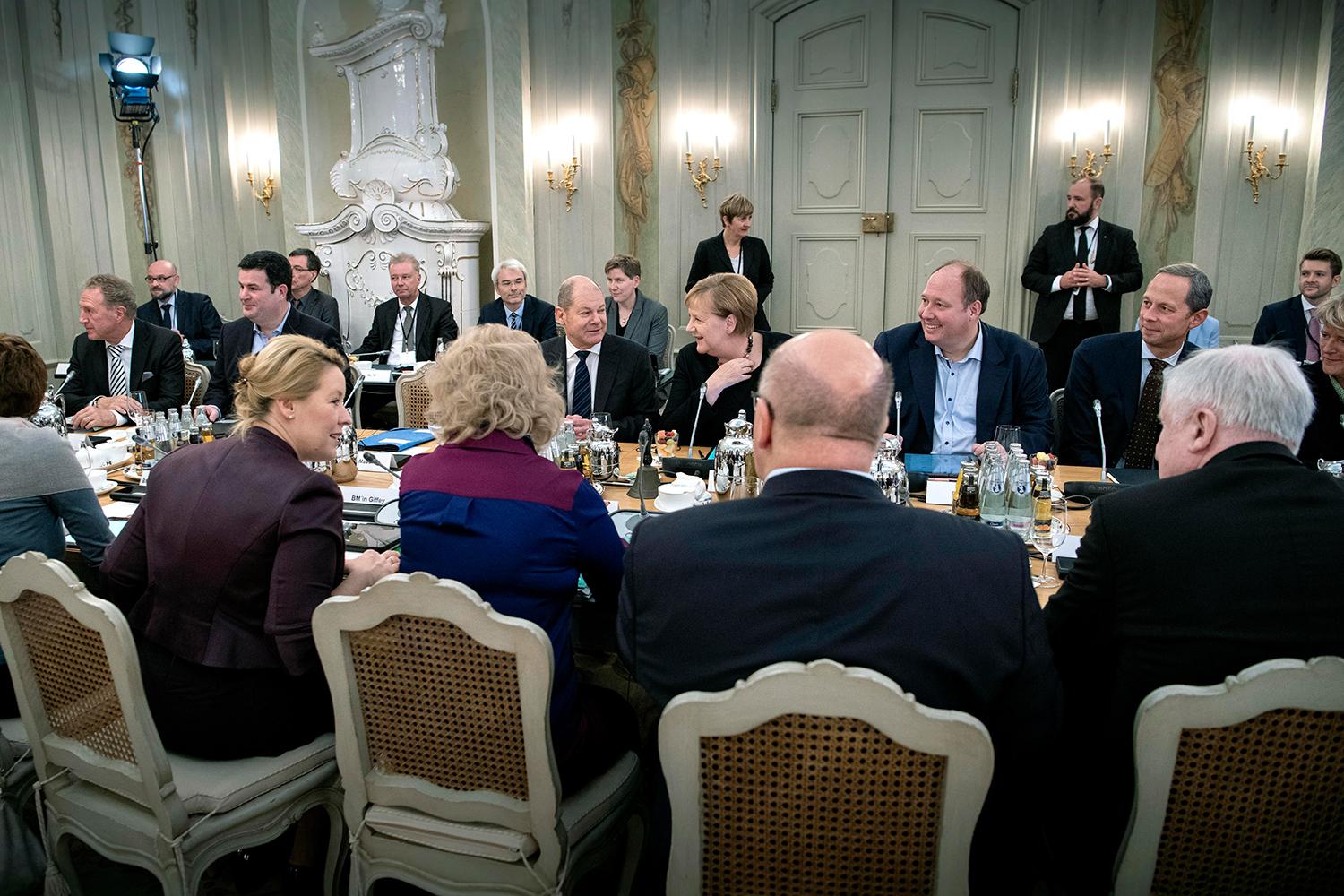
20 November: Cabinet retreat at Schloss Meseberg. Ten million electric vehicles are to be on the road by 2030. Some 1.1 billion euros to be made available for new mobile communications locations. All state administrative services to be digitalised by 2022. At a retreat in Meseberg, the German government adopted projects and strategies to make Germany fit for the digital future.

4 December: 70th anniversary of the founding of NATO. In London NATO leaders issued a joint declaration, which expressed their commitment to the transatlantic partnership, and saw space and defence against cyber attacks as new challenges. NATO aims to adopt a policy of both deterrence and dialogue with Russia.

6 December: The Chancellor visits Auschwitz. In the former German concentration camp in Auschwitz, Chancellor Angela Merkel paid tribute to the millions of victims of the Holocaust. She was invited by the Auschwitz-Birkenau Foundation. "I feel a deep shame in the face of the barbaric crimes perpetrated by Germans here," declared the Chancellor.

11 December: At the Federal Chancellery, the Chancellor met the families of Bundeswehr soldiers and police officers currently serving overseas. It is hard to do without a member of the family, she said, especially at Christmas. Currently some 4,000 soldiers and about 100 police officers from Germany are serving around the world, including in Afghanistan, Mali, Ukraine, Moldova, Kosovo and in the Sahel region.