
Tokyo, 28 April 2022: Federal Chancellor Scholz travels to Japan. Arrival at Tokyo Haneda airport.

Japan is the third largest economy in the world after the US and China. Like Germany, it is an industrial nation.

The visit began with a visit to the German-Japanese Business Dialogue conference. Although the volume of trade between Germany and Japan recovered slightly in 2021 after the pandemic decreased, it has not yet returned to pre-pandemic levels.

“These recent developments – debt crises, states isolating themselves, inflation, war – show us that free trade, fair competition and open markets cannot be taken for granted,” said Federal Chancellor Scholz in an appeal for globalisation to be smarter, more sustainable and more supportive.

The Federal Chancellor was received with military honours at the Kantei, the official residence of Prime Minister Fumio Kishida.

Before meeting his counterpart, Federal Chancellor Scholz said he was delighted to receive Prime Minister Kishida's invitation and he was looking forward to their talks.
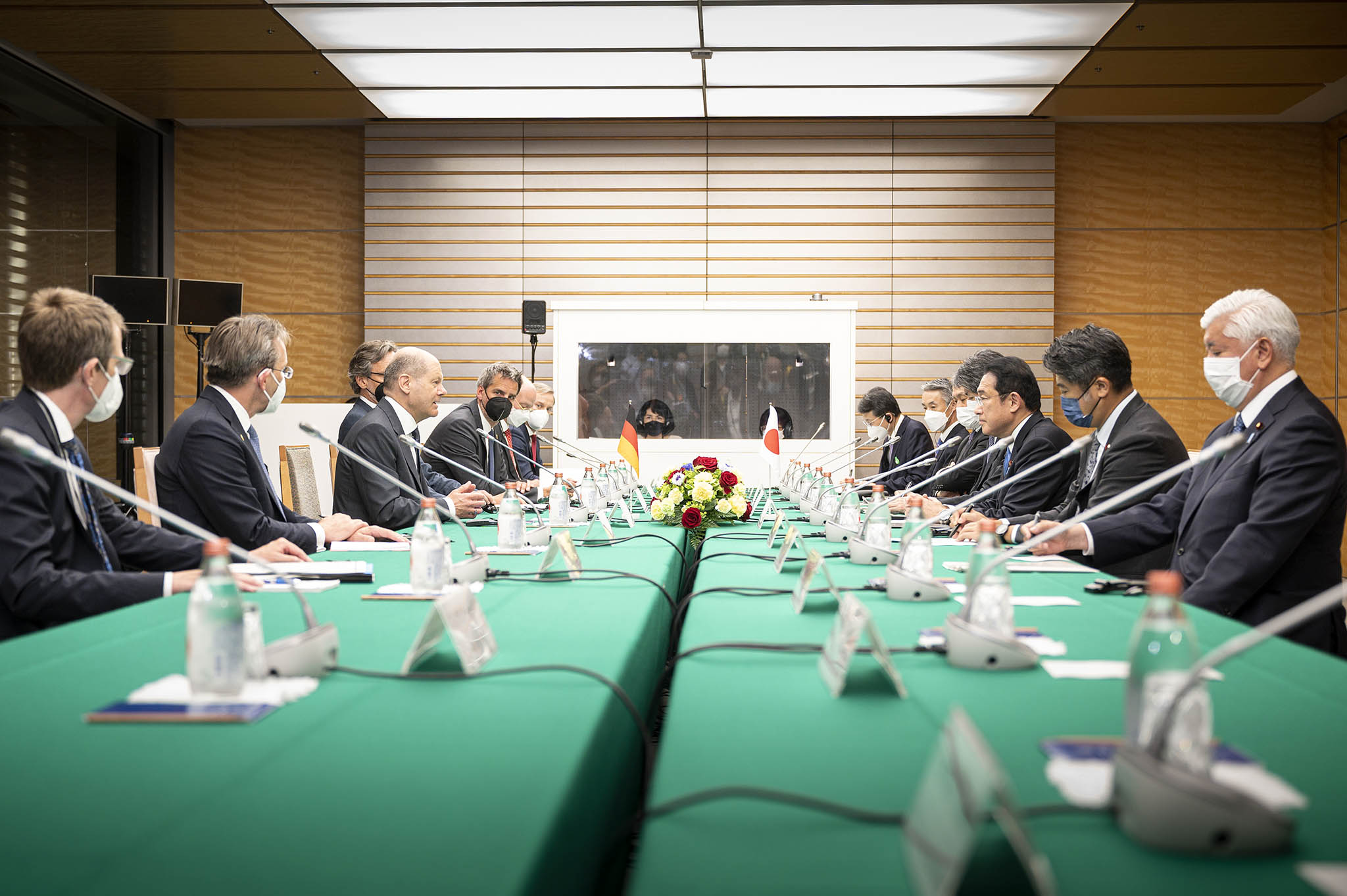
Scholz: At the present time our good relationship is shaped by our close collaboration within the G7 and our condemnation of Russia’s invasion of Ukraine.

At the subsequent press conference, the two leaders underlined their close cooperation, not only in supporting Ukraine but also on other political issues.

Scholz explained the two leaders had agreed to intensify and enhance their bilateral relationship by holding regular government consultations starting next year.

Kawasaki, 29 April 2022: On the second day of his trip, Federal Chancellor Scholz still had time to visit the Toa Keihin refinery, a short distance outside Tokyo, before flying back to Germany. A hydrogen generation plant belonging to the Chiyoda Corporation is located at the facility.

The business uses a process that combines hydrogen with a solvent. This allows it to be transported in conventional containers and cargo ships. Later the hydrogen can be separated from the solvent and used by industry.