The case of Alexei Navalny
"Far removed from rule-of-law principles" – the German government’s verdict on the sentence imposed by a Moscow court on Russian opposition leader Alexei Navalny.
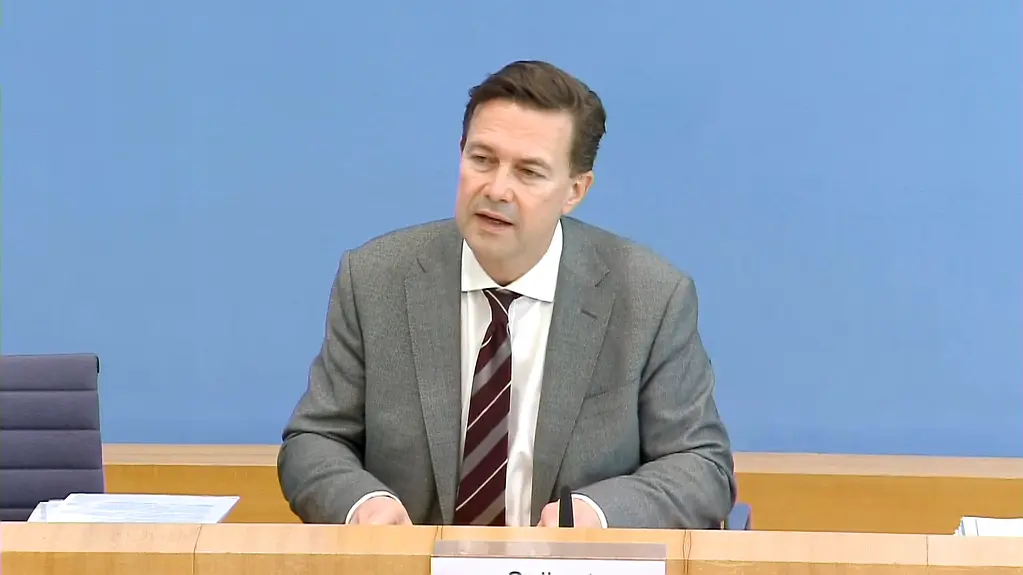
State Secretary Steffen Seibert at the Federal Press Conference
Photo: Presse- und Informationsamt der Bundesregierung
At the government press conference on Wednesday, speaking on behalf of the Chancellor, federal government spokesperson Steffen Seibert strongly condemned the three and a half years prison sentence handed down to Alexei Navalny on Tuesday. "Yesterday’s ruling against Alexei Navalny is far removed from rule-of-law principles," he underscored.
It is based on a ruling which the European Court on Human Rights classed as "arbitrary" and a contravention of the right to a fair trial in 2017.
Russia must comply with international commitments
The federal government spokesperson stated clearly, "As a member of the Council of Europe, Russia has undertaken to comply with the European Convention on Human Rights and to implement the decisions of the European Court of Human Rights." That is why the German government – "and the Chancellor personally" – call for Alexei Navalny to be freed.
Ensuring fundamental rights in Russia
The Russian leadership must also guarantee Russian citizens their right to freedom of expression and freedom of assembly, continued Steffen Seibert. He pointed to the "appalling examples of police brutality" and "police violence against peaceful and unarmed demonstrators". He stressed, "The German government condemns this systematic use of force."
With a view to the poison attack on Alexei Navalny in Siberia in August 2020, Steffen Seibert outlined what the German government expects of Russia, which is "that it complies with the Chemical Weapons Convention and that it investigates the circumstances surrounding the chemical weapons attack on Mr Navalny on Russian soil".
It is not acceptable "that the victim of a chemical weapon attack is behind bars as a result of an arbitrary ruling, while the perpetrators of the attack against him have not been brought to justice," said Steffen Seibert.
The Russian opposition leader and internet journalist Alexei Navalny was conducting research in Siberia, when he collapsed on a domestic flight in August 2020. After an emergency landing in Omsk he was treated for symptoms of poisoning. 48 hours later, he was flown out of Russia, in a coma, to Berlin’s Charité Hospital. Several specialised laboratories in Europe identified a banned military nerve agent of the Novichok group as the cause of poisoning. After several weeks in a coma, Navalny remained in Germany for rehabilitation measures. On 17 January 2021 he returned to Moscow, where he was arrested at the airport.