65th Berlin International Flm Festival
The 65th Berlinale got off the ground with Isabel Coixet’s film about a courageous woman who tracks her husband to the icy wastes of the North Pole. For eleven days the film festival will be showcasing the best the film world has to offer with world premieres, cinematic highlights and a large number of political films, which Minister of State Monika Grütters welcomed at the opening ceremony.
4 min reading time
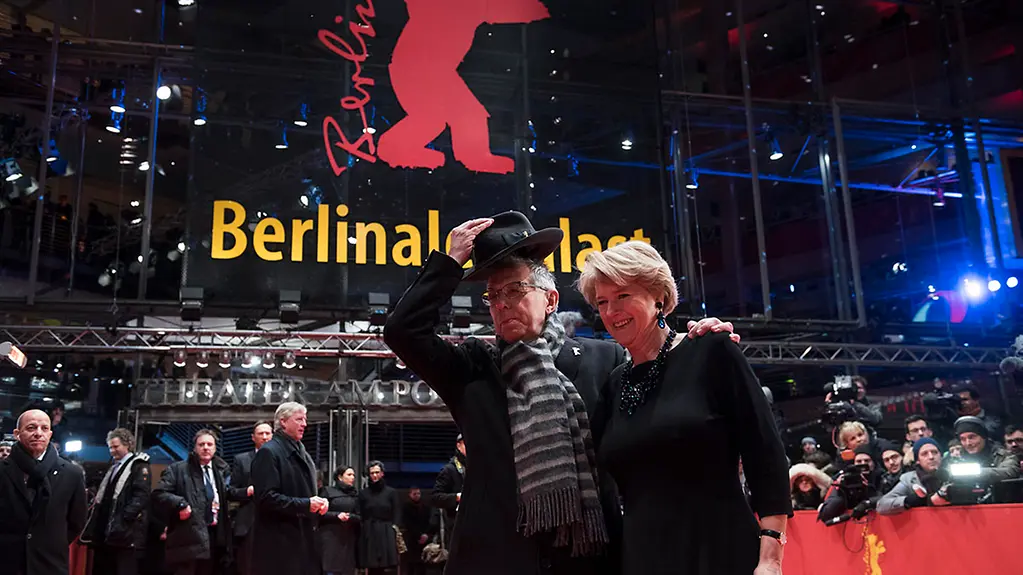
Festival Director Dieter Kosslick and Minister of State Monika Grütters hosted the opening ceremony
Photo: Bundesregierung/Bolesch
"Let us look forward to a Berlinale which I am sure will surprise us again this year with incredible and untold tales and new perspectives." With these words, Federal Government Commissioner for Culture and the Media Monika Grütters opened the 65th film festival in the Berlinale Palast in front of an audience of film makers, stars and fans from around the world.
A festival of artistic liberty
"Only one year ago we could not have imagined how brutal the threat to artistic liberty can be – even here in Europe," said Monika Grütters. The attacks in Paris reminded us that liberty also needs courageous advocates and passionate defenders in places where we thought it was safe.
Art and culture can build bridges in places where diplomacy and politics have their limits, declared Monika Grütters with conviction. And she stated with admiration, "The Berlinale has always been political, from the very outset." This year too, as it turns 65, it is making a political mark, said the Minister of State delightedly.
Around the world in eleven days
Isabel Coixet’s adventure film "Nobody wants the Night" kicked off the festival which will take its audiences around the world in eleven days. The Competition embraces 19 productions which are competing for the prestigious Gold and Silver Bear awards; four films are being shown outside the Competition. Germany’s film industry is represented with four productions.
An international jury headed by the American director, scriptwriter and producer Darren Arnofsky will select the winners. The jury also includes the actors Daniel Brühl and Audrey Tautou and the scriptwriter, director and television producer Matthew Weiner, along with the directors Bong Joon-ho from South Korea and Claudia Llosa from Peru, and the American producer Martha De Laurentiis.
Berlin firmly in the grip of film fever
This year as every year the Berlinale will draw in not only the professionals, but also fans to watch and wonder. A total of 441 films are on the programme, divided into nine sections and several special presentations. The special presentation "Berlinale goes Kiez" with its Flying Red Carpet in particular will ensure that the entire city is caught up in Berlinale fever.
The Retrospective this year ensures a genuine firework display of colour films. It is showing about 30 spectacular Technicolor films, some of which have been painstakingly restored, including "Singin' in the Rain" and "Gone with the Wind ".
Television on the big screen
For the first time ever the film festival will also be showing television series from the USA, Europe and Germany on the big screen. "The Berlinale is a festival for the public at large and thus the right place to present to our visitors the best and most exciting series and to give them the opportunity to experience these within the scope of the festival," declared Festival Director Dieter Kosslick with conviction.
By contrast the "Berlinale Talents" has been an integral part of the festival for some time. 300 promising young film makers have been invited again this year to rediscover film as a multidimensional spatial artwork under the title "A Space Discovery". The Talent Campus offers a good opportunity for networking and a forum for industry experts to engage with one another.
A meeting place for the film industry and a film market
But this is still not all the Berlinale has to offer. The European Film Market, which takes place every year during the film festival, is one of the largest markets of its kind anywhere in the world. The first diary date in the year for the film industry, it is one of the most important platforms for the trade in films and audio-visual materials. Producers, distributors, purchasers and sellers, financers and representatives of the television, home entertainment and new media sectors make the most of this opportunity to find out about the latest productions and developments in the global film landscape, to trade in film rights and to establish and refresh contacts.
Since 2001 the Berlin International Film Festival has been part of the cultural events of the German government in Berlin, and the German government sponsors the event to the tune of 6.5 million euros, from the budget of the Minister of State and Federal Government Commissioner for Culture and the Media.