Merkel receives Tunisian Prime Minister
The Chancellor has described the transformation process in Tunisia as a great success. The country has made great efforts on the path to democratisation, she said during Tunisian Prime Minister Jomaâ’s visit. Both countries want to strengthen their relations
4 min reading time
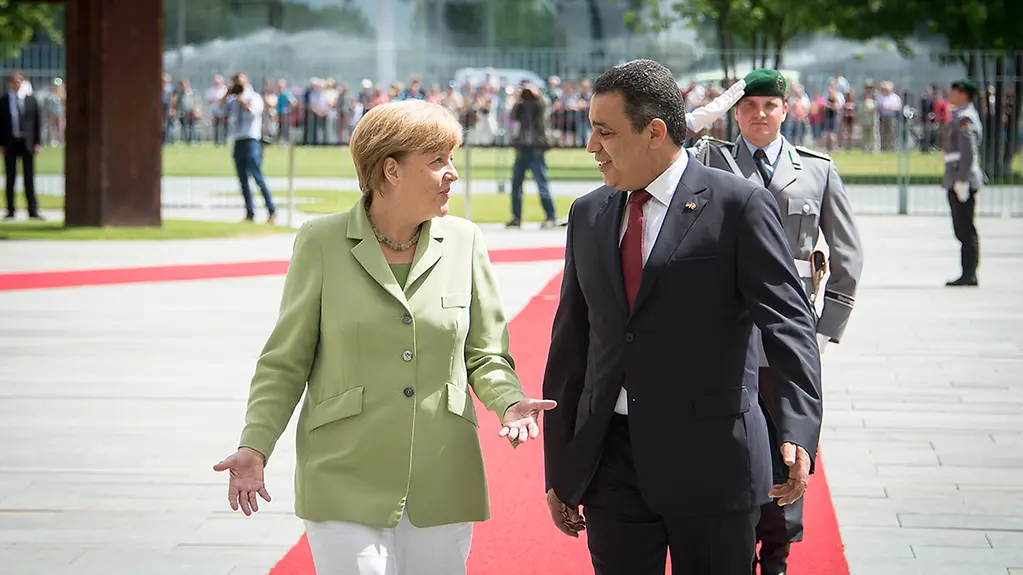
Merkel: Create more incentives to invest in Tunisia
Photo: Bundesregierung/Bergmann
Following the talks the Chancellor seemed pleased that Jomaâ accepted her invitation to visit Germany. She praised the country’s democratic progress and announced that a workshop involving the State Secretaries of both countries is to be held on 19 June. This will be followed by an economic forum. Merkel added that there were already 250 German companies operating in Tunisia, but said it was necessary to create more incentives to invest in the country.
The Prime Minister too appealed for further investment in his country and thanked Germany for its assistance to date. He stressed that additional German investors were always welcome in his country at any time. He added that his country wants to be a high-tech hub and a partner of Europe in the future, but also a platform for trade, as Tunisia is also part of Africa and the Arab world.
Jomaâ thanked Germany for its support in his country’s transformation process. One of this process’s successes is the constitution – a “beautiful baby” has been born, said the Prime Minister. Since then, he said, progress has been so marked that free elections could be held by the end of the year. These would be open elections to which international election observers would be warmly welcomed, too, he added.
In September 2012 Germany and Tunisia strengthened their close cooperation within the framework of the Transformation Partnership. This is about Germany helping Tunisia improve its economic and social living conditions. The projects relate, in particular, to vocational training, the energy industry, the reform of the justice system, as well as promoting the rule of law and good government leadership, civil society and professional media.
Establishing an Academy of Good Governance
Germany and Tunisia are also working together in the areas of education, training and good governance. Merkel offered to establish a German-Tunisian Academy of Good Governance in Tunisia. Jomaâ suggested establishing a joint university in his country in the future.
Both heads of state applauded the renewed increase in the number of German tourists visiting Tunisia. This has not, however, reached a pre-Arab Spring level. In this respect Jomaâ said that there has not been a terrorist attack against tourists in Tunisia in years. He added that every effort would be made to ensure this remains the case.
Border security with Libya
Tunisia’s nearly two million Libyan refugees are a great challenge for the country. For this reason, it is important to strengthen security along the Tunisian-Libyan border to prevent the infiltration of terrorist forces from Libya, said Merkel. Germany will do everything in its power to help the country with this issue, she added.
This help could be in the form of assistance with training the border police or provision of equipment like protective vests, Merkel continued. Swift action is required on this, she stressed. Experts on both sides would be holding talks on the matter from 19 June onwards, she said.
Building on existing relations
The Federal Republic of Germany and Tunisia have maintained mutual relations since the 1950s. The Federal Government has supported the country in its transition to democracy since the revolution on 14 January 2011. The principal instrument of this support is the Transformation Partnership, which granted funding totalling over 50 million euros to more than 100 projects in Tunisia in 2012 and 2013.
The actual implementation of this partnership at State Secretary level is also the focus of discussions at the second round of the German-Tunisian State Secretary consultations in the Federal Foreign Office on 19 June. These were initiated by the Chancellor and the then Tunisian Prime Minister back in 2012. The German-Tunisian economic forum also forms part of the bilateral relations.
On the path towards a democratic future
With the adoption of its new constitution on 27 January 2014, Tunisia set its course towards a democratic future. The constitution forms the basis of a civilian democratic state and covers guaranteed basic rights and basic freedoms such as equality between men and women.
Mehdi Jomaâ was appointed Minister for Industry under Prime Minister Hamadi Dschebali on 13 March 2013. Prior to that he was active in private business. On 15 December 2013 the national dialogue between the government and the opposition, which was established following the murder of left-wing Member of Parliament Mohamed Brahmi, appointed Mehdi Jomaâ as transitional Prime Minister. On 9 January 2014 Jomaâ took up office as Prime Minister.