- E-mail, Federal Chancellor Scholz visits the Balkans, Greece and Bulgaria
- Facebook, Federal Chancellor Scholz visits the Balkans, Greece and Bulgaria
Share the article
- E-Mail E-mail, Federal Chancellor Scholz visits the Balkans, Greece and Bulgaria
- Facebook Facebook, Federal Chancellor Scholz visits the Balkans, Greece and Bulgaria
- X X, Federal Chancellor Scholz visits the Balkans, Greece and Bulgaria
- Threema , Federal Chancellor Scholz visits the Balkans, Greece and Bulgaria
- WhatsApp share via Whatsapp, Federal Chancellor Scholz visits the Balkans, Greece and Bulgaria
Pristina, 10 June 2022: Federal Chancellor Olaf Scholz was welcomed at the airport in the Kosovan capital by Prime Minister Albin Kurti.
In addition to Kosovo, the Federal Chancellor also visited Serbia, Greece, North Macedonia and Bulgaria in the course of his two-day trip.
Talks with Prime Minister Kurti also focused on Kosovo’s prospects for joining the EU. It was important for the EU-led dialogue between Kosovo and Serbia to move forward, said the Federal Chancellor.
“It is inconceivable for two countries that don't recognise each other’s existence to become members of the EU,” said the Federal Chancellor.
Afterwards, Federal Chancellor Scholz went on to visit the KFOR base in Film City to gain an impression of the work being done there by the German contingent.
The NATO-led KFOR (Kosovo Force) has ensured security and stability in the region ever since the end of the Kosovo war in 1999. During his visit, he thanked the soldiers in person.
In Belgrade, Federal Chancellor Scholz is received by Serbian President Aleksandar Vučić.
It was already clear that Russia’s war against Ukraine was a terrible, senseless war instigated in pursuit of an imperialist vision of Russia, said Scholz at the meeting in Belgrade. “This is why it is so important for the European Union and for all of us to stand in solidarity with Ukraine and help it defend itself against this attack.”
For the Federal Chancellor, this “naturally includes sanctions against Russia. Our expectation is that these sanctions will be supported by all those countries who are candidates for EU accession,” said Scholz in an appeal to the Serbian President.
In the evening, the Federal Chancellor was expected in Thessaloniki by Greek Prime Minister Kyriakos Mitsotakis.
Here he attended a dinner held for participants of the South-East European Cooperation Process. The regional initiative has 13 member states.
Thessaloniki, 11 June 2022: Day 2: From the city in northern Greece, the journey continued to North Macedonia.
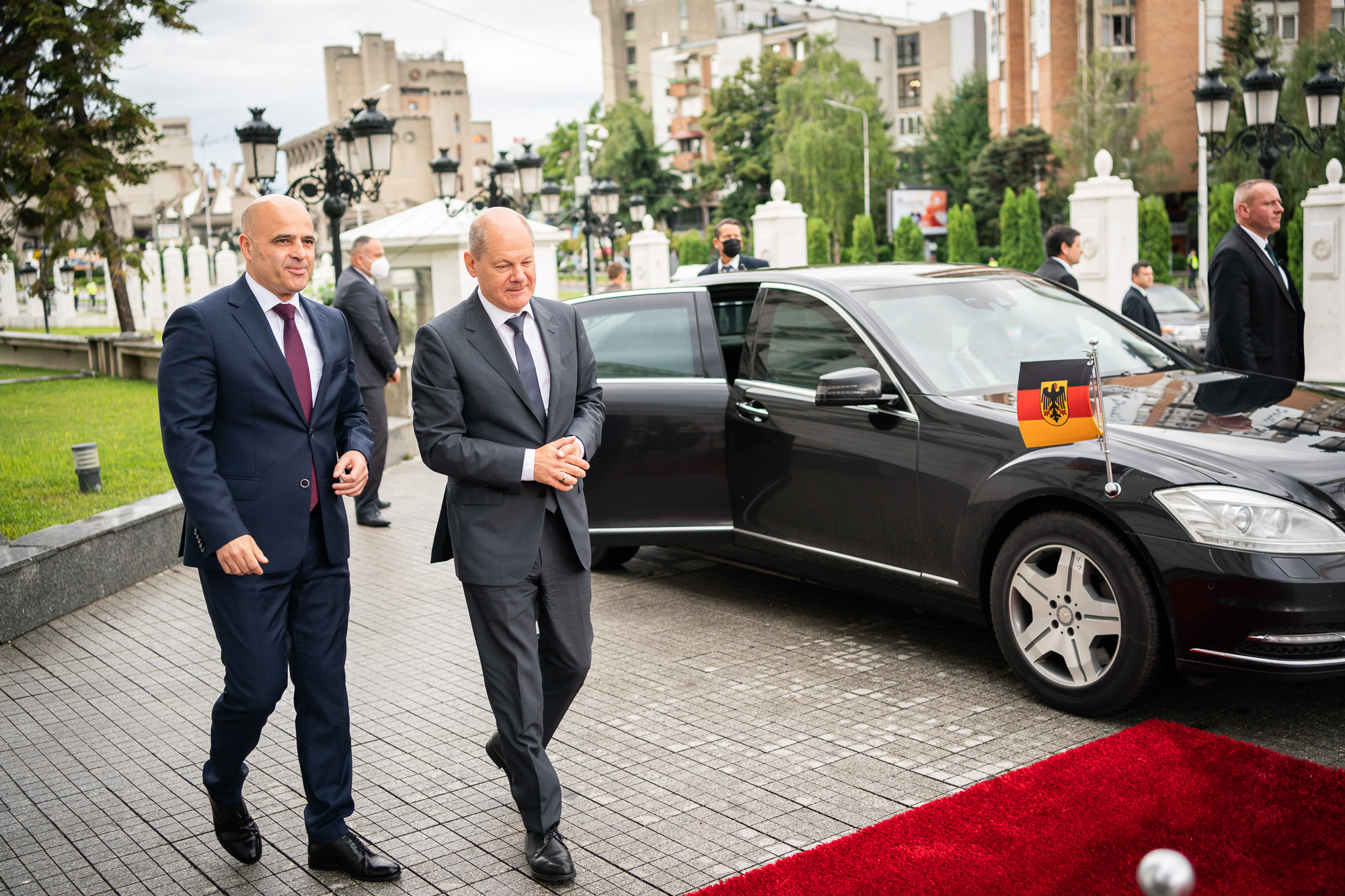
He was welcomed by Prime Minister Dimitar Kovačevski at the latter’s official residence in Skopje.
“Germany is serious about integrating the states of the Western Balkans in the EU,” said Federal Chancellor Scholz during his visit – and this applied especially to North Macedonia, he added.
“I would also like to express my appreciation for the fact that North Macedonia fully supports the EU’s positions and actions towards Russia,” said Scholz. “This is further proof of how firmly North Macedonia supports European values and is prepared to stand up for them, too.”
The last stop on his trip took Federal Chancellor Scholz to Sofia. At the airport, he was greeted by the head of the Prime Minister’s cabinet, Lena Borislavova.
He was aware that European enlargement was an important issue for Bulgaria too, said the Federal Chancellor during his visit, and that it had naturally triggered many questions and discussions – all of which was a natural part of the process.
Scholz said he firmly believed that “we Europeans bear a joint responsibility for the European Union and for stability in the Western Balkans”. It was important to use the current enlargement process to the benefit of Europe, said Scholz, and to demonstrate the solidarity of the European Union – something that was especially important at the present time.
Pristina, 10 June 2022: Federal Chancellor Olaf Scholz was welcomed at the airport in the Kosovan capital by Prime Minister Albin Kurti.
In addition to Kosovo, the Federal Chancellor also visited Serbia, Greece, North Macedonia and Bulgaria in the course of his two-day trip.
Talks with Prime Minister Kurti also focused on Kosovo’s prospects for joining the EU. It was important for the EU-led dialogue between Kosovo and Serbia to move forward, said the Federal Chancellor.
“It is inconceivable for two countries that don't recognise each other’s existence to become members of the EU,” said the Federal Chancellor.
Afterwards, Federal Chancellor Scholz went on to visit the KFOR base in Film City to gain an impression of the work being done there by the German contingent.
The NATO-led KFOR (Kosovo Force) has ensured security and stability in the region ever since the end of the Kosovo war in 1999. During his visit, he thanked the soldiers in person.
In Belgrade, Federal Chancellor Scholz is received by Serbian President Aleksandar Vučić.
It was already clear that Russia’s war against Ukraine was a terrible, senseless war instigated in pursuit of an imperialist vision of Russia, said Scholz at the meeting in Belgrade. “This is why it is so important for the European Union and for all of us to stand in solidarity with Ukraine and help it defend itself against this attack.”
For the Federal Chancellor, this “naturally includes sanctions against Russia. Our expectation is that these sanctions will be supported by all those countries who are candidates for EU accession,” said Scholz in an appeal to the Serbian President.
In the evening, the Federal Chancellor was expected in Thessaloniki by Greek Prime Minister Kyriakos Mitsotakis.
Here he attended a dinner held for participants of the South-East European Cooperation Process. The regional initiative has 13 member states.
Thessaloniki, 11 June 2022: Day 2: From the city in northern Greece, the journey continued to North Macedonia.
He was welcomed by Prime Minister Dimitar Kovačevski at the latter’s official residence in Skopje.
“Germany is serious about integrating the states of the Western Balkans in the EU,” said Federal Chancellor Scholz during his visit – and this applied especially to North Macedonia, he added.
“I would also like to express my appreciation for the fact that North Macedonia fully supports the EU’s positions and actions towards Russia,” said Scholz. “This is further proof of how firmly North Macedonia supports European values and is prepared to stand up for them, too.”
The last stop on his trip took Federal Chancellor Scholz to Sofia. At the airport, he was greeted by the head of the Prime Minister’s cabinet, Lena Borislavova.
He was aware that European enlargement was an important issue for Bulgaria too, said the Federal Chancellor during his visit, and that it had naturally triggered many questions and discussions – all of which was a natural part of the process.
Scholz said he firmly believed that “we Europeans bear a joint responsibility for the European Union and for stability in the Western Balkans”. It was important to use the current enlargement process to the benefit of Europe, said Scholz, and to demonstrate the solidarity of the European Union – something that was especially important at the present time.