Press statement after the steel dialogue in the Federal Chancellery
Following the steel dialogue in the Federal Chancellery, Federal Chancellor Friedrich Merz emphasised the importance of an independent steel industry in Germany. The Federal Government will create the necessary conditions for a competitive framework for the industry, he said.
- Transcript of press conference
- Thursday, 6 November 2025
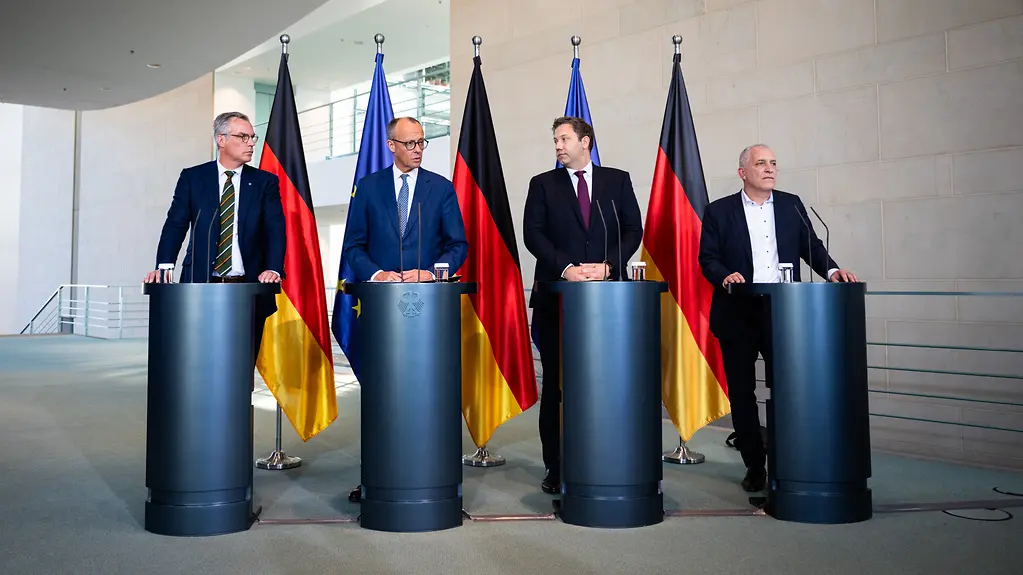
The shared goal is to secure an independent steel industry in Germany, said Federal Chancellor Merz after the steel dialogue.
Photo: Federal Government/Sandra Steins
Federal Chancellor Merz received high-ranking representatives of German steel companies, trade unions and federal states at the Federal Chancellery for a dialogue on the future of the German steel industry. The associated Federal Ministers also took part in the discussions. The aim, Merz said following the meeting, is to support the steel industry in Germany in positioning itself successfully for the future.
In his statement, Federal Minister of Finance Lars Klingbeil emphasised the central importance of the steel industry for Germany’s status as a business location, and for its resilience. It is the shared duty of politics and business to give security to those working in the changing steel industry, he said. Both Federal Chancellor Merz and Federal Finance Minister Klingbeil emphasised the great emotion in the descriptions of the companies’ dramatic situation. It concerns “the fate of a key industry”, said Merz.
The most important points from the press statement in brief:
- Improved trade protection: The steel industry is characterised by global overcapacity and market-distorting practices by international competitors. The Federal Government is committed to effective and long-term protection against the effects of these practices in EU trade policy. According to Merz, the European Commission’s proposals were a step in the right direction.
- Lower energy costs: A reliable and affordable energy supply is essential for the competitiveness of energy-intensive industries such as the steel industry. The Federal Government will therefore push forward with the energy transition, making it more efficient and effectively reducing energy costs – such as through an electricity price for industry and an expansion and extension of the existing electricity price compensation for energy-intensive companies, the Federal Chancellor emphasised.
- For climate-friendly steel production: The Federal Government will continue to support the steel industry in its transition to more climate-friendly production. The steel industry is also facing challenges due to this transformation, he said. The aim is to maintain critical value chains in the country, the starting point of which is always steel. According to Merz, this is the only way to secure employment.
- Protection of European markets: Both the Federal Chancellor and the Federal Minister of Finance agreed to the industry’s request to give preference to the use of domestic steel in procurement, such as for railway tracks or in the defence industry. Klingbeil spoke in favour of “a little more ‘buy European’, a little more European patriotism”.
Read the transcript of the statements here (in German only):