Press conference of the Federal Chancellor after the meeting with US President Trump
Transatlantic relations, the war in Ukraine, economic and trade issues: Federal Chancellor Friedrich Merz discussed these topics with US President Donald Trump in Washington, D.C.. Due to the current situation, the talks focussed on the situation in Iran.
- Transcript of press conference
- Wednesday, 4 March 2026
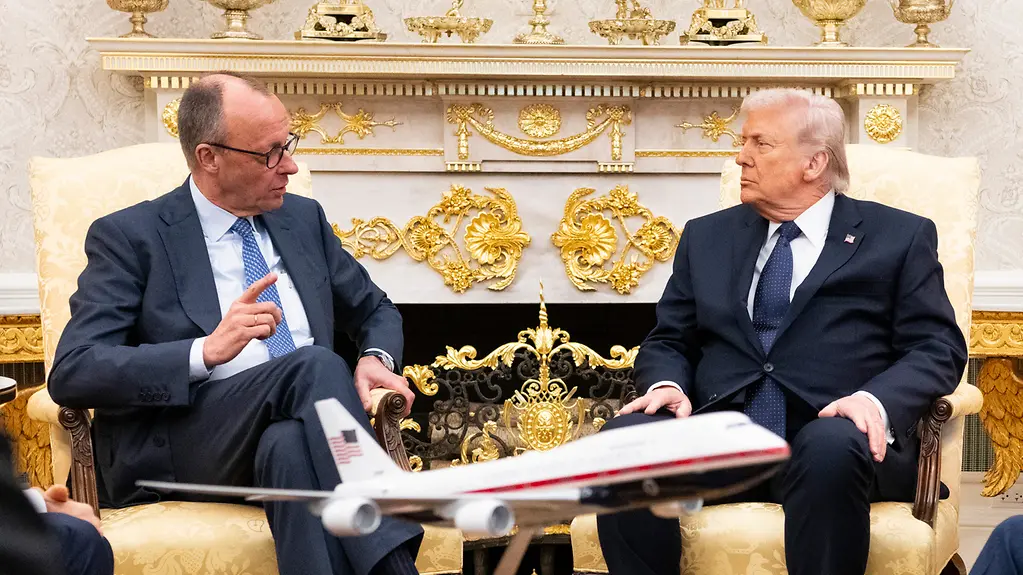
In addition to the situation in Iran, transatlantic trade relations and the Russian war of aggression against Ukraine were important topics.
Photo: Federal Government/Guido Bergmann
Federal Chancellor Friedrich Merz was received by US President Donald Trump in Washington, D.C.. Both agreed that the Iranian regime was responsible for the brutal oppression of its people, Chancellor Merz said after the talks, and also that Iran’s nuclear and missile programme was a threat to peace and security in the entire region.
“We therefore share the interest of the United States and Israel in seeing an end to all this at some point”, said the Chancellor at the White House. In addition to the situation in Iran, Merz and Trump also discussed the upcoming NATO summit in Ankara, transatlantic trade relations, and the Russian war of aggression against Ukraine.
The most important points in brief:
- The situation in Iran: “Iran must end its nuclear programme, its missile programme, terror and oppression”, said Merz. Germany, he said, wanted to contribute to a new order of peace and stability in the Middle East. A politically and economically stable Iran was in everyone’s interest. The Federal Government, he said, wanted to support the Iranian people in freely deciding their own fate and making their contribution to a stable and peaceful order in the region.
- Transatlantic relations: With a view to the forthcoming NATO summit in Ankara in July, the Federal Chancellor emphasised European intentions to strengthen the Euro-Atlantic pillar of NATO. This, he said, also included close cooperation between Germany and France on nuclear deterrence issues.
- Trade relations: “Following the Supreme Court’s judgement, we now want a fair, lasting agreement”, said the Federal Chancellor. He said that it was still unclear how the US administration would deal with the Supreme Court’s tariff ruling. The Chancellor went on to say that an agreement that placed a greater burden on transatlantic trade than the agreement of August 2025 was out of the question for Germany and the European Union.
- War against Ukraine: Europe, according to Merz, doubted greatly whether President Putin was prepared to agree to a peace agreement that was acceptable to Ukraine and Europe. “Only when Washington puts Russia under pressure again will President Putin be prepared to make concessions”, emphasised Merz. The Chancellor also argued that Europe should be more closely involved in the negotiations between the United States, Russia and Ukraine. “Only a peace that Europe supports and legitimises can be truly lasting.”