Hannover Messe and German-Brazilian intergovernmental consultations
“Think Tech Forward” is the motto of the 79ᵗʰ Hannover Messe, which Chancellor Merz visited. Brazil is the 2026 partner country of the world's largest industrial trade fair. The 3ʳᵈ German-Brazilian intergovernmental consultations that follow will also focus on economic issues.
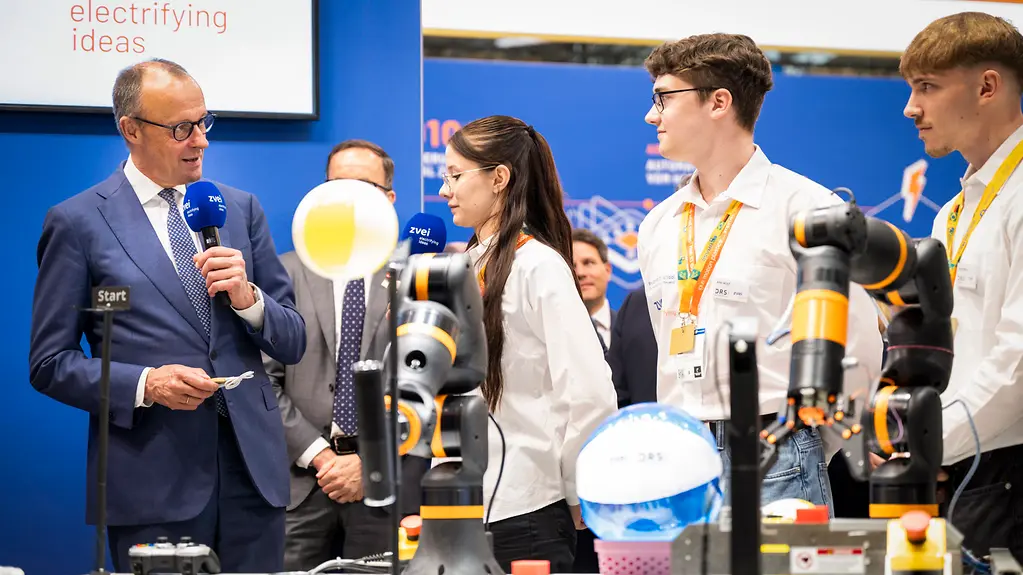
On Sunday, Federal Chancellor Merz opened the Hannover Messe, which is centred around technological progress and corresponding innovations.
Photo: Federal Government/Guido Bergmann
Technological progress and the digital transformation of the economy — these are the focal points behind this year's Hannover Messe motto: “Think Tech Forward”. This theme also brings various applications of artificial intelligence into focus.
At the opening of the 79ᵗʰ Hannover Messe on Sunday, Federal Chancellor Merz welcomed Brazilian President Luiz Inácio Lula da Silva and said he was delighted “to be able to open Hannover Messe 2026 together with President Lula”. According to Chancellor Merz, the fact that Brazil is an official partner country this year is fitting, “because next week, on 1 May, the MERCOSUR agreement will finally come into force”.
The Hannover Messe is the largest and most important industrial trade fair in the world. This year, it will officially take place from 20 to 24 April — for the 79ᵗʰ time. This year's partner country, Brazil, was the first partner country of the Hannover Messe back in 1980. A total of 4,000 international companies from the mechanical engineering, electrical and digital industries as well as the energy sector are taking part in this year's trade fair, presenting over 14,000 new products and solutions.
MERCOSUR free trade agreement
The Federal Government welcomes the provisional application of the EU-MERCOSUR agreement, thus allowing the economy on both sides to benefit sooner. “Four countries from South America and the European Union will then enter a new phase in their cooperation, forming the largest single market in the world with over 700 million consumers,” emphasised the Federal Chancellor on Sunday. The European Union and the MERCOSUR states of Argentina, Brazil, Paraguay and Uruguay signed a partnership agreement and an interim trade agreement on 17 January. EU Commission President Ursula von der Leyen travelled to Paraguay for the event.
Brazil is Germany's most important trading partner in South America and one of the world's most important locations for German companies with a total potential market of 300 million people. Around 1,300 companies funded with German capital are currently active in the country and account for around 10 percent of industrial value creation. Brazil is an important sales market — particularly for machinery, chemical products and motor vehicles.
“Made for Germany”
The Federal Government wants to strengthen Germany as a business location — a goal that the “Made for Germany” initiative is also pursuing. Almost 130 companies have announced plans to invest around 800 billion euros in Germany as part of the “Made for Germany” programme. At the initiative's event entitled “Industrial AI: From Strategy to Scale”, the Federal Chancellor gave a speech at the Hannover Messe.
In particular, he mentioned the targeted use of artificial intelligence in industry: “If Germany gets it right now, AI will help to create and maintain industrial value creation and high-quality jobs in the country and then really turn them into opportunities for us all,” explained the Chancellor.
German-Brazilian intergovernmental consultations
The 3ʳᵈ German-Brazilian intergovernmental consultations, which took place in Hanover on 20 April, were held under the motto of joint inclusive growth and employment, peace and security.
Both governments have decided on a series of joint projects and initiatives to further intensify the close cooperation between Germany and Brazil. These plans include programmes on foreign policy, armaments cooperation and defence policy, as well as economic cooperation, digital transformation, research, technology and space, the environment and climate, labour law and fair trade. A joint declaration PDF, 141 KB, barrier-free summarised the results of the visit.
The German-Brazilian intergovernmental consultations in pictures

Hanover, 19 April 2026: Federal Chancellor Friedrich Merz received Brazil's President Luiz Inácio Lula da Silva with military honours at Herrenhausen Palace. Germany and Brazil met for the third time for intergovernmental consultations.

The intergovernmental consultations were held under the motto of joint inclusive growth and the topics of employment, peace and security.

Both governments agreed on a series of joint projects and initiatives to further intensify the close cooperation between Germany and Brazil.

Joint programmes are planned in foreign policy, armaments cooperation and defence policy — as well as in economic cooperation and digital transformation. The countries also aim to cooperate on research, technology and space travel, as well as in the areas of the environment and climate, labour law and fair trade.

Intergovernmental consultations primarily take place between the relevant ministers. Among those taking part in the consultations on behalf of Germany was Federal Minister of Finance Lars Klingbeil.

The objectives of the partnerships were set out in writing at the signing ceremony. Minister for Economic Cooperation and Development Reem Alabali Radovan and Brazil's Minister of the Environment and Climate Change João Paulo Capobianco also signed a joint declaration.

At a time when the world order is changing fundamentally, the closeness of the two countries is more necessary than ever, he said: “We want to be a network of strong and like-minded partners,” said Federal Chancellor Merz.

The Chancellor praised the EU-MERCOSUR trade agreement, which will provisionally enter into force on 1 May, as a joint success of the partnership: “The agreement will contribute significantly to closer cooperation. This applies, in particular, to the future topics of technology, artificial intelligence, energy, the circular economy, environmental technologies and agriculture.”