European migration policy
She will work together with willing countries in all dimensions of migration policy. This is what Federal Chancellor Merkel declared during the visit by Prime Minister of Spain Sánchez. Together, they announced even closer cooperation - both on a bilateral and a European level.
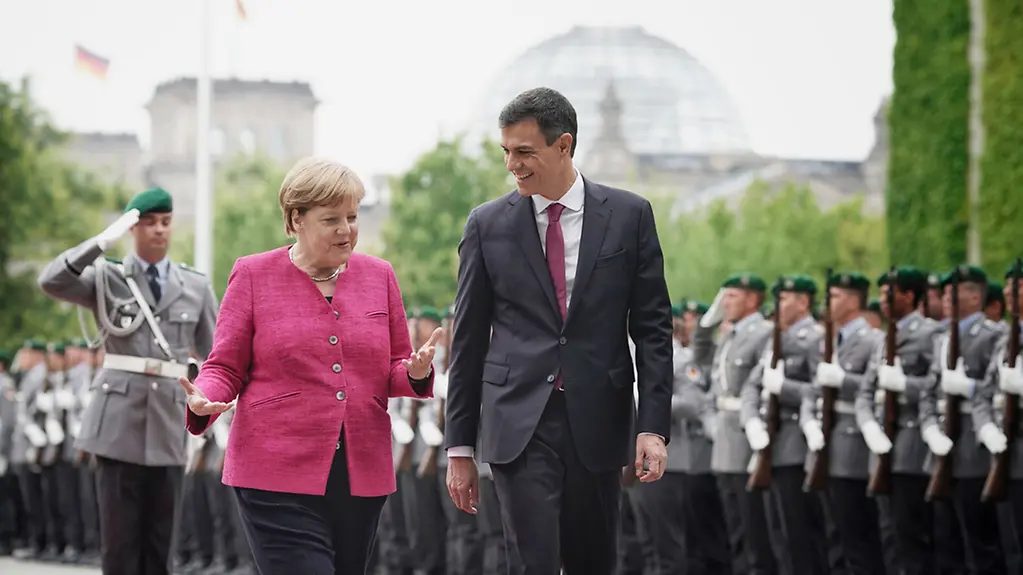
Sánchez in Berlin: European refugee policy was the main topic of his inaugural visit to the Chancellor.
Photo: Bundesregierung/Kugler
Federal Chancellor Angela Merkel praised the German-Spanish relations. She emphasised the shared interests of both countries at the European Council in Brussels: It is mainly about further developing the economic and monetary union, as well as a joint asylum and migration policy.
The big question for most of the member states is how to reduce the number of migrants arriving, who get to Europe via traffickers and have no right to stay. This was already clear at the work meeting on 24 June, said the Chancellor.
A joint European answer
The European member states have already agreed on some points of the joint asylum policy. They are still working on the Asylum Procedures Directive and the Dublin IV Regulation. A united mechanism should be the result. But this takes time, the Chancellor emphasised. It would be possible to work together with all willing countries, in all dimensions of the migration policy. “We will have further talks on this aspect over the next few days,” said Merkel.
According to the Dublin Regulation, asylum seekers must be registered in the country in which they enter the European Union. This EU state is also responsible for the asylum application.
The Chancellor is calling for constructive contact between the EU member states and the countries of origin: not every EU country must negotiate with every African country. The tasks need to be shared out. In order to overcome this problem, Europe would have to support the development of African countries that are greatly affected by migration. “This is always a question of giving and receiving.” Merkel also announced that migration within Europe, so-called secondary migration, would be discussed at the Council.
Spanish Prime Minister, Pedro Sánchez, supported the Chancellor. He spoke in favour of a joint European answer to migration both to Europe as well as within it. “We must stay united and act as a European Union.”
Franco-German impetus
Merkel referred to joint Franco-German issues for the upcoming further development of the economic and monetary union: “We have made suggestions with France which we will also be discussing, of course,” said Merkel. This has less to do with influencing other EU member states and more to do with “providing food for thought”. The Banking Union would have to be concluded. Europe also needs a capital market union. It is high time the Eurozone was stabilised. Sánchez corroborated this. He announced that Spain would support Germany and France on this issue.
In terms of the trade relations with the USA, Merkel and Sánchez supported the member states’ position. Both emphasised that this was a joint stance by the European Union.