Federal Chancellor Merz’s trip to Asia
Federal Chancellor Merz visited Asia from 26 to 30 October, stopping off in Singapore, Japan and South Korea. Purpose of the trip: in a time of global upheaval, to further deepen security and economic cooperation with these countries.
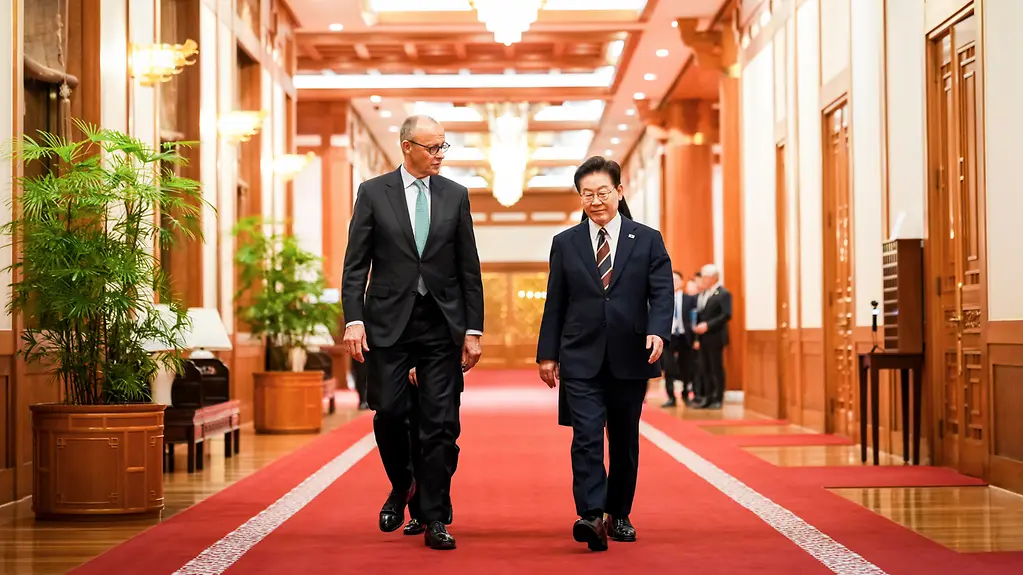
In Seoul, the President of South Korea, Lee Jae-myung, welcomed the Federal Chancellor at his official residence.
Photo: Federal Government/Steffen Kugler
At the end of his tour of Asia, Federal Chancellor Friedrich Merz gave a positive assessment following his visits to Singapore, Japan and South Korea. “This region is of the utmost strategic importance to us,” said Merz in Seoul. And the Chancellor went on to say that they share common security interests. Germany is also regarded as an important partner in the region. “This opens up opportunities that we must make the most of,” the Federal Chancellor concluded.
Following his visits to Singapore and Japan, Chancellor Merz arrived in the Republic of Korea (South Korea) on Thursday. In Seoul, he was received by the South Korean President, Lee Jae-myung. Following the talks, the Chancellor said that, in a time of global upheaval, “it is only logical that we should now deepen our partnership, because more than ever we need a strong network of partners who share important interests and common values”. This applies in terms of security policy, the economy and geopolitics.
Working together to promote free trade
On Friday, Chancellor Merz opened the 19th Asien-Pazifik-Konferenz der Deutschen Wirtschaft in Seoul. In his speech, he emphasised the importance of rules-based, free trade and advocated trade agreements as well as active de-risking through fair partnerships in the fields of raw materials and technology. Merz also proposed the establishment of a global political alliance for rules-based trade, in which like-minded states would contribute to a fair international trade policy. With regard to relations between South Korea and Germany, the Chancellor emphasised that the structural similarities between their industries provided a sound basis for deeper bilateral cooperation.
Merz then visited Camp Bonifas and the Demilitarised Zone on the border with North Korea. “At this very moment, thoughts are going through my mind about how grateful we should be that we have not had to experience such a division in Germany for 36 years,” said the Chancellor during his visit to the border area. “Let us hope that Korea, too, will one day have the chance to regain its national unity.”
The Demilitarised Zone (DMZ) is a border strip 248 kilometres long and approximately four kilometres wide, which divides the Korean Peninsula along the 38th parallel, dividing the Korean Peninsula into the Democratic People’s Republic of Korea (North Korea) and the Republic of Korea (South Korea). The DMZ – Demilitarised Zone – was established in 1953 as a buffer zone following the end of the three-year Korean War. As no formal peace treaty has been signed to date – there is merely a permanent ceasefire – both countries remain in a state of war under international law.
Strengthening cooperation with Japan
On Wednesday, the Federal Chancellor travelled to Japan, the second stop on his tour of Asia. There, in Tokyo, he was received by Prime Minister Sanae Takaichi. At the joint press conference, the Chancellor emphasised that Japan plays “a key role for Germany as a close friend and a true premium partner”. At the meeting, “a package of measures” was agreed upon with a view to expanding the partnership and deepening cooperation on security policy.
For example, defence cooperation should be expanded. In addition, both countries have signed a declaration on economic security and aim to reduce “critical dependencies”. Furthermore, Germany and Japan intended to collaborate on strategic projects. “We are working together here to build a shared future,” said Chancellor Merz. To this end, for example, they have also agreed on an AI dialogue and a statement on high-tech cooperation.
Talks on trade agreements between Asia and Europe
During his visit to Japan, Chancellor Merz also gave a speech at the German-Japanese Business Summit. In it, the Chancellor called for greater investment, technological cooperation and free, rules-based trade. “If Germany and Japan combine their strengths, new opportunities will arise that no single company can tap into in the same way,” emphasised Merz. He then visited a Japanese company with a German partner.
In conclusion, the Chancellor emphasised in a statement on Wednesday that there had been “very intensive” discussions on whether to “resume talks on a joint trade agreement between the ASEAN – Association of Southeast Asian Nations – states and the European Union”. Germany is regarded as “a very important partner”, not least because of “its strong position within the European Union”. “Even though we are geographically separated by many thousands of kilometres, we are, in many respects, truly neighbours,” said the Chancellor.
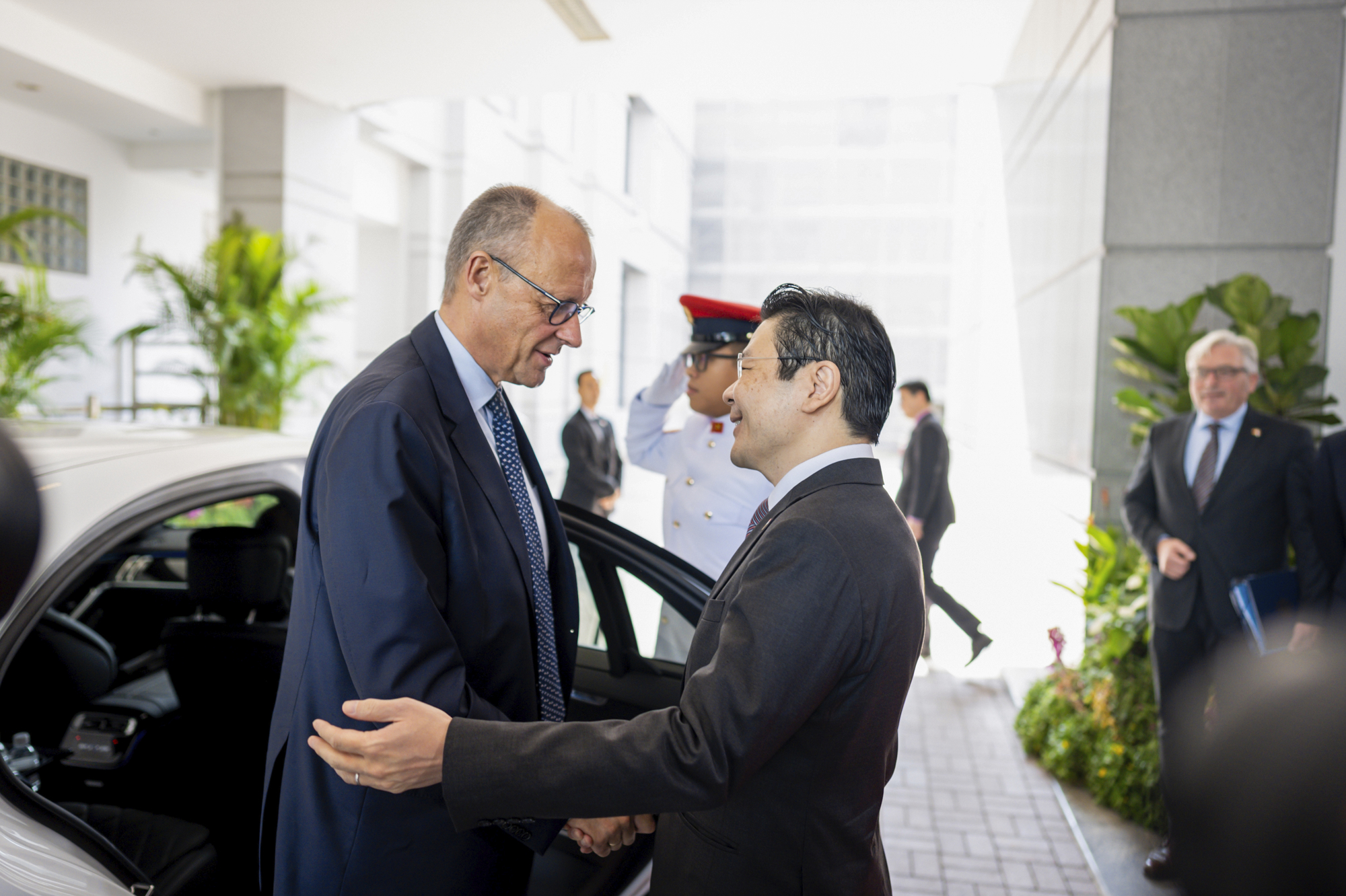
Singapur, 27. Oktober 2026: Start der mehrtägigen Asienreise war der Stadtstaat an der Südspitze der Malaiischen Halbinsel. Premierminister Lawrence Wong empfing Bundeskanzler Merz.

„Wir Europäer stehen vor denselben Herausforderungen wie die Länder in der Region des Indo-Pazifiks. Wir müssen uns in einer zunehmend von Unsicherheiten geprägten Welt behaupten“, betonte Kanzler Merz bei seinem Besuch.

„Diese neue Welt eröffnet uns aber auch Chancen, unsere Partnerschaften gemeinsam zu vertiefen“, ergänzte Merz.

Die beiden Regierungschefs vereinbarten einen Arbeitsplan zur Vertiefung der strategischen Partnerschaft in den Bereichen Wirtschaft, Sicherheit, Digitalisierung und Energie.

Im Rahmen der Vortragsreihe Singapore Lecture sprach sich der Bundeskanzler für ein Freihandelsabkommen der EU mit der Transpazifischen Partnerschaft (CPTPP) aus.

Zusammen hätten Europa und der Indo-Pazifik beachtlichen Einfluss. Man könne gemeinsam den freien und fairen Welthandel schützen und fördern, unterstrich Merz.

Am Nachmittag besuchte der Kanzler das Hafengelände des Betreibers PSA Horizons.

Ein erheblicher Teil des deutschen Außenhandels mit Staaten außerhalb der EU entfällt auf die Indo-Pazifik-Region. Durch neue Impulse für die Handelspolitik soll Deutschland stärker von den weltweiten Handelsbeziehungen profitieren.

Tokio, 28. Oktober 2026: In Japan nahm Kanzler Merz am Deutsch-Japanischen Wirtschaftsgipfel teil. Dort setzte er sich für die Gründung einer „globalen politischen Allianz für regelgebundenen Handel“ ein. Die solle einen auf internationalen Vereinbarungen basierenden Warenaustausch verteidigen, stärken und weiterentwickeln.

Anschließend wurde Bundeskanzler Merz am Amtssitz von Ministerpräsidentin Sanae Takaichi mit militärischen Ehren empfangen.

Medienpräsenz beim Gespräch des Kanzlers mit der japanischen Ministerpräsidentin. Im diplomatischen Protokoll auch bekannt als Auftaktbilder oder Bildtermin.

Merz und Takaichi beschlossen ein Maßnahmenpaket zur Vertiefung der bilateralen Partnerschaft in den Bereichen Wirtschaftssicherheit, Verteidigung, Hochtechnologie und Raumfahrt. Die japanische Regierungschefin nahm zudem die Einladung an, Partnerland der Hannover Messe 2028 zu sein.

Tokio, 29. Oktober 2026: Am zweiten Tag in Japan informierte sich der Bundeskanzler über die Übung „Keen Sword“. Dabei trainierten Soldatinnen und Soldaten des Sanitätsdienstes der Bundeswehr gemeinsam mit internationalen Partnern die Versorgung und Evakuierung einer großen Zahl von Verwundeten.

Der letzte Stopp vor der Weiterreise nach Südkorea war das Unternehmen Kyoto Fusioneering, das zusammen mit mehreren deutschen Firmen an der Entwicklung und dem Bau des ersten Fusionsenergiereaktors arbeitet.

Wenig später: Bundeskanzler Merz ist auf dem Flughafen Seongnam in Seoul, Südkorea, gelandet.

Südkoreas Präsident Lee Jae-myung empfing den Kanzler in seinem Amtssitz. Lee amtiert seit Juni 2025 als Präsident der Republik Korea.

„Mehr denn je“ seien Partner wichtig, die gemeinsame Interessen und Werte teilten, sagte Merz bei dem Besuch. „Das gilt sicherheitspolitisch, das gilt wirtschaftlich, und das gilt geopolitisch.“

Merz kündigte ein neues Rahmenabkommen als „Grundlage für die Zusammenarbeit in modernsten Technologien“ an. So sei etwa eine Partnerschaft im Bereich der Halbleiterindustrie geplant.

Beide Länder veröffentlichten eine gemeinsame Erklärung zur vertieften Zusammenarbeit. Darin bekräftigten sie ihre Entschlossenheit, auch die Beziehungen in den Bereichen Sicherheit und Verteidigung weiter zu vertiefen.

Seoul, 30. Oktober 2026: In seiner Rede bei der 19. Asien-Pazifik-Konferenz der Deutschen Wirtschaft unterstrich der Kanzler die Bedeutung eines regelgebundenen, freien Handels und warb für Handelsabkommen sowie aktives De-Risking durch faire Rohstoff- und Technologiepartnerschaften.

Danach besuchte er den bedeutenden, über 1200 Jahre alten buddhistischen Bongeunsa-Tempel.

Besuch in der demilitarisierten Zone in Panmunjeom: Ein Kommando der Vereinten Nationen überwacht das 248 Kilometer lange und vier Kilometer breite Gebiet zwischen Nord- und Südkorea auf die Einhaltung des 1953 unterzeichneten Waffenstillstandsabkommens.

In einem Forschungszentrum informierte sich der Kanzler über den Bereich der Quanten-Nanowissenschaft.

Bundeskanzler Merz zog eine positive Bilanz seiner Asien-Reise. „Diese Region ist für uns von größter strategischer Bedeutung“, sagte er. Und man habe gemeinsame Sicherheitsinteressen, so der Kanzler weiter. Deutschland werde zudem in der Region als wichtiger Partner angesehen. Das eröffne Chancen, die es zu nutzen gelte, resümierte er.
Expanding the strategic partnership with Singapore
The trip began with a visit by the Federal Chancellor to Singapore. He met Prime Minister Lawrence Wong there on Tuesday for talks. “Germany and Singapore are linked by a political and economic partnership that has developed over decades,” said Merz at the subsequent press conference. Germany is also a partner in South-East Asia, a region of growth and future potential. In addition to trade relations, both countries wished to step up their cooperation in the fields of digitalisation and AI, as well as in defence and security policy.
Specifically, Germany and Singapore intend, for example, to conclude new agreements on cybersecurity. The Federal Chancellor expressed his gratitude for Singapore’s continued support for Ukraine. The country is an active member of the Coalition of the Willing. “At a time of upheaval that is challenging Singapore, Germany, Europe and the whole world as never before, we are pulling together,” emphasised Merz. “Above all, we are firmly committed to strengthening our strategic partnership.”
The Federal Chancellor subsequently met with President Tharman Shanmugaratnam and also delivered a keynote speech as part of the prestigious “Singapore Lecture“ series, which has been running since 1980. In it, he set out four core foreign policy principles for the Federal Government in this new geopolitical era. Germany therefore intends, firstly, to invest in global alliances; secondly, to strengthen its own resilience; thirdly, to invest in the international order; and fourthly, to continue to prioritise dialogue and diplomacy.
Strengthening trade relations
Singapore, Japan and South Korea are characterised by a high level of innovation, particularly in the fields of future-oriented and high technologies. The Chancellor’s visit to South-East and East Asia should therefore also serve to further advance cooperation in these areas. Furthermore, Singapore, Japan and South Korea are key players in tackling global challenges and face similar challenges to those of the Federal Republic of Germany.
The security and prosperity of Germany and Europe are closely linked to the region. A significant proportion of Germany’s foreign trade with countries outside the EU is with the Indo-Pacific region. The Federal Chancellor hoped to build on this with his visit and provide fresh impetus for trade policy.
Germany and its companies should benefit more from their global trade relations. The aim is to boost investment in Germany and safeguard jobs. The importance of economic cooperation is also evident from the fact that the Federal Chancellor was accompanied by a business delegation on his trip.