2026 Digital Summit
Opportunities, risks, security, and political and strategic issues concerning artificial intelligence: these are the focus of this year’s Digital Summit in Berlin, which is being held under the theme “Shaping AI: safe, sovereign, competitive”.
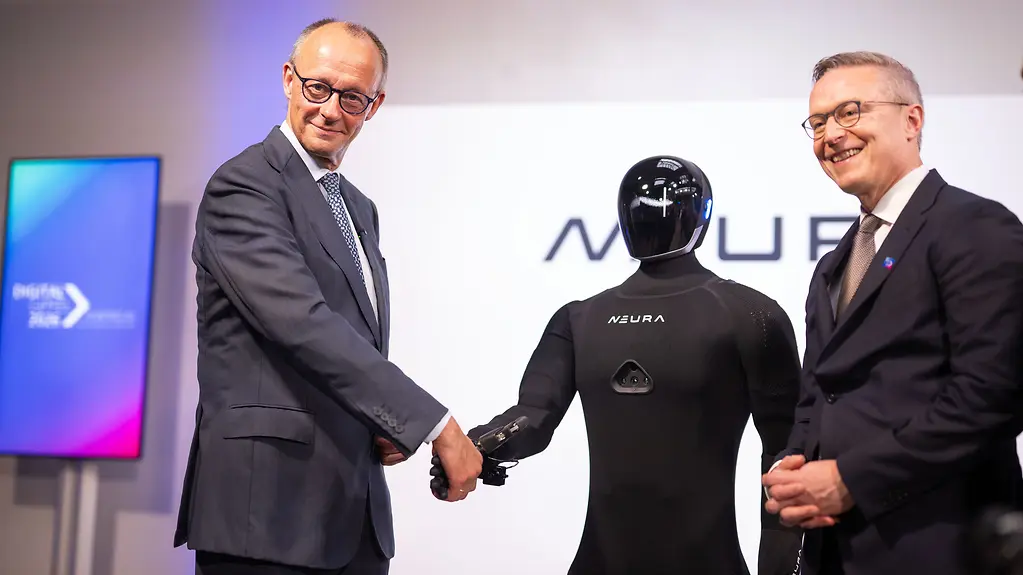
At the Digital Summit, Federal Chancellor Merz also took a look at a robot manufactured by NEURA Robotics.
Photo: Federal Government/Laurin Schmid
This year’s Digital Summit, which is organised by the Federal Ministry for Digital Affairs, is once again being held in Berlin. Following on from last year’s summit, which focused on digital sovereignty, the theme in 2026 is artificial intelligence. Under the theme “Shaping AI: safe, sovereign, competitive”, the conference will discuss specific applications of AI, AI security, opportunities and risks, future developments and political and strategic issues relating to artificial intelligence.
The goal of the Federal Government is to be proactive in shaping AI in a way that is secure and trustworthy in order to enhance our economic performance, boost the government’s scope of action and make everyday life easier for citizens. As an AI nation, Germany is set to deliver economic growth, jobs, an efficient and responsive public administration as well as trustworthy and secure everyday applications.
Germany aims to be a global leader
A key priority for the Federal Government is to significantly boost Germany’s position in the international race for AI. In industry, in particular, Chancellor Merz is convinced that if German firms can harness the unique know-how and innovative ideas of AI, the country could rise to become a world leader in industrial AI.
Federal Minister for Digital Transformation Dr Karsten Wildberger emphasised: “The 2026 Digital Summit embodies our commitment to shaping AI in a safe and trustworthy way, seizing opportunities and driving Germany and Europe further ahead in the face of international competition. To this end, we are creating a reliable framework to promote greater digital sovereignty and competitiveness. I’m looking forward to two exciting days, during which we’ll demonstrate just how well-positioned we already are in the field of AI and where, together with our partners, we can unlock new sources of innovation.”
Read the AI Task Force’s report on its findings here: Germany as an AI Nation by 2030 PDF, 971 KB, barrier-free
What is the Digital Summit?
The Digital Summit is an annual conference that serves as a key platform for shaping the digital transformation of the economy, government and society in Germany. The summit was originally launched in 2006 in response to the growing importance of the IT sector to the German economy, and was known as the “National IT Summit” until 2016. Since last year, the gathering has been organised by the Federal Ministry for Digital Transformation and Government Modernisation.
Who takes part in the 2026 Digital Summit, and what exactly is planned?
The Digital Summit was opened on 2 November by Karsten Wildberger, the Federal Minister for Digital Transformation and Government Modernisation, with speakers from the worlds of business, academia, society and politics shedding light on the many facets of AI. Digital ministers from Europe and Canada, the European Commission, members of the German Bundestag, high-ranking representatives of the federal states and representatives from the worlds of business, academia and civil society were expected to be attending in person.
On the opening day, Federal Chancellor Friedrich Merz also addressed the summit, where he called for faster progress in Germany and Europe in the face of international competition for AI. The aim, he said, is to become quicker and better at “developing digital technologies and actually making use of them”, and he noted the importance of shaping this change in line with our local values. The focus is on people, he emphasised, not technology.
In addition to numerous panel discussions, a range of side events are taking place alongside the Digital Summit, organised by federal ministries, civil society, businesses, associations and the academic community. The side events address key themes of the Digital Summit and explore different perspectives.
Why is artificial intelligence the focus of the 2026 Digital Summit?
Artificial intelligence is becoming increasingly important for future growth, innovation and prosperity. Our country aims to become a leading centre for AI in Europe, thereby securing its future competitiveness both in Europe and globally. The Digital Summit is intended to highlight just how well-positioned our country already is and where further innovation is still needed.
How can Germany become an AI nation?
The Federal Government has set up an inter-ministerial AI task force. Under the leadership of the Federal Ministry for Digital Transformation, it has drawn up the overarching vision for Germany’s path to becoming an AI nation by 2030. The findings report PDF, 971 KB, barrier-free , published on 2 November, sets out measurable targets for this and brings together 18 key cross-departmental measures.
The proposed measures range from a strategic analysis and monitoring framework, through AI expertise, security and infrastructure initiatives, to programmes focusing on technology, innovation, applications and talent. Together, they address the key prerequisites for a high-performing, self-reliant and responsibly managed AI nation. Specifically, for example, by 2030 at least 80 per cent of large enterprises and 55 per cent of small and medium-sized enterprises are expected to be using AI. The proportion of economic output generated by AI is expected to exceed ten per cent, and 90 per cent of federal authorities are likely to be using at least one AI application to carry out core tasks by 2030.
Given the highly dynamic pace of technological development in the field of artificial intelligence, it is essential to continuously review and adapt objectives and measures. The performance report forms the strategic basis; continuous review and adaptation ensure that Germany can respond promptly and flexibly to new challenges and technological breakthroughs.
What was decided at the 2025 Digital Summit?
In 2025, the Digital Summit took place in collaboration with the French Government as the “Summit on European Digital Sovereignty”. The aim of this European Digital Summit, which was held at the EUREF Campus in Berlin, was to further develop key aspects of an independent, secure and innovation-friendly digital future for Europe.
Since then, both countries have made good progress in the areas of data protection rules, data sovereignty, digital commons, the AI task force on digital sovereignty and the promotion of AI innovation. Federal Minister Wildberger commented: “I think quite a lot has happened over the past year, but we need to speed things up even further. When it comes to regulation, we need even more scope for innovation.”