Press statement by Federal Chancellor Merz on the situation in the Middle East
The USA and Israel have been conducting massive military strikes against Iran since Saturday. Chancellor Merz is in close contact with European partners, Israel and partners in the region. He will discuss the developments with US President Trump in Washington on Tuesday.
- Transcript of press conference
- Sunday, 1 March 2026
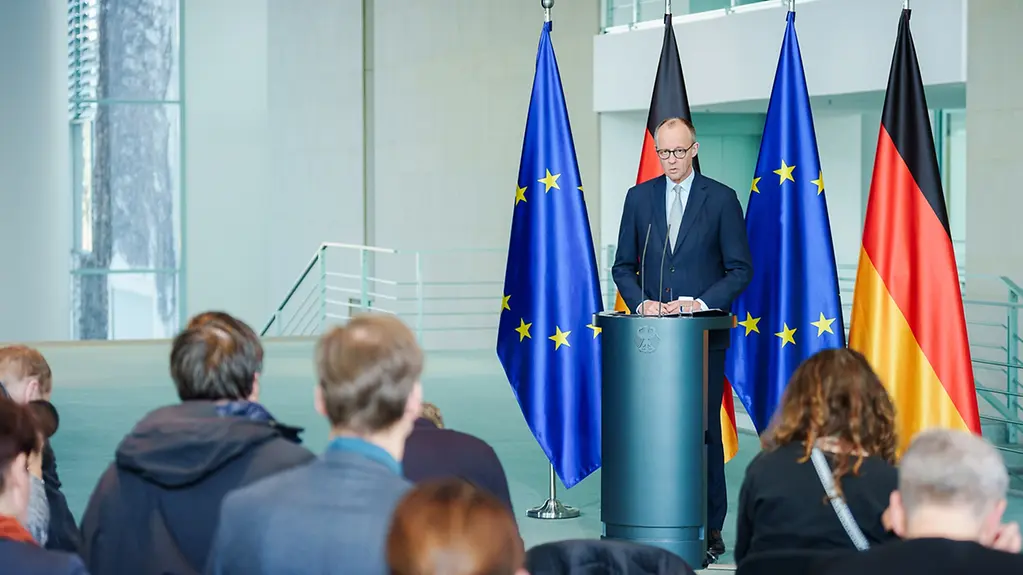
In his statement, Chancellor Merz called on Iran to end its military strikes immediately.
Photo: Federal Government/Jesco Denzel
The National Security Council, chaired by Federal Chancellor Friedrich Merz, met in Berlin on Sunday to discuss the situation in the Middle East. The German government leaves no doubt as to its position on the Iranian regime: "The mullah regime is a regime of terror that is responsible for the decades-long oppression of the Iranian people," said Chancellor Merz.
The regime threatened Israel's existence, was responsible for the terror of Hamas and Hezbollah, and its nuclear and missile programmes threatened peace and security, said the Chancellor. Germany thus shares the USA's interest in stopping this regime's terror and halting its dangerous nuclear and ballistic armament. The aim of the military strikes was to end the destructive game of a weakened regime. However, this was not without risk, said Merz. He also emphasised: Germany wants to contribute to a new order of peace and stability in the Middle East.
Statement by Federal Chancellor Merz on the situation in the Middle East:
Ladies and gentlemen, a warm welcome to all of you even though it’s a Sunday. In recent days and weeks, we have witnessed an unprecedented number of wars and upheaval both around the world and in our neighborhood. The lines of conflict are becoming increasingly blurred. Existing rules, including those of international law, are disregarded more and more.
As you know, the United States of America and Israel have been carrying out massive military strikes against Iran since yesterday. Based on everything we know, numerous prominent representatives of the Iranian regime have been killed, including the religious leader Ali Khamenei. This marks a turning point into an uncertain future.
I will discuss all of these developments with President Trump in Washington on Tuesday. I am in close contact with our partners in Europe, Israel, and throughout the region, especially these last few hours.
Today, Sunday, the National Security Council met under my leadership. We received a comprehensive situational assessment by our different government departments and services, to the extent that this is available.
The Federal Government has also taken steps today and yesterday to provide the best possible support to German vacationers and travelers in the region. Here in Germany, we are doing everything we can to ensure public safety. This applies in particular to the protection of Jewish, Israeli, and American institutions. We will not tolerate antisemitic or anti-American attacks on German soil.
We have agreed on a common position of the Federal Government on developments in Iran. The Federal Government leaves no doubt where we stand on the Iranian regime. The mullah regime is a terrorist regime responsible for decades of oppression of the Iranian people. Thousands of people fell victim to this regime during the demonstrations at the beginning of the year alone. The regime threatens the very existence of the State of Israel and is responsible for Hamas’ and Hezbollah’s terrorism.
Finally, Iran’s nuclear and missile programs threaten peace and security. Iran’s indiscriminate attacks on neighboring countries and the Gulf states are destabilizing the entire region. Its collaboration with terrorist organizations endangers our allies and ourselves. The same applies to Iran's systematic support for Russia's war of aggression against Ukraine. The German government therefore shares the relief of many Iranians that this mullah regime is now coming to an end.
We share the interest of the United States and Israel in seeing an end to this regime’s terror and its dangerous nuclear and ballistic armament. The military strikes are intended to put an end to the destructive game being played by a weakened regime. This is not without risk. We do not know how far the region will be dragged into escalation by Iran’s harsh counterstrikes. We take the concerns of our partners in Iran’s immediate neighborhood in the Gulf and in Europe very seriously. Therefore, we call on Tehran to immediately end these indiscriminate attacks.
After all, it is unclear whether the plan to bring about political change from within through military strikes from outside will work. Iran’s internal dynamics are difficult to understand. Comparisons with Afghanistan, Iraq, and Libya certainly only apply in part. However, they demonstrate the real risks in the medium term. We in Europe and Germany would also have to bear the consequences.
The German government is drawing clear conclusions from this for our own actions. Categorizing the events under international law will have relatively little effect. This is especially true when these classifications remain largely inconsequential. Over the years and decades, appeals from Europe, including Germany, condemning Iran's violations of international law, and even extensive packages of sanctions have had little effect. This is also due to the fact we were not prepared to enforce fundamental interests with military force if necessary.
Therefore, this is not the time to lecture our partners and allies. Despite our reservations, we share many of their goals without being able to actually achieve them ourselves.
As the German government, we intend to take action where we can, together with our partners in the United States, Israel, the region, and Europe. Even though we cannot yet foresee what the future will look like, we want to develop an agenda with Iran for that “day after”. This is also a signal of hope to the courageous Iranian people, who deserve a better future for their country.
We are guided by four key principles. First, we aim to contribute to the establishment of a new order of peace and stability in the Middle East, an order where all neighbors recognize Israel's right to exist and its right to security without any conditions. Second, we want to continue working toward a binding agreement that commits Iran to permanently ending both its military nuclear and its ballistic missile programs. Third, in return, we want to do our part to help Iran stabilize and get back on its feet economically. Europe will be a key factor to make this a success. Finally, fourth, we want to support the Iranian people in determining their own destiny by their own free will and contributing to a stable and peaceful regional order.
The German government's view of developments in Iran is shaped by our own geopolitical vulnerability. Russia's war against Ukraine is in no way inferior to the injustices of the Iranian regime. Moscow's invasion of a peaceful neighbor is just as unjustifiable as Tehran’s war of terror against Israel. That is why the German government is also doing everything in its power to achieve a just peace for Ukraine. As you probably know, Germany is currently Kyiv's strongest supporter.
We appreciate the important negotiating work being done here by the United States of America under President Trump, and we would like to see even closer transatlantic cooperation. We want this cooperation at the negotiating table with Russia as well. We want it in our efforts to use pressure and sanctions to persuade Russia to compromise during the negotiations.
Anyone who wants security, peace, and justice in the Middle East must also want them in Europe. This is why the German government is providing the majority of the support to Ukraine in its fight against Russia’s aggression, as part of the transatlantic burden-sharing. This is why we are not lecturing our partners on their military strikes against Iran. We want to work with them to establish a peaceful order grounded in the necessary degree of realism, both in the Middle East and in Europe.
Thank you very much.