The Federal Government’s autumn 2026 forecast
The German economy is back on track for growth and is therefore proving more resilient than expected. At the presentation of the autumn 2026 forecast, Federal Minister for Economic Affairs Reiche emphasised the importance of reforms to ensure that growth can be self-sustaining in the future.
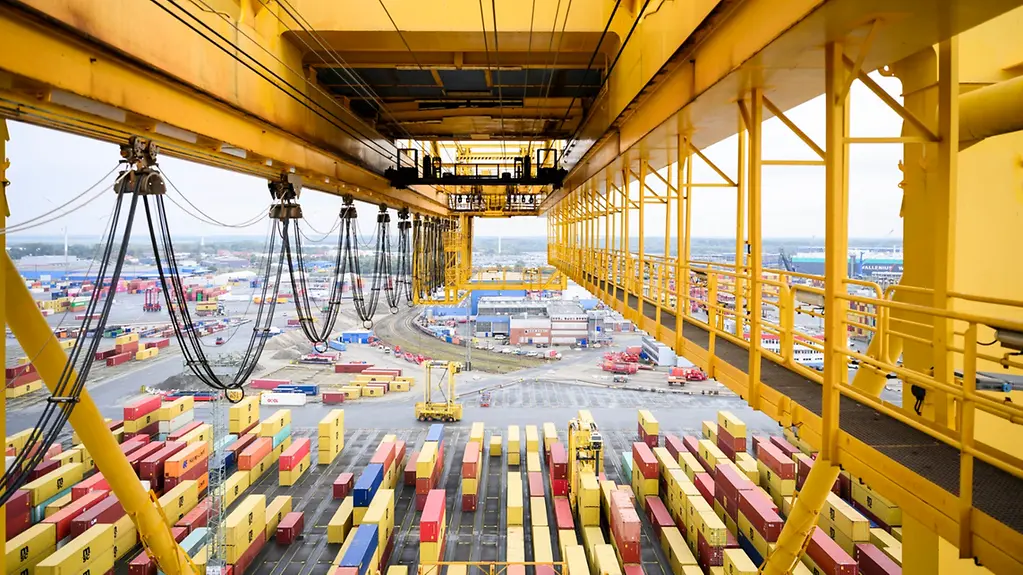
Growth is being driven primarily by robust exports and state investment in defence and infrastructure.
Photo: Federal Government / Marvin Ibo Güngör
Federal Minister for Economic Affairs Katherina Reiche has presented the Federal Government’s autumn 2026 forecast in Berlin. “We have come through the worst; the German economy is growing again. This is an important signal, but it is only the beginning”, she said.
The Federal Government is raising its growth forecast significantly compared with its spring projections: it expects gross domestic product (GDP) to rise by 1.3 percent this year, which is 0.8 percentage points higher than before. It is forecasting growth of 1.1 percent for 2027. For 2028, it is forecasting growth of 0.6 percent.
Strong exports and state investment
The German economy is on a growth trajectory and has proved to be more resilient than expected. Despite the conflict in the Middle East and rising energy prices, it expanded significantly in the first half of 2026. Growth is being driven primarily by robust exports and state investment in defence and infrastructure.
Promoting investment in Germany
According to Reiche, private investment is particularly necessary to realise growth potential. The Federal Chancellor will invite investors from all over the world to the first investment summit on 19 and 20 October, the Minister announced. Germany, she said, has great potential: capital, talent and technology. According to Reiche, the reforms that have been set in motion are necessary to realise this potential and foster self-sustaining economic growth. She emphasised that the reforms that have been started must therefore be implemented over the coming months.
Development dependent on the resolution of geopolitical conflicts
The Federal Government has taken a number of measures to ease the burden on consumers and businesses, for example with regard to energy prices. However, due to the rise in energy and consumer prices resulting from the conflict in the Middle East, private consumption and private investment are likely to remain subdued. A sustainable resolution to the geopolitical crises would accelerate economic recovery as a whole.
Consequently, the consumer price inflation rate is forecast to be 2.7 percent in total for this year, three percent for 2027 and 2.2 percent again in 2028.
Tax revenue is estimated on the basis of the spring and autumn projections. The Federal Government, states, local authorities and social security organisations all base their budget planning on the forecast macroeconomic indicators. The same applies to reports submitted to the European Union under the Stability and Growth Pact. In addition to these two forecasts, the Federal Government publishes its annual forecast – known as the Annual Economic Report – at the start of each year.