Cabinet decision
The Federal Government wants to continue its reform programme to ensure that the German economy returns to stronger growth. There are signs of a slight recovery with investments and initial relief measures. Read the most important information from the annual economic report here.
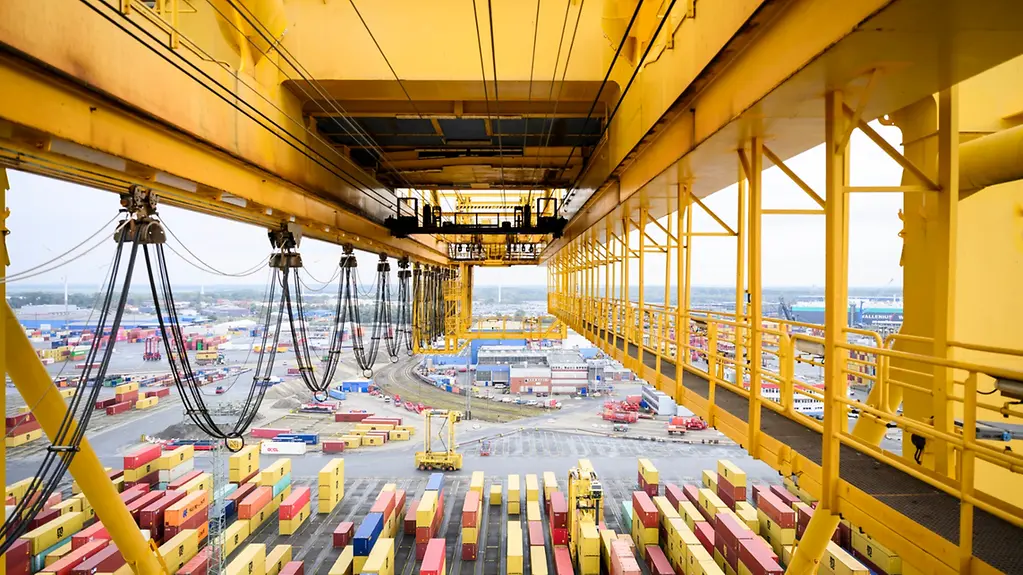
In order to strengthen its export economy, German trade relations will also be further diversified.
Photo: Federal Government/Marvin Ibo Güngör
The Federal Cabinet has approved the annual economic report. It shows the Federal Government’s key investments and relief measures, the planned reforms and the growth projection for the current year. The Federal Government's aim is to get the German economy and Germany back on a growth trajectory. Above all, this requires decisive structural reforms.
With the annual economic report, the Federal Government provides the German Bundestag and the Bundesrat with macroeconomic orientation data for the current year in January – in accordance with Section 2 of the Act to Promote Economic Stability and Growth.
Economy slowly picking up speed again
In 2025, economic growth rose slightly by 0.2 per cent for the first time in two years. For 2026, the Federal Government is assuming growth of 1.0 per cent of real GDP. This is an important signal after the stagnation of recent years, but not yet a radical turnaround. This growth is primarily driven by government investment in the modernisation of infrastructure. In addition, there is significant relief, for example through improved rules on company depreciation and falling energy costs.
In contrast, German foreign trade is not yet expected to stimulate growth. This is because the important export-oriented German economic sectors are still under considerable pressure due to the difficult geopolitical situation and trade policy uncertainties. To regain its strength in the face of tougher international competition, the German export industry urgently needs reforms in Germany.
Reforms for competitiveness and sustainable growth
The Federal Government is continuing its reform programme in order to secure growth, employment and prosperity:
- Plans to reduce excessive bureaucracy: With a concrete plan to reduce bureaucracy by billions, a modernisation agenda and the acceleration of planning and approval procedures.
- with the High-Tech Agenda Germany, the Federal Government is promoting key future innovations. The Germany Fund is intended to mobilise private investment.
- Energy costs to fall further. For electricity-intensive and trade-intensive sectors of the economy, this goal is to be achieved with industrial electricity pricing and the expansion of electricity price compensation measures.
- The active pension, the reformed basic income support and easier regular immigration of skilled labour are intended to increase the supply of labour.
- The planned reforms to the social security systems are intended to limit higher burdens on employees and employers.
Strengthening international trade relations
In order to strengthen the German and European economy, the Federal Government will also continue to advance the diversification of trade relations.
The European Union has signed a free trade agreement with the Mercosur--Mercado Común del Sur states. It has also reached an agreement with India. Both agreements make an important contribution to opening up new markets and deepening reliable partnerships.