Photo series
Federal Chancellor Merz travelled to Asia this week. In Singapore, Japan and South Korea, he met with the respective heads of government. The aim of the trip was to strengthen partnerships with Asian countries. The main focus was on cooperation in the areas of trade relations, security and defence policy, and in the digital sector.
- E-mail, The German Federal Chancellor’s trip to Asia
- Facebook, The German Federal Chancellor’s trip to Asia
Share the article
- E-Mail E-mail, The German Federal Chancellor’s trip to Asia
- Facebook Facebook, The German Federal Chancellor’s trip to Asia
- X X, The German Federal Chancellor’s trip to Asia
- Threema , The German Federal Chancellor’s trip to Asia
- WhatsApp share via Whatsapp, The German Federal Chancellor’s trip to Asia
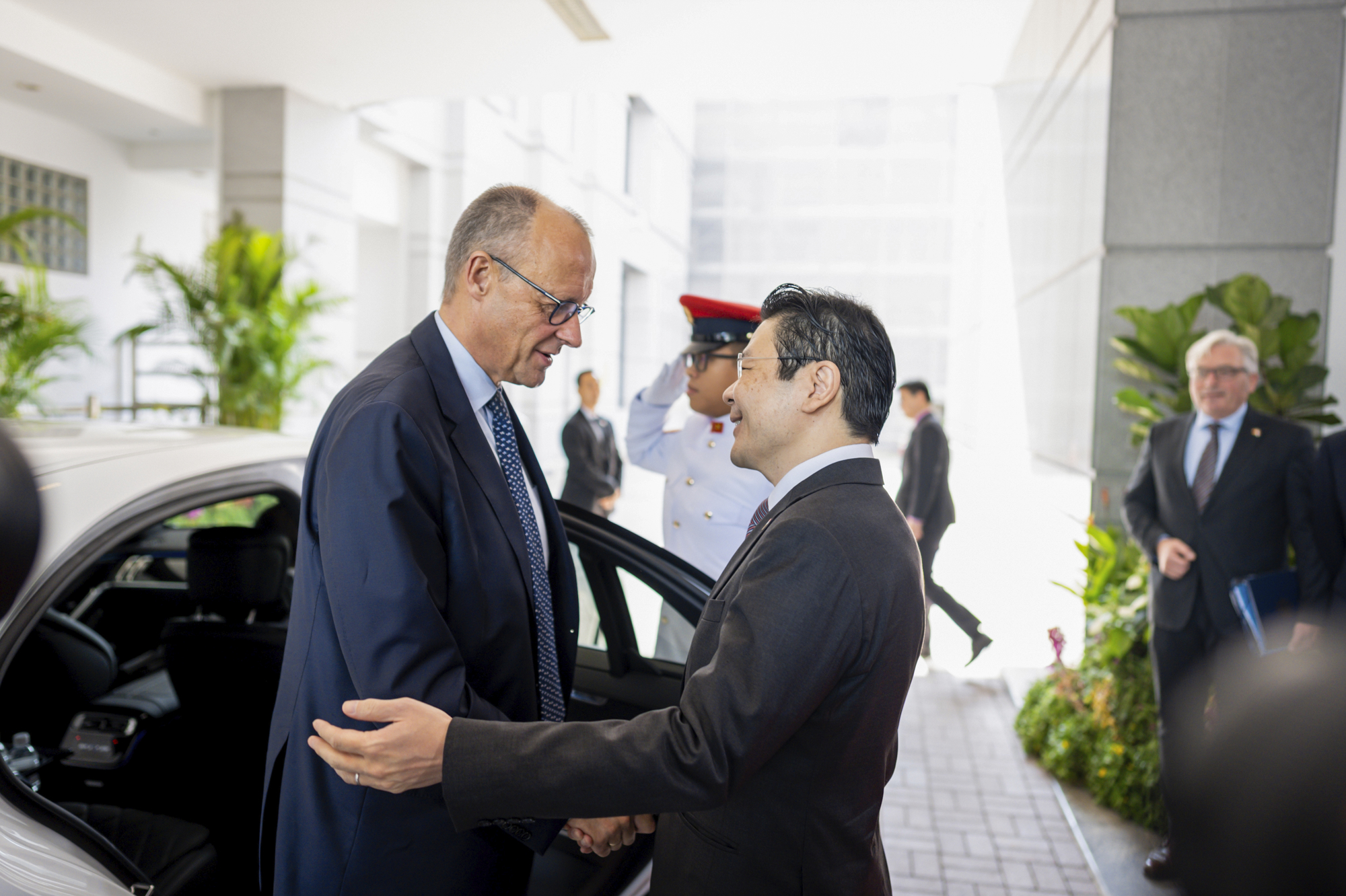
Singapore, 27 October 2026: The multi-day tour of Asia started in the city-state at the southern tip of the Malay Peninsula. Federal Chancellor Merz was received by Prime Minister Lawrence Wong.
“We Europeans face the same challenges as the countries in the Indo-Pacific region. We must hold our ground in a world increasingly characterised by uncertainty,” emphasised Chancellor Merz during his visit.
“But this new world also presents us with opportunities to strengthen our partnerships together,” added Merz.
The two heads of government agreed on a work plan to strengthen their strategic partnership in the areas of the economy, security, digitalisation and energy.
As part of the Singapore Lecture series, the Federal Chancellor spoke in favour of a free trade agreement between the EU and the Comprehensive and Progressive Agreement for Trans-Pacific Partnership (CPTPP).
Together, Europe and the Indo-Pacific would wield considerable influence. Merz emphasised that, together, we could protect and promote free and fair world trade.
In the afternoon, the Chancellor visited the port facilities operated by PSA Horizons.
A significant proportion of Germany’s foreign trade with countries outside the EU is with the Indo-Pacific region. New initiatives in trade policy are intended to enable Germany to benefit more from global trade relations.
Tokyo, 28 October 2026: In Japan, Chancellor Merz took part in the German-Japanese Economic Summit. There, he advocated for the establishment of a ‘global political alliance for rules-based trade’. It should defend, strengthen and further develop trade in goods based on international agreements.
Federal Chancellor Merz was then received with military honours at the official residence of Prime Minister Sanae Takaichi.
Media coverage of the Chancellor’s meeting with the Japanese Prime Minister. In diplomatic protocol, this is also known as ‘opening photographs’ or a ‘photo opportunity’.
Merz and Takaichi agreed on a package of measures to strengthen the bilateral partnership in the fields of economic security, defence, high technology and space travel. The Japanese head of government also accepted the invitation to be the partner country for the 2028 Hannover Messe.
Tokyo, 29 October 2026: On his second day in Japan, the Federal Chancellor found out more about the ‘Keen Sword’ exercise. During the exercise, soldiers from the Bundeswehr Medical Service, together with international partners, practised the medical treatment and evacuation of a large number of wounded personnel.
The final stop before continuing the journey to South Korea was Kyoto Fusioneering, a company which is working alongside several German firms on the development and construction of the first fusion energy reactor.
Later, Federal Chancellor Merz landed at Seongnam Airport in Seoul, South Korea.
South Korean President Lee Jae-myung received the Chancellor at his official residence. Lee has been President of the Republic of Korea since June 2025.
Partners who share common interests and values are important “now more than ever,” said Merz during the visit. “This applies in terms of security policy, it applies economically, and it applies geopolitically.”
Merz announced a new framework agreement as the “basis for cooperation in cutting-edge technologies”. For example, a partnership in the semiconductor industry is planned.
Both countries issued a joint statement on enhanced cooperation. In it, they reaffirmed their determination to further deepen relations in the fields of security and defence.