Federal Cabinet retreat at Neuhardenberg Castle
The Federal Cabinet met for a closed-door session at Neuhardenberg Castle, chaired by the Federal Chancellor. Federal Chancellor Friedrich Merz emphasised that the talks had inspired a great deal of confidence, that they were on the right track and would be resolutely pressing ahead.
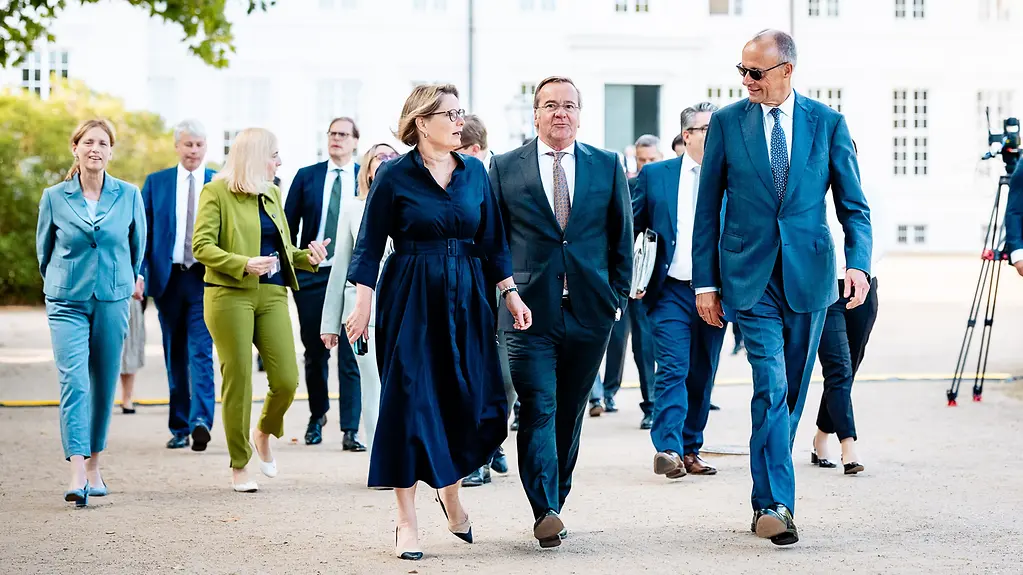
On the second day of the closed-door meeting, the Federal Government will continue its discussions, focusing, amongst other things, on the competitiveness of skilled trades and start-ups.
Photo: Federal Government/Jesco Denzel
How can Germany remain a strong industrial nation – and continue to rank among the world’s best, even in the age of artificial intelligence (AI) – thereby safeguarding prosperity and jobs within the country? The Federal Cabinet addressed these and other issues during its retreat at Neuhardenberg Castle on 25 and 26 August. The subsequent regular Cabinet meeting also addressed the issue of drought.
Federal Chancellor Friedrich Merz concluded with a positive assessment: “We are approaching the remaining months of 2026 with vigour, but also with great confidence, and we are certain that we will continue to make progress along this path.” At the start of the closed-door meeting, he had reiterated how the Federal Government had introduced a new policy for the good of Germany.
Federal Minister of Finance Lars Klingbeil emphasised that acting in unison was one of the coalition’s strengths. The Federal Government wants to see Germany return to the forefront – both technologically and economically. Federal Minister of the Interior Alexander Dobrindt also reiterated the coalition’s unity, stressing that this is the only way to overcome the challenges faced.
A wide range of perspectives discussed
It was important to the Federal Cabinet to have a wide range of perspectives on the issues at hand: the guest speakers represented international companies, the skilled trades sector, start-ups and investors. This meant that they could cover a wide range of topics, from industrial AI, defence and security to local climate action.
To kick things off, the Federal Government discussed the framework conditions for industrial competitiveness, sovereignty and key technologies. Roland Busch (CEO – Chief Executive Officer of Siemens) and Aidan Gomez (CEO – Chief Executive Officer of Cohere) gave keynote speeches on this topic. This was followed on Wednesday by a discussion on the competitiveness of the skilled trades and start-ups. Keynote speeches were delivered by Jörg Dittrich (President of the German Confederation of Skilled Trades), Judith Dada (General Partner at Visionaries Club, winner of the “Investor of the Year” award at the German Startup Awards) and Ruth Bosse (CEO – Chief Executive Officer & founder of Ark Climate, winner of the “Newcomer of the Year” award at the German Startup Awards).
More sovereignty – less bureaucracy
At a press conference after the first working session on Tuesday, Dorothee Bär, Minister for Research, Technology and Space, stressed that the Federal Government is driving forward modernisation and innovation: “Innovation policy is about preparing for the future,” said Bär, adding that this is especially crucial to Germany’s sovereignty and security.
Karsten Wildberger, the Federal Minister for State Modernisation and Digital Affairs, also emphasised the importance of digital sovereignty. This includes an independent infrastructure and competitiveness in the field of artificial intelligence. It is also important here to step up efforts to cut red tape and to further speed up the process.
Verena Hubertz, the Federal Minister for Housing, Urban Development and Construction, emphasised the importance of speeding up the process and cutting red tape in the construction sector too, which, she explained, is central to the economy and must regain momentum. The Federal Government is working resolutely and collaboratively towards this – including in Neuhardenberg.
Drones and customs apps – where AI is already enhancing everyday life
Examples of how innovation and technology work well in business and government were showcased following the discussion. New technologies can make Germany safer whilst also fostering technological capabilities and creating value for the economy and society. Defence, security and macroeconomic innovation can go hand in hand in this context. This was demonstrated during an in-flight demonstration of Tytan Technologies’ interceptor drone, attended by its CEO – Chief Executive Officer and founder, Balazs Nagy. As a successful start-up in the defence industry, the company represents a new generation of technology-driven businesses in Germany.
The Federal Criminal Police Office (BKA) and the customs authorities demonstrated how the state itself can be both a user and a driving force behind new technologies. To this end, demonstrations were given to show how artificial intelligence (AI) and new technologies are used at the Federal Criminal Police Office, and how digital identity checks are carried out by Customs using the ZEPOS app, alongside a customs dog demonstration. The demonstrations were accompanied by keynote speeches made by Federal Ministers Boris Pistorius, Alexander Dobrindt and Carsten Linnemann.
Focus on the dry summer at the Federal Cabinet meeting
Following the Federal Cabinet retreat, a regular Cabinet meeting was held at Neuhardenberg Castle. At this meeting, members of the Federal Government and others gave their assessment of the drought experienced over the past few weeks.
“We must continue to curb climate change whilst also better adapting our country to the consequences of climate change,” emphasised the Federal Chancellor. In this regard, it is important to review the relevant programmes for climate adaptation and heat protection, to integrate them more effectively, remove barriers to applications or time limits, and, “above all, ensure significantly greater transparency”.
Neuhardenberg Castle is situated on the edge of the Oderbruch and was built in the Baroque style in the early 18ᵗʰ century. The town is also closely linked to the German resistance against National Socialism: Carl-Hans Graf von Hardenberg, who took over the estate in 1921, was one of the conspirators behind the attempt on Hitler’s life on 20 July 1944. At Neuhardenberg Castle, Claus Schenk Graf von Stauffenberg, Henning von Tresckow and other participants were able to press ahead with their preparations relatively undisturbed. Since 2001, responsibility for the castle and its cultural programme has lain with the Neuhardenberg Castle Foundation. The town has also been used for Federal Cabinet retreats since the early 2000s.