Reporting to the Bundestag
Strengthening education, scaling up private investments and fair trade are central tasks of development policy in Africa, said Federal Development Minister Gerd Müller. The Federal Government's 15th Development Policy Report, which the Minister presented to the Bundestag, makes a positive assessment overall.
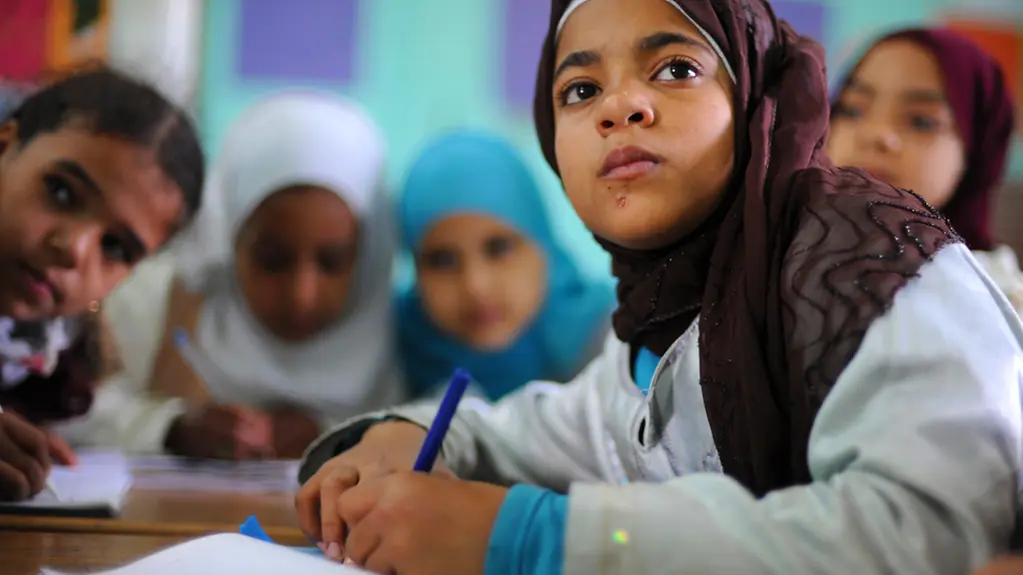
Progress is being made in development cooperation: school enrolment rates in developing countries are increasing
Photo: Plan / Mohammed Hossam El Din
"Development policy is no longer a marginal issue," Federal Development Minister Gerd Müller said during the debate in the Bundestag on the Federal Government's 15th Development Policy Report. "The budget for development cooperation increased by 35 per cent in this legislative period and the 0.7 per cent of GDP target has been achieved for the first time," the Minister said. "Development policy issues are now on the international agenda," Müller said with a view to the G7 and the G20 Summits.
Gerd Müller regards development policy as key to shaping fairer globalisation. "We are making progress and have launched concrete initiatives, creating future prospects for people in the region around Syria, agricultural innovations for a world without hunger and fair trade alliances." The Federal Development Ministry's Marshall Plan With Africa both pointed out what the problems were as well as the solutions.
The Development Minister made reference to the investment centres that were being set up in Asia and Africa. Progress was also being made when it came to school enrolment rates and stemming the tide of disease, he said.
More money for development policy
The Federal Government's official development assistance (ODA) commitments increased from 12.5 billion euros to 16.2 billion euros in the period between 2014 and 2015 alone.
More than 12 billion euros in funding had, for example, been made available to tackle the root causes of displacement, the Minister told Members of the Bundestag. The Development Ministry had a total of some 1.5 billion euros each year to invest in the fields of food, agriculture and rural development. In 2015, ODA commitments in the field of education – totalling 1.7 billion euros – meant Germany was the largest bilateral donor worldwide.
Official development assistance (ODA) is the term used to refer to money that members of the Development Assistance Committee (DAC) of the Organisation for Economic Co-operation and Development (OECD) make available directly to developing countries or through international organisations specifically for development projects.
Future fields of activity
As well as taking stock of what has been achieved during this legislative period, the 15th Development Policy Report for the first time also provides a comprehensive outlook on future fields of activity.
The report outlines those steps that need to be taken to meet global challenges such as global population growth, climate change, migration flows and violent conflicts. These are based on the guiding principles of the 2030 Agenda and its Sustainable Development Goals (SDGs). The report identifies the key challenges as being in the fields of food, overcoming poverty and hunger, climate action and environmental protection, shaping a fair global economy, overcoming the causes of displacement and securing peace.
The Federal Government's report underlines the importance of cooperation with policy-makers, civil society, science and industry when it comes to achieving the ambitious goals set out in the Agenda 2030.