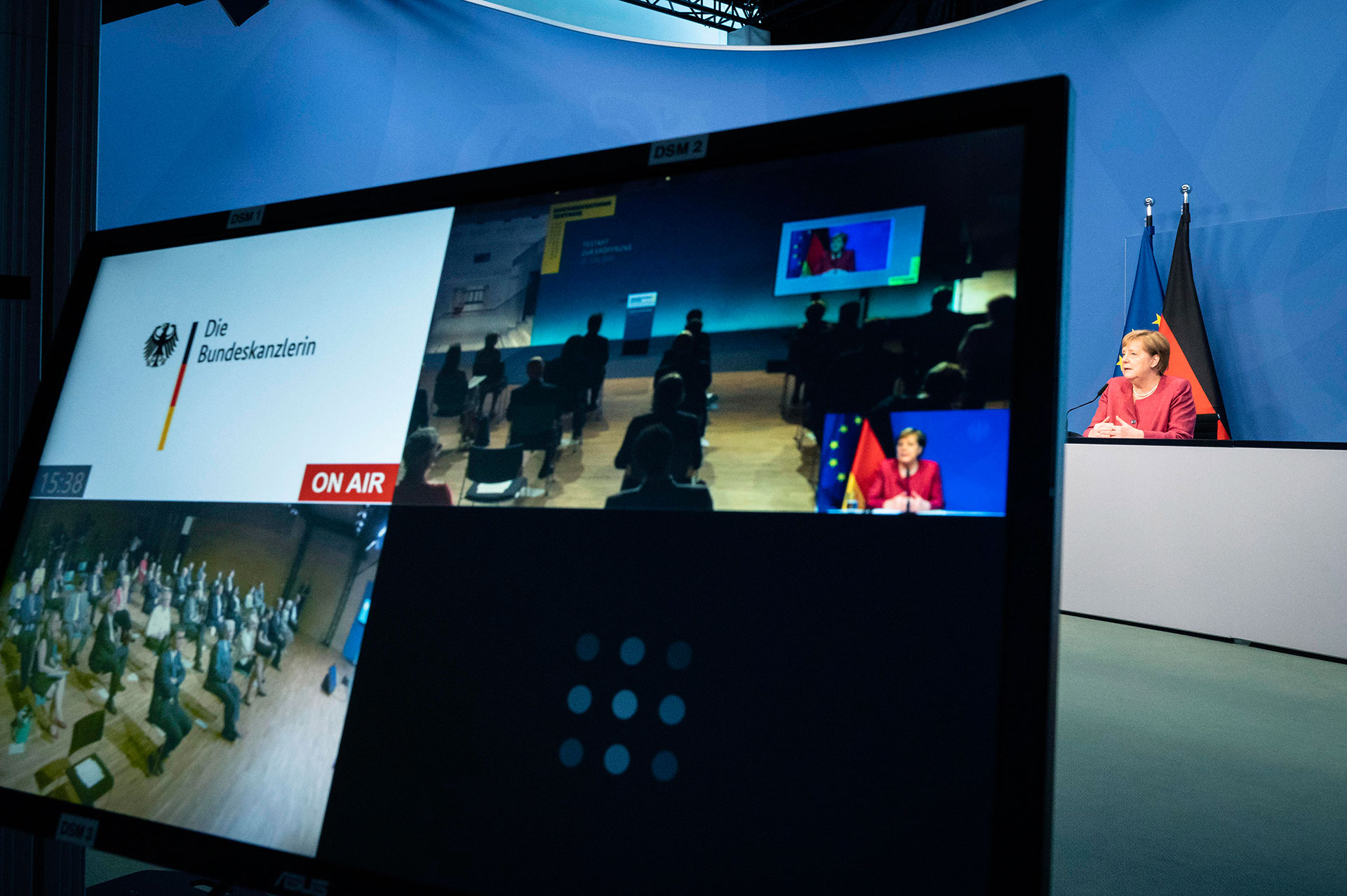
Berlin, 21 June 2021: The Federal Chancellor attended the opening of the German Documentation Centre for Displacement, Expulsion and Reconciliation via link. It took several years of preparation to set up this unique place of learning and remembrance which focuses on forced migration in the past and present.

The Italian Prime Minister Mario Draghi was only the second visitor Federal Chancellor Merkel met in person this year. The meeting delighted the attending journalists and everyone involved.

They discussed topics of the upcoming European Council meeting at the end of the week. Key topics will include the pandemic and migration. Draghi and Merkel agreed that the situation in the countries of origin must be improved.

Berlin, 22 June 2021: The Federal Chancellor and the President of the European Commission, Ursula von der Leyen, appeared before the press, following their talk about the German Recovery and Resilience Plan (DARP).

Ursula von der Leyen “has a positive message for us”, said the Federal Chancellor. The EU Commission has approved Germany’s plans. The German Recovery and Resilience Plan focuses on investment in digitalisation and climate protection.

Berlin, 23 June 2021: On Wednesday, the Federal Chancellor took part in what was probably the last government question time session during her term of office, facing questions from members of the German Bundestag.

In her opening statement, she also addressed the current COVID-19 pandemic, saying she believed it had required an enormous effort on the part of society as a whole.

In the afternoon, Federal Chancellor Merkel was awaited at the Foreign Office, where she attended the second Conference on Libya.

The goal of this conference of foreign ministers is to draw up measures for stabilising this North African country that is affected by civil war. The conference was hosted by the German Foreign Office and the United Nations.

Following the conference, the Federal Chancellor received participants of the Conference on Libya at the Chancellery. First up was the US Secretary of State Antony Blinken,

followed by Libya’s interim Prime Minister Abdulhamid Dbeiba.

Berlin, 24 June 2021: In her government statement issued before the European Council meeting, Federal Chancellor Angela Merkel said that the EU's ability to act jointly had to be reinforced and that lessons had to be learned from the COVID-19 crisis.

Among the topics discussed at the EU Council meeting that began in Brussels in the afternoon, is the digital COVID-19 certificate, a common EU standard for vaccinated and tested people, as well as those who have recovered from the illness that is to be applied across the EU from 1 July. Close to 30 million documents have been issued in Germany to date.

The EU heads of state and government also spoke about relations with Turkey and Russia. Following the talks, Federal Chancellor Merkel reported that the EU Commission’s suggestions regarding an extension of the refugee agreement was endorsed by 27 member states.