Cabinet reshuffle
It’s now official: Nina Warken is the new Head of the Federal Chancellery, Carsten Linnemann is the new Federal Minister of Health and Steffen Bilger is the new Minister of Transport. Here is an overview of their main responsibilities.
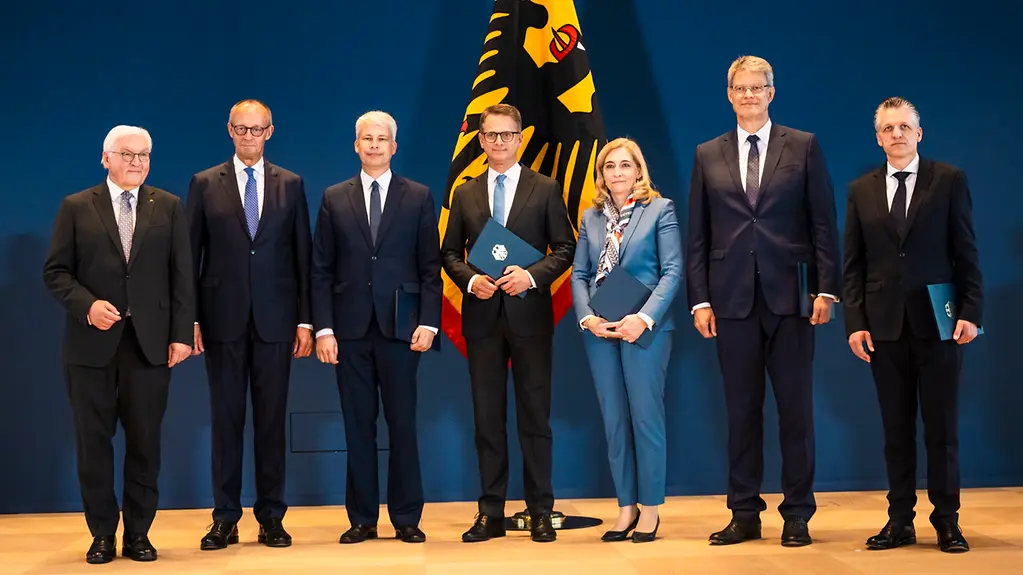
As Head of State of the Federal Republic of Germany, the Federal President appoints the new ministers and dismisses their predecessors.
Photo: Federal Government/Steins
Federal President Frank-Walter Steinmeier has appointed the new cabinet members. Last week, when introducing the new ministers he was proposing, Chancellor Merz said: “We want a government that approaches its work with the utmost enthusiasm and joy, whilst also reflecting the diversity in our society and politics. We are a reformist government, and we intend to continue demonstrating that.”
The new ministers:
Nina Warken, Federal Minister of Special Affairs
As Federal Minister of Special Affairs, the former Federal Minister of Health, Nina Warken, will head up the government’s central office, the Chancellery. She is a 47-year-old lawyer and has been Federal Minister for Health since May 2025. In her new role as Head of the Federal Chancellery, she will act as a close adviser to the Federal Chancellor. She will coordinate the cooperation between ministries and act as an important link to Parliament, the federal states and civil society groups.
Dr Carsten Linnemann, Federal Minister of Health
Dr Carsten Linnemann is the new Federal Minister of Health. The 48-year-old economics graduate has held the post of Secretary General of the CDU since 2023. The key tasks of his ministry will be to ensure and further develop the effectiveness and financial sustainability of statutory health insurance and long-term care insurance. Another key focus will be on health promotion and prevention.
Steffen Bilger, Federal Minister of Transport
Steffen Bilger is the Head of the Federal Ministry of Transport. The 47-year-old lawyer was most recently the First Parliamentary Secretary of the CDU/CSU – Christian Social Union – parliamentary group in the Bundestag. As a minister, he is now responsible for national transport policy – which includes the construction and maintenance of motorways, main roads and bridges, as well as rail infrastructure and rail services.
Why the Federal President? As Head of State of the Federal Republic of Germany, the Federal President appoints the ministers. However, these are put forward to him by the Federal Chancellor, as specified by Article 64 of the Basic Law. Following their appointment, the new ministers must take the oath of office before the Bundestag in accordance with Article 56 of the Basic Law. To avoid having to recall Parliament back to Berlin from its summer recess – which would be extremely costly – the swearing-in ceremony will take place after the parliamentary recess has ended.