Speech by Federal Chancellor Merz on the occasion of the 2026 German Employers’ Day
At the German Employers’ Day, Federal Chancellor Merz emphasised that young people should once again have confidence in their future in Germany. To this end, the Federal Government is currently devoting all its efforts to major social reforms and the modernisation of the country.
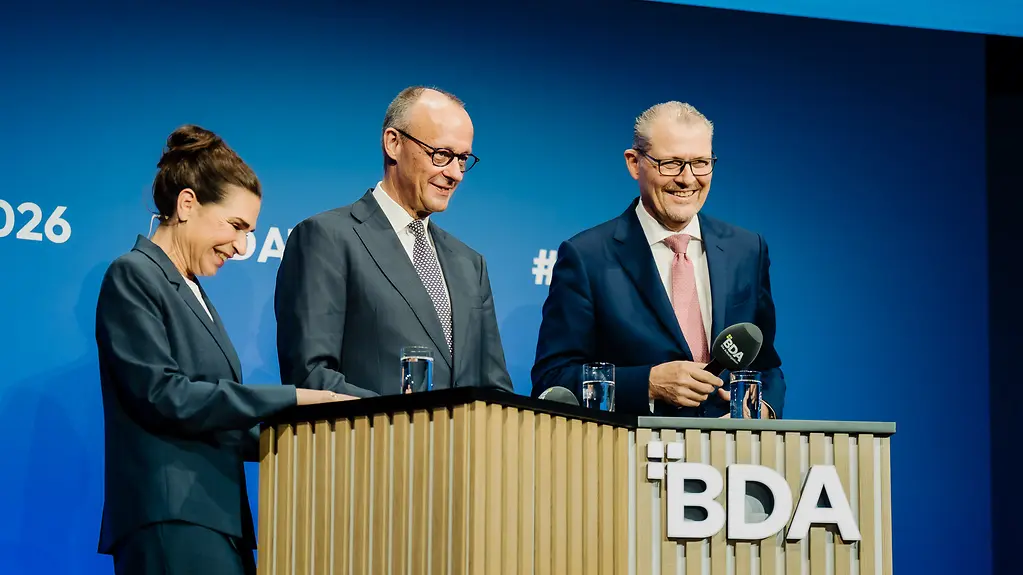
In a conversation with the BDA President, the Federal Chancellor called on employers to join forces with their 30 million employees in supporting the reform process.
Photo: Federal Government/Jesco Denzel
Federal Chancellor Friedrich Merz intends to push ahead with major reforms in the areas of pensions, healthcare and long-term care: for a welfare state that remains affordable in the future, and an economy capable of long-term growth. To this end, politicians, employers and employees should work together.
There are some positive signs: The economy is proving more resilient than expected and is growing despite the wars and trade conflicts, said the Federal Chancellor at the German Employers’ Day in Berlin. Long-term growth requires the right conditions. Merz stressed that, above all, it now comes down to major social reforms. Never before have all social reforms been tackled at the same time. “We are responsible to the younger generation for the actions we take today. They should be able to live in a country where they can build lives for themselves through hard work, as we older people did. A country in which they can see a bright future for themselves and their families,” emphasised Merz.
The most important points in brief:
- Funding healthcare and care: The first phase of the healthcare reform is intended to ensure that expenditure under the statutory health insurance scheme is once again soundly financed and that contributions are stabilised. The aim of the next step is to ensure stable contribution rates in the long term and a good pension provision. The first part of the care reform is not merely a cost-cutting measure, but rather strengthens prevention and rehabilitation. A commission of experts is to draw up specific proposals for a care system that is both sustainable and fair.
- Secure pensions: “As regards the statutory pension scheme, we need – and I want – a major reform that will secure the pension system in the long term,” said the Chancellor. With the new statutory funded pension scheme for all employees, the level of old-age provision will rise for younger generations, whilst contributions will fall. Merz reiterated that the decisions reached within the coalition on pensions and the labour market must now be implemented.
- Driving forward the reduction of red tape: Progress is being made in state modernisation and the reduction of bureaucracy in Germany. Experts and reports would bear this out, said Merz. There are many tangible signs of a new beginning and of optimism. The transformation of the economy is underway.
- Increasing investment: The Chancellor emphasised that both domestic and foreign investment figures are on the rise. Germany is regarded as the most attractive place to invest in Europe. Merz said that next week’s Invest in Germany Summit would focus primarily on messages from investors “to the people of our country”.
German Employers’ Day is organised annually by the Confederation of German Employers’ Associations (BDA). It represents the joint economic and social policy positions of German employers. The BDA – the Confederation of German Employers’ Associations – has around one million member companies, employing some 30.5 million people, through its member organisations. At the Employers’ Day, leading figures from the worlds of business, politics and society will discuss a wide range of topics – from securing employment and the skilled workforce, value creation in the age of AI, the conditions for economic recovery, education as a strategic priority, and the reduction of red tape, to strengthening defence capabilities.
Read the full speech here (in German only):