Bundesregierung
New responses to new threatsSat, 20.11.2010
|
||
|
NATO is adapting to new challenges.
At their annual summit, the heads of state and government of NATO
member states, meeting in Lisbon, adopted a new Strategic Concept.
Along with Russia, the NATO member states intend to put in place a
missile defence system.
The new Strategic Concept is to
replace the one currently in use that dates back to 1999, and is to
take into account security developments in the intervening period.
The Alliance faces new challenges in the form of international
terrorism, cyber attacks, energy security issues, and the
proliferation of weapons of mass destruction. Experience gained in
operations such as Kosovo and Afghanistan too are to be
incorporated, as is the concept of networked security.
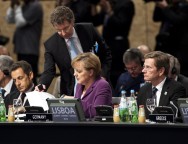 Photo: REGIERUNGonline/Kugler Photo: REGIERUNGonline/Kugler  Nicolas
Sarkozy, Angela Merkel and Guido
Westerwelle"NATO is moving into
the 21st century," stressed Chancellor Angela Merkel, "both in
terms of the analysis of the existing threats and the responses of
the Alliance to these threats." Nicolas
Sarkozy, Angela Merkel and Guido
Westerwelle"NATO is moving into
the 21st century," stressed Chancellor Angela Merkel, "both in
terms of the analysis of the existing threats and the responses of
the Alliance to these threats."The 28 member states realise that they must find common responses to the new threats. This is also reflected in the missile defence system, said Angela Merkel, who was accompanied by Federal Foreign Minister Guido Westerwelle and Federal Defence Minister Karl-Theodor zu Guttenberg. The common analysis of threats with Russia and the talks about cooperating on a missile defence system demonstrate that, "the Cold War is finally over". The aim is a world free of nuclear weaponsThe Strategic Concepts also reaffirms the concept of nuclear deterrent. Like no other strategic concept before it, however, it stresses the importance of disarmament. NATO too has the clear goal of a world free of nuclear weapons. The concept also provides for the establishment of a missile defence system, and offers Russia the opportunity to cooperate on this. In its latest analysis NATO identified the threat of a ballistic missile attack as a significant threat to the Alliance. In conjunction with weapons of mass destruction, this threat becomes all the more serious. Technical progress in individual states will also allow them to develop ever more precise ballistic missiles with an ever greater range. The new Strategic ConceptThe eleven-page document is entitled Active Engagement – Modern Defence. The core tasks laid out in the new concept are:Collective defence: Collective defence and the guarantee that NATO members will assist one another against attack in line with Article 5 of the Washington Treaty are to remain core functions of the Alliance. This also applies to new security challenges where they threaten the fundamental security of individual Allies or the Alliance as a whole.  Photo:
REGIERUNGonline/Kugler Tried and
tested Alliance with a new
strategyCrisis management: No
conflict can be resolved today with military means alone. NATO does
not intend to put in place civilian instruments, but with the new
concept its interface capacities are to be extended, i.e. the
options of working with civilian actors. NATO has thus drawn its
conclusions from the ISAF operations in Afghanistan, where in
practice there is already close cooperation between military and
civilian crisis management instruments. Photo:
REGIERUNGonline/Kugler Tried and
tested Alliance with a new
strategyCrisis management: No
conflict can be resolved today with military means alone. NATO does
not intend to put in place civilian instruments, but with the new
concept its interface capacities are to be extended, i.e. the
options of working with civilian actors. NATO has thus drawn its
conclusions from the ISAF operations in Afghanistan, where in
practice there is already close cooperation between military and
civilian crisis management instruments.Cooperative security: NATO does not claim to be able to cope with threats alone. It will do so within the scope of the concept of networked security. NATO intends to engage closely with other actors to enhance international security. The Strategic Concept accords new weight to this policy of partnerships. Under the aegis of the United Nations, NATO aims to act with the EU, and will also be seeking partnership with Russia and other actors. NATO thus expressly makes no global claims, but aims to be part of a global security network. NATO also intends to slim down its command structure. Currently more than 13,000 people are deployed in 11 headquarters. The total workforce is to be reduced to 8,950, and the number of agencies from fourteen to three.  |
||