Bundesregierung
Transferring responsibility – supporting Afghanistan in the long termSat, 20.11.2010
|
||
|
As of next year NATO aims step by
step to transfer responsibility for security in Afghanistan to the
Afghans themselves. A conference in Germany is to decide on the
further procedure to stabilise the country.
The transfer of the responsibility
for security in Afghanistan must be sustainable and irreversible,
demanded Chancellor Angela Merkel at the summit meeting of the
heads of state and government of NATO member states in Lisbon.
Lasting security cannot be achieved by military means alone,
declared Angela Merkel. Military efforts must go hand in hand with
a political process.
This will also be the aim of an Afghanistan Conference that is to be held next November in Bonn, in response to a proposal of the Afghan President Hamid Karsai - ten years after the United Nations conference on Afghanistan that was held in December 2001 on the Petersberg near Bonn. This 2001 conference produced the first successful agreement on Afghanistan. Consultations among troop providing nations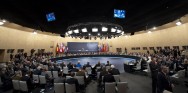 Photo:
REGIERUNGonline/Kugler Photo:
REGIERUNGonline/Kugler  Working
session”Today marks a new phase
of our mission in Afghanistan," declared NATO Secretary General,
Anders Fogh Rasmussen, as he opened the consultations among troop
providers. President Karsai and UN Secretary General Ban Ki Moon
also attended. At the Afghanistan Conference held in London in
July, the Afghan President declared that it was his goal to see the
responsibility for security throughout Afghanistan in Afghan hands
by 2014. Working
session”Today marks a new phase
of our mission in Afghanistan," declared NATO Secretary General,
Anders Fogh Rasmussen, as he opened the consultations among troop
providers. President Karsai and UN Secretary General Ban Ki Moon
also attended. At the Afghanistan Conference held in London in
July, the Afghan President declared that it was his goal to see the
responsibility for security throughout Afghanistan in Afghan hands
by 2014.The NATO member states have now launched the transition process. As of 2011 Afghan security forces are to gradually assume leadership. The decision as to when responsibility for the individual regions will be transferred will depend on the specific developments on the ground. Transition cannot be pinned down to one date, but is a process that will depend on conditions being met. For NATO it is important that the focus of military support shift increasingly from military actions to training. The Federal Armed Forces also subscribe to this new focus, declared Federal Defence Minister Karl-Theodor zu Guttenberg. Transfer does not automatically mean withdrawalThe transfer of responsibility to the Afghan partners should not be confused with an immediate withdrawal of troops, underscored Federal Foreign Minister Guido Westerwelle. But, depending on the way the security situation develops, it might be possible to start drawing down the German contingent as of 2012. Equally, a responsible hand-over does not mean that Germany and its partners within the international community will withdraw entirely from Afghanistan. International commitment will then take the form of long-term development cooperation based on partnership. This was reaffirmed in a declaration. The mission of the Federal Armed ForcesThe current mandate of the German Bundestag puts a ceiling of 5,350 on the German troops deployed to the International Security Assistance Force (ISAF) in Afghanistan. This mandate will run until 28 February 2011. At present almost 5,000 soldiers are deployed. The remaining 350 soldiers can be deployed under special circumstances for a limited period of time as a reserve if so decided by the Defence Committee and the Foreign Affairs Committee of the German Bundestag. German forces are deployed in the Kabul region and in the north of the country. The majority of German troops are in the north of Afghanistan under the Regional Command North. This area is about half the size of the Federal Republic of Germany. German soldiers are stationed in Mazar-e-Sharif, Kunduz, Faisabad and Taloqan. In Kabul too German soldiers are deployed. The members of the Termes squadron in Uzbekistan are also part of the ISAF contingent. The mission is increasingly focussing on training Afghan security forces. By October 2011, the Afghan police force is to grow to 134,000 and the Afghan army to 171,600 men.  |
||