Bundesregierung
Building bridges for peace and securityFri, 03.04.2009
|
||
|
The two-day NATO summit has begun in
Baden-Baden. The first evening was largely dedicated to the 60th
anniversary of NATO, which participants celebrated with a concert
of classical music. There was, however, also be enough time for
political issues, in particular the need to decide on a successor
for NATO Secretary General Jaap de Hoop Scheffer.
"I am convinced that we will be
appointing a new NATO Secretary General this evening,” declared the
Chancellor shortly before the NATO summit. Like many other heads of
state and government she hoped to see the Danish Prime Minister
Anders Fogh Rasmussen in this post.
We should do our very best to try to convince all others, she continued. "We know him well through our long-standing contacts.” Anders Fogh Rasmussen had previously confirmed that he would be available as a candidate for the post. The NATO Secretary General is elected unanimously by member states Networked security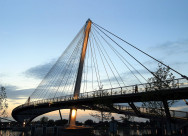 Photo:
picture-alliance / obs Photo:
picture-alliance / obs  The bridge
across the Rhine links Germany and
FranceAt the anniversary summit
meeting on 3 and 4 April member states hammered out a new
strategic concept. And NATO is expanding. It welcomed two new
members, Albania and Croatia. The bridge
across the Rhine links Germany and
FranceAt the anniversary summit
meeting on 3 and 4 April member states hammered out a new
strategic concept. And NATO is expanding. It welcomed two new
members, Albania and Croatia.The anniversary summit broke new ground in the history of NATO – for the first time ever a summit was jointly hosted by two countries. Germany and France together prepared the summit meeting, which was held in Baden-Baden, Kehl and Strasbourg. Summit participants, however focussed their attention on the future of the alliance. Terrorism and the proliferation of nuclear weapons, but also the consequences of climate change and natural disasters are new threats and demand new answers. Chancellor Angela Merkel is convinced that NATO needs a new strategy – networked security. The NATO summit offered time for in-depth discussion. The event began with a concert and dinner at Baden-Baden’s Kurhaus. On Saturday the North Atlantic Council met at the level of heads of state and government. The North Atlantic Council is the most important policy-making organ of NATO. Over the two days of the summit about six hours were earmarked for discussions. The foreign and defence ministers of member states also attended. No security without reconstruction, no reconstruction without security"NATO must get used to coordinating activities with other international organisations.” This was the bold message of the Chancellor in her most recent video podcast.  Photo: Nato Summit
logo The ISAF mission in
Afghanistan shows how important it is to cooperate with other
organisations. The protection offered by the military operation in
Afghanistan makes possible reconstruction work, which in turn
generates greater security. This shows us that civilian and
military inputs cannot be viewed separately. The Afghan partners
are to gradually assume greater ownership. Photo: Nato Summit
logo The ISAF mission in
Afghanistan shows how important it is to cooperate with other
organisations. The protection offered by the military operation in
Afghanistan makes possible reconstruction work, which in turn
generates greater security. This shows us that civilian and
military inputs cannot be viewed separately. The Afghan partners
are to gradually assume greater ownership.This is why Germany is helping to train the Afghan security forces. This commitment remains. The Chancellor has already announced that Germany will continue to provide assistance in northern Afghanistan on the basis of the concept of networked security. For the first time ever, NATO member states had the opportunity to discuss further procedure in Afghanistan with the new US President Barack Obama. . Old friends and new facesThere was, however, also a lot to celebrate on this 60th anniversary of the founding of NATO. Since 1949 it has been the world’s most important security-policy alliance. It sees itself as a community of values shared by free democratic states. It began with ten West European member states alongside the USA and Canada. Today it also embraces a number of Central and Eastern European states. And the alliance continues to expand. At this summit it welcomed two new members – Albania and Croatia. France too has rejoined the military command structure, which it left in 1966 because of concerns about retaining military independence. At the summit, the heads of state and government also discussed NATO’s relationship with Russia. After the war in Georgia in August last year, relations were suspended. After this NATO summit meeting, the meetings of the NATO-Russia Council are to be resumed. Strengthened for the futureThese are complex topics and ambitious objectives. There was a lot to discuss in Baden-Baden, Kehl and Strasbourg. Germany and France did their utmost to be good hosts. Together they pursued one goal – "We want to make this summit a success, a summit that will strengthen NATO,” underscored the Chancellor in the run-up to the summit. Both countries have done everything possible to ensure just this.  |
||